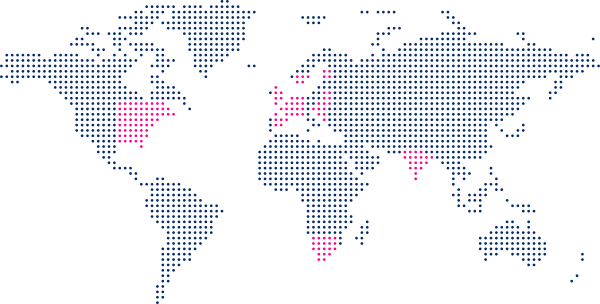
We spoke to our Managing Partner Dorota Cagiel based in New Delhi who shared her market insights into Indian Business culture.
Expanding into India involves more than market research or regulatory compliance. Success depends heavily on understanding the country’s cultural and organisational dynamics. Business in India often operates within a hierarchical, trust and relationship-driven context where decision-making can follow the hierarchy and respect for seniority remains deeply embedded. Communication is polite and indirect, and negotiations often involve building trust and relationships before final decisions are made.
In India around 60% of employees are on permanent contracts, while average tenure is 6.5 years, reflecting a mix of stability and project-based employment. Approximately 50% of leaders are perceived as behaving consistently with stated organisational values, and 48% of employees feel the culture reflects these values. Diversity, equity and inclusion policies are present in around 40% of Indian companies, while 55% of organisations have formal employee wellbeing programmes, though implementation varies widely.
Because of this complexity, having local insight helps international companies avoid missteps, build appropriate glo-cal people strategies, and adapt leadership style to local realities.
Hierarchy and authority remain central in many organisations, with senior executives holding most decision-making power. Formal titles and indirect communication are common, especially during early interactions, and meetings often begin with relationship-building before moving to formal discussion. Workforce fluidity is higher than in many European markets, and permanent employees often coexist with temporary staff.
Business relationships place strong emphasis on personal rapport, trust and long-term collaboration. Teamwork, loyalty and group cohesion are highly valued. Balancing traditional hierarchical norms with modern, agile management practices is a challenge. Organisations are increasingly investing in leadership alignment and employee development to strengthen the engagement.
Our India operations are supported from the New Delhi office with the team led by Dorota Cagiel. The team provides local expertise to interpret how Indian culture, from hierarchical structures to workforce flexibility and efficiencies as well as engagement, plays out in daily business.
Friisberg helps international clients align corporate governance, find top talent, grow leadership teams and train international and cross-cultural teams. The team also designs engagement, performance and retention practices suitable for India’s business environment. They advise on leadership interactions to respect local norms while remaining effective and bridging with foreign parties. By establishing credibility and networks, Friisberg enables sustainable operations and long-term success in India.
India presents vast opportunities and success requires cultural understanding, flexibility and strategic adaptation. With Friisberg’s local presence in New Delhi, under Dorota Cagiel’s leadership, international companies can navigate India’s workforce dynamics, cultural complexities and people challenges to build high-performing organisations.
Note: These insights reflect common patterns observed in professional settings. Every individual and organisation is unique, and no culture can be defined in absolute terms. Our aim is to highlight trends that international leaders may encounter when working across borders, and to share how Friisberg helps clients navigate these differences with respect and effectiveness.
You need to load content from hCaptcha to submit the form. Please note that doing so will share data with third-party providers.
More InformationYou need to load content from reCAPTCHA to submit the form. Please note that doing so will share data with third-party providers.
More InformationYou need to load content from reCAPTCHA to submit the form. Please note that doing so will share data with third-party providers.
More InformationYou need to load content from reCAPTCHA to submit the form. Please note that doing so will share data with third-party providers.
More InformationYou need to load content from Turnstile to submit the form. Please note that doing so will share data with third-party providers.
More Information