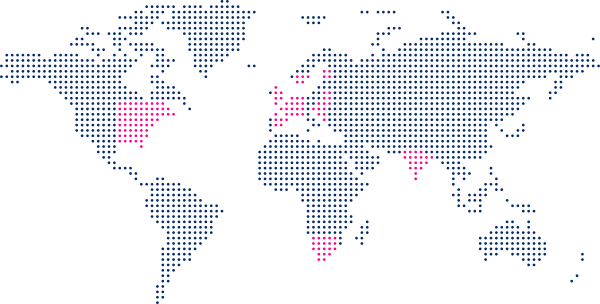
Expanding into Bulgaria requires more than understanding the market, it demands insight into organisational culture and people dynamics. In Bulgaria, 55% of leaders and 52% of organisational culture are perceived as authentic and aligned with stated values, highlighting the importance of cultural credibility in business success.
Bulgarian companies are actively developing employees whose behaviour reflects organisational culture, demonstrating a strong focus on aligning leadership and workforce practices. At the same time, 55% of businesses have a DEI policy (compared with 91% in the UK and 72% in Romania), and over 65% have formalised wellbeing policies, showing growing recognition of inclusion and employee support.
Workforce stability remains strong: 81% of employees are on permanent contracts, and average tenure is 9.2 years. Younger professionals are driving cultural change, with 69% of 18-29 year olds supporting more women in senior roles.
Bulgaria blends tradition with evolving cultural expectations. Understanding these dynamics is crucial for international businesses, and Friisberg’s local expertise ensures organisations can navigate them effectively.
Bulgarian companies often retain clear hierarchical structures with respect for senior positions. Input from teams is valued, but final decisions tend to sit with senior leaders. This aligns with assessments of traditional corporate culture in the country.
A national working conditions survey found that 81% of Bulgarian employees are on permanent contracts, and the average tenure in the same organisation is around 9.2 years.
This reflects expectations of stability and long-term employment relationships, which can differ from markets where job mobility is higher.
A 2025 study reported that only 51% of respondents in Bulgaria believe their organisational culture fully supports their business goals.
Between 54% and 72% of companies say they are actively trying to improve organisational culture.
In Germany and Bulgaria, expectations for correspondence between leadership behaviour and real culture, and between culture and stated values, are high. The study found that 55% of leaders and 52% of organisational culture were perceived as authentic and aligned with stated values.
By contrast, only 9% of respondents in Germany believe their organisation hires employees whose behaviour fully aligns with the culture, and only 8% feel that the development of such people is fully encouraged. In Bulgaria, however, the largest number of respondents give their organisation the highest rating for developing employees whose behaviour aligns with organisational culture.
This highlights that in Bulgaria, cultural alignment and employee development are perceived as more actively supported than in some other European markets, making local insight especially valuable for international companies.
In a study of 708 employees, around 20% reported frequent workplace conflict.
In broader surveys, 29.3% of employees said they were completely satisfied with working conditions, while 43.5% were fairly satisfied.
Wellbeing policies are widely formalised in the region: the UK, Romania, and Bulgaria all have over 65% of organisations with formalised wellbeing policies. However, implementation can be inconsistent, particularly in the United Kingdom. Germany lags behind both in terms of the existence of policies and the consistency between behaviour and organisational intentions.
In Bulgaria and Romania, organisations are often more innovative in their approach, offering additional benefits and flexible practices to support employees. This confirms that Bulgarian businesses are increasingly recognising the value of wellbeing and employee support initiatives.
Social attitudes are also evolving. A national survey found that 61% of Bulgarians believe there should be more women in senior business roles, rising to 69% among people aged 18 to 29.
Diversity, equity and inclusion (DEI) policies are less widespread in Bulgaria compared with some other countries: 55% of businesses in Bulgaria have a DEI policy, compared with 91% in the UK and 72% in Romania. This suggests that while inclusion is gaining attention, there is still significant room for growth and international companies can play a role in strengthening DEI initiatives.
This indicates that younger professionals increasingly welcome modern leadership styles, inclusive workplace cultures, and structured DEI and wellbeing approaches.
Bulgarian workplaces blend traditional hierarchy with modern expectations. Friisberg helps leaders understand when formality is expected, when informal communication is appropriate and how to adapt leadership styles to fit local norms.
With high rates of permanent employment and long tenure, employee loyalty and stability matter. Friisberg helps international companies structure roles, communication and engagement strategies that align with these expectations.
Since only around half of companies feel their culture supports strategy, Friisberg provides practical guidance on aligning values, behaviours and leadership expectations to create cohesive teams.
The insights that 55% of leaders and 52% of organisational culture are aligned, and that Bulgaria scores highest in developing employees whose behaviour aligns with the culture, underline why leadership behaviour, cultural authenticity, DEI, wellbeing, and employee development are critical in Bulgaria.
Face to face communication and trust building remain important in Bulgaria. Friisberg’s on the ground presence ensures that new entrants develop the relationships needed to operate effectively.
Bulgaria offers strong opportunities, but business success depends on understanding how people work, communicate and build trust. With Friisberg’s local expertise, organisations gain more than market insight, they gain a partner who understands the cultural context that determines long term success.
Note: These insights reflect common patterns observed in professional settings. Every individual and organisation is unique, and no culture can be defined in absolute terms. Our aim is to highlight trends that international leaders may encounter when working across borders, and to share how Friisberg helps clients navigate these differences with respect and effectiveness.
You need to load content from hCaptcha to submit the form. Please note that doing so will share data with third-party providers.
More InformationYou need to load content from reCAPTCHA to submit the form. Please note that doing so will share data with third-party providers.
More InformationYou need to load content from reCAPTCHA to submit the form. Please note that doing so will share data with third-party providers.
More InformationYou need to load content from reCAPTCHA to submit the form. Please note that doing so will share data with third-party providers.
More InformationYou need to load content from Turnstile to submit the form. Please note that doing so will share data with third-party providers.
More Information