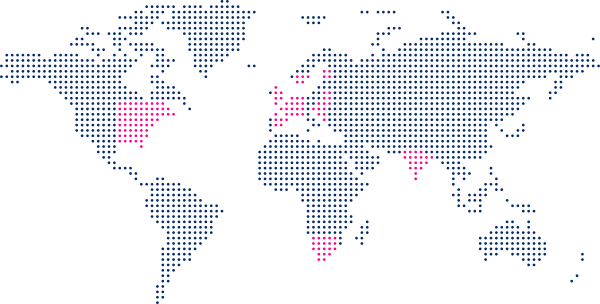
On 27th January 2026, the “Mother of all trade deals” was signed between the European Union and India after nearly 20 years of negotiations. Covering a combined market of around two billion people and roughly a quarter of global GDP, it is one of the most significant trade deals of the past decade.
For C-suite leaders, this is not just a geopolitical milestone. It has direct implications for growth strategy, opportunities for talent deployment supply chains, investment decisions and leadership priorities over the coming years. Dorota Cagiel from our New Delhi office explores the significance of this trade deal in the article below.
Executives are currently navigating an era of geopolitical tension and tariff unpredictability; the EU-India pact provides a significant counterweight to existing trade dependencies. This diversification can reduce geopolitical risk exposure and open alternative channels for growth.
At its core, the agreement significantly lowers barriers to trade on both sides. Most EU exports to India will see tariffs sharply reduced or eliminated over time, while the EU will also cut duties on the majority of Indian exports, supporting two-way trade in manufacturing, pharmaceuticals, textiles, consumer goods, and more.
Another area of positive development in the EU - India FTA is that it contains provisions regarding the relevant UN and ILO conventions advancing women’s economic empowerment and gender equality, including promoting cooperation in international force to advance these objectives.
For the C-suite leader, global operations must be reassessed and India’s role in European-led value chains must be re-evaluated. Leaders must consider integrating tariff reductions into pricing and commercial strategies, strengthen regulatory and compliance capabilities, and invest in local partnerships to accelerate market entry and execution.
Looking ahead, timing and governance remain important. Implementation will be phased and still requires approvals, with some sensitive sectors still protected and global trade tensions continuing to influence competitiveness. Even so, the deal represents a structural shift in EU–India economic relations, and early movers will be best positioned to translate policy change into lasting advantage.
You need to load content from hCaptcha to submit the form. Please note that doing so will share data with third-party providers.
More InformationYou need to load content from reCAPTCHA to submit the form. Please note that doing so will share data with third-party providers.
More InformationYou need to load content from reCAPTCHA to submit the form. Please note that doing so will share data with third-party providers.
More InformationYou need to load content from reCAPTCHA to submit the form. Please note that doing so will share data with third-party providers.
More InformationYou need to load content from Turnstile to submit the form. Please note that doing so will share data with third-party providers.
More Information