As someone working closely with C‑suite executives at Friisberg & Partners International I’m curious to find out what makes leaders excel. A recent statistic from EY immediately stood out:
It’s no coincidence. Sport develops resilience, teamwork, discipline, and decision-making under pressure all the qualities that make leaders thrive. As EY puts it, while we’re all competing in the war for talent, there’s another battle ongoing: the fight for gender parity. Women gain a crucial advantage when sport becomes a lever to level the playing field.
Yet, too many girls step away from sport early. By the age of 16, 64% of girls have stopped participating, often due to fear of judgment, low confidence, or academic pressures. These numbers show why it’s so important to encourage girls and women to stay active and share the lessons learned along the way.
I’ve seen the impact of this personally. I’ve been rowing since 2009 and, since 2016, have balanced a full-time career with training and competition, including years in GB high-performance programmes, at Molesey Boat Club, Oxford Brookes University, and with The Paralympic British Rowing Team. Managing work alongside rowing taught me lessons in focus, resilience, and leadership that continue to shape how I operate today.
The EY article argues that athletes often become exceptional leaders because of the unique pressures and demands of sport. As a cox, I learned to:
These are the same skills that make for an effective C‑suite executive: clear decision-making under pressure, motivating diverse teams, and adapting strategy on the fly.
While this was extremely rewarding, it included many hours a day driving to training, family sacrifices and annual leave being used up on competition. The experience taught me lessons about resilience, focus, and balance that I now bring into my work with executives:
Sport teaches you that leadership is not just about personal excellence - it’s about lifting the entire team and sustaining performance under pressure, but my main takeaway is to make sure you enjoy the journey. Otherwise, what's the point?
Whether you’re in high-performance sport, a professional environment, or both, the crossover is clear:
The EY article highlights female athletes as future leaders but the principle applies to all leaders: the lessons learned in sport create exceptional, adaptable, and resilient leaders.
I acknowledge that I sometimes didn't get the balance right along the way which left me burnt out, but the reminder of why I was doing this, always pulled me through.
So how can we close the gender gap? Keep showing up for women's sport. Simple.
Scandinavia is a region, not a country. Within it lie nations such as Sweden, Norway, and Denmark - each with subtle but consequential differences in how work is done, how leaders lead, and how people relate.
Many say ‘The Finnish design, the Swedes build, the Danes sell and the Norwegian buys’. Michael Karlsson from our Swedish office offers his take on the cultural nuances in Sweden.
Swedish organizations tend to emphasize equality. You might see senior executives grabbing lunch in the staff canteen, and open dialogue is encouraged, even when expressed views diverge from the majority.
One of the more striking, and sometimes frustrating, behaviours to outsiders is how decisions are made: only after lengthy discussion and with broad buy-in. Some see this as overly cautious or consensus-driven, and I agree it can be slow at times.
Swedish managers are typically strong on defining objectives, but less directive about execution. Topics like politics or religion are avoided. Emotions are usually kept in check, confrontation is muted, and critical feedback is often delivered indirectly.
Outside office hours, Swedes generally respect strong boundaries. Socializing outside work is limited unless it’s an organized event. At the same time, benefits such as generous parental leave, extended holidays, and solid pension contributions are highly valued and contrast favourably with many local norms elsewhere.
For many acquired firms, the Swedish way can feel frustrating and not very transparent: the deliberative decision process, indirect communication, and strict work–life boundaries represent a different rhythm than they’re used to.
And for businesses entering Sweden from abroad, a common and unexpected hurdle is the cost and legal obligations tied to Swedish employment norms - especially around parental leave, vacation entitlements, and pension contributions.
But those very attributes - equality, fairness, and balance - are also what many come to admire and adopt over time.
At Friisberg, our experience blends local insight with global reach.
We regularly support clients navigating cross-border transitions, whether via management audits, integration projects, or executive search mandates.
Our role is not just to explain culture, but to bridge it helping clients connect foreign ways of doing business with Swedish norms sustainably.
Note: These insights reflect common patterns observed in professional settings. Every individual and organisation is unique, and no culture can be defined in absolute terms. Our aim is to highlight trends that international leaders may encounter when working across borders, and to share how Friisberg helps clients navigate these differences with respect and effectiveness.
The rise of artificial intelligence is not a future speculation, but a present-day reality. The way companies operate - from customer service to decision-making and value creation - is transforming rapidly. AI is not just another new technology: it represents a strategic shift in thinking that will create new winners and losers in the marketplace.
Today, the question is no longer whether a company uses artificial intelligence, but how maturely and with what business logic it does so.
Many companies begin AI projects believing that the quick implementation of a few “boxed” solutions will make their processes more efficient. However, this usually leads only to local optimization. The true value of AI lies in its ability to reorganize the way work is done, how decisions are made, how resources are allocated, and even how the company itself is structured.
An AI-capable organization recognizes that AI:
Our experience shows that companies successful in the AI era consciously build maturity across the following five dimensions:
The first step is not implementation, but assessment:
To support this, the AI Readiness & AI Maturity assessment provides a 360° view of what the organization is ready for - and what it is not.
The advantage: avoiding costly, frustrating AI projects that start in the wrong direction.
The gain: fast, focused AI implementation that creates tangible business value.
AI is not optional. It is the new minimum for competitiveness.
Artificial intelligence represents a paradigm shift that reshapes industries, work, and value creation. Success depends not on technology itself, but on whether the organization is ready to adopt, operate, and use AI strategically.
At Friisberg, we not only prepare your business for the adoption of AI, but also support you in implementing concrete solutions through our strategic collaboration partners (AI Architects).
When Friisberg supports clients acquiring or investing in UK businesses, the conversation often turns to culture. What makes British business tick? Why do meetings feel so polite yet so pointed? And how can leaders from abroad adapt to what is arguably one of the most understated yet complex business cultures in the world?
Here are some of the lessons we’ve learned through decades of cross-border work:
Quiet Hierarchies
British organisations may appear flat on paper, but hierarchy is alive and well – it’s just subtle. Job titles, who speaks first, even where people sit in a meeting all communicate status. It’s rarely explicit, but everyone recognises it.
Pragmatism over Process
UK leaders tend to prioritise progress over perfection. Consultation matters, but few will wait for full consensus before acting. Decisive leaders are respected – provided they can justify their choices when questioned.
Indirect, Yet Polished
The British are famously restrained communicators. Criticism is softened with diplomacy, “Perhaps you might consider…”, and praise is often understated. To the uninitiated, “That’s interesting” can sound encouraging – until it isn’t.
Reading between the lines is an essential skill in the UK boardroom.
In Britain, meetings are as much about relationships as results. Small talk: the weather, the weekend, even the biscuits is part of doing business. These conversational rituals might feel trivial elsewhere, but here they help establish trust and collaboration before decisions are made.
Compared with countries like Sweden, the UK draws a softer line between professional and personal life. Colleagues often socialise after hours, and deals are just as likely to be discussed over dinner as in the boardroom.
While statutory benefits such as parental leave or holiday entitlement may appear modest compared with much of Europe, British employees tend to value flexibility above all else: remote working options, adaptable hours, and autonomy over how they deliver results.
Friisberg combines deep UK roots with a genuinely global outlook. Originating from Deloitte’s UK search practice, our consultants now work across sectors from defence and infrastructure to technology and professional services.
We understand both sides of the cultural bridge and help international clients cross it smoothly. From guiding leadership assimilation and assessing cultural fit to preparing management teams for integration, we help businesses translate not just language, but intent.
Because in the UK, it’s often the unwritten rules, not the formal regulations, that make all the difference.
Every culture is nuanced and every organisation unique, but our experience shows that success in Britain relies on more than strategy. It demands cultural intelligence, curiosity, and the ability to read the room as well as the market.

Note: These insights reflect common patterns observed in professional settings. Every individual and organisation is unique, and no culture can be defined in absolute terms. Our aim is to highlight trends that international leaders may encounter when working across borders, and to share how Friisberg helps clients navigate these differences with respect and effectiveness.
When I sit in board meetings, I can usually tell within minutes whether there is a genuine people voice in the room.
It is not about someone from HR being present, it is about whether the conversation shows empathy, curiosity and an understanding of how people actually work - what motivates them, what holds them back and what builds trust or creates fear.
Many boards still see HR as a function rather than a lens. They value human capital as a cost centre instead of a strategic asset and that is where the problem begins.
The Data Behind the Gap
Despite years of progress in governance and diversity, UK boards remain light on people expertise.
The message is clear: Boards constantly talk about people yet rarely include a people expert in the conversation.
The Real Risk of Excluding HR
Almost every major board crisis of the past decade has started with people.
Cultural drift, leadership misalignment, or poor communication, but none of these problems can be solved by finance or compliance alone.
Boards that lack HR expertise often miss early warning signs such as rising attrition, inconsistent leadership behaviour, or disengagement at key transition points. By the time those issues reach the boardroom, the damage has usually been done.
Having a senior HR voice at the table changes that. It ensures that discussions about numbers also include context about morale and capacity, that risk assessments consider human behaviour, not just systems and that succession planning becomes proactive instead of reactive.
The Strategic Power of HR Insight
Exceptional HR leaders have a rare ability to read an organisation, they see patterns in people behaviour that others overlook.
A skilled HR Director reads an organisation the way a CFO reads a balance sheet., not in numbers, but in signals. They see how leadership tone affects retention, how structure influences motivation and how culture shapes performance.
When that insight is present in the boardroom, decision-making improves, strategy becomes more realistic and more humane and companies make better calls on growth, transformation and risk because they understand the capacity of the people behind the plan.
I recently spoke with Tess Hilson-Greener who has 30+ years of global experience leading HR transformation across corporates, government, and private equity-backed businesses. She commented,
“HR is changing from a supporter of strategy to a shaper of it. It enables boards to see beyond metrics and into meaning understanding not just what was delivered, but how it was achieved and at what human cost or gain.
“In the decade ahead, HR’s will take on new board-level roles such as Chief People Strategists, AI Governance Officers, and Workforce Architects sitting alongside CFOs and COOs as equal stewards of organisational intelligence and value creation.
“The HR professionals who recognise this shift early will lead the organisations of the future invited onto boards by merit, not mandate. They will earn their place through insight, foresight, and measurable impact, redefining what leadership looks like in the AI-centred decade ahead.”
The UK Context
The UK’s regulators and investors are already signalling that people insight is no longer optional.
The FRC Corporate Governance Code 2024 expects boards to explain how culture supports strategy, not only how performance links to targets. The Investment Association Stewardship Priorities 2025 list human capital management alongside climate and technology as a top focus for governance.
People expertise has become strategic and boards that fail to include it risk appearing out of touch.
Why It Matters to Investors and CEOs
Investors increasingly recognise that culture and leadership quality determine whether strategy translates into performance. A London Business School Governance Insight Study 2024 found that boards with HR representation achieved 17% higher return on invested capital following major organisational change compared with those without.
For CEOs, a people-focused voice at board level acts as ballast, because it grounds decisions in reality and sends a signal across the workforce that people truly matter.
Why Friisberg UK
At Friisberg & Partners International, we believe leadership begins with people so when we assess or advise boards, we look carefully at how directors listen, challenge and communicate.
We work closely with HR Directors across the UK who are redefining what modern leadership looks like. They are commercially sharp, emotionally intelligent and structurally influential. They are not back-office operators, they are strategic anchors.
Our role is to help boards recognise that value and embed it in governance. When people insight informs strategy, performance follows.
Final Reflection
The strongest boards understand a simple truth: you cannot govern what you do not understand and you cannot understand an organisation without understanding its people.
Question for reflection: If your board was making a critical decision tomorrow, who would be the voice reminding them what it means for the people who make it happen?
When Friisberg supports international clients entering or acquiring companies in Germany, the conversation quickly turns to what many call “the German way of doing business.” For foreign firms, Germany’s cultural traits can be both reassuring and surprising combining precision and structure with a distinctly collaborative mindset.
German business culture values clarity, order, and defined responsibility. Hierarchies exist and are respected, yet leaders are expected to be rational rather than authoritarian. Authority is derived from expertise and competence rather than position alone.
Unlike in the UK, where pragmatism may drive quicker calls, or Sweden, where consensus dominates, German leaders expect decisions to be based on thorough analysis and detailed preparation. This process can appear slow to outsiders, but once a decision is made, implementation is swift and precise.
German professionals typically communicate in a clear and straightforward manner. Euphemisms and indirect hints, common in British or Swedish workplaces, are rare. “No” means no, and criticism is delivered plainly, though constructively.
Documentation matters. Contracts, meeting minutes, and project plans are carefully prepared and meticulously followed. Foreign partners used to more informal or verbal agreements often need to adapt quickly to this emphasis on the written word.
Work hours are respected as professional time, and personal lives are kept largely separate. Unlike in the UK, where colleagues often socialize outside the office, or Hungary, where personal networks blend with business, Germans generally prefer to keep professional and private spheres distinct.
There is a strong cultural emphasis on efficiency and productivity during working hours, rather than staying late to demonstrate commitment. Punctuality is non-negotiable - arriving even five minutes late to a meeting may be perceived as unprofessional.
For international businesses, the rigidity of structure and adherence to process can feel daunting. Negotiations are typically thorough, with a strong focus on detail, legal frameworks, and risk management. Casual improvisation or “figuring it out as we go” is rarely accepted.
On the other hand, once mutual trust is established and agreements are in place, foreign companies often find German partners to be highly reliable, consistent, and long-term oriented.
Germany is one of Europe’s largest and most competitive markets. For international companies, succeeding here requires more than meeting compliance standards, it demands a genuine understanding of how German’s work, decide, and lead.
Friisberg, with its presence across Germany and Europe, bridges these cultural nuances. We help clients align their leadership and organizational practices with local expectations without losing sight of their global identity.
For those entering the German market, cultural awareness is not just a courtesy. It is a strategic advantage.
Note: These insights reflect common patterns observed in professional settings. Every individual and organisation are unique, and no culture can be defined in absolute terms. Our aim is to highlight trends that international leaders may encounter when working across borders, and to share how Friisberg helps clients navigate these differences with respect and effectiveness.
October is European Cybersecurity Month (ECSM) - an annual initiative dedicated to raising awareness about online safety and empowering individuals and organizations to protect themselves from cybercrime. And it couldn’t come at a more critical time.
Did you know that cyber-attacks have cost Europe’s four largest economies an estimated €307 billion between 2020 and 2025? As digital transformation accelerates across every sector, the risks and responsibilities for business leaders have never been higher.
The Network & Information Security Directive (NIS2) is the European Union’s latest and most comprehensive framework to strengthen cybersecurity across Member States. It builds on the original NIS Directive, introducing tougher requirements, broader scope, and - most notably, personal accountability for senior executives.
Under NIS2, board members and senior leadership can be held personally liable for failures in cybersecurity governance. This marks a significant cultural shift: cybersecurity is no longer just for the server room – it belongs in the boardroom.
The Directive applies to organizations in critical sectors such as digital infrastructure, transport, finance, energy, healthcare, and manufacturing. However, its ripple effects will be felt across the wider business ecosystem, especially through supply chains and third-party vendors.
Organizations must establish robust cybersecurity risk management practices. This includes:
The goal? To proactively reduce exposure to cyber threats and limit potential damage.
Senior management must oversee and approve cybersecurity measures, receive ongoing training, and ensure continuous risk assessment.
Failure to comply may result in fines, management bans, or even personal liability.
Entities must have processes for prompt reporting of significant security incidents.
NIS2 sets out strict notification timelines - including a 24-hour notification requirement, to help national authorities respond rapidly to cyber crises.
Every organization must plan for how to maintain operations during and after a cyber incident.
That means:
In addition to these four pillars, NIS2 requires essential and important entities to implement 10 minimum cybersecurity measures, covering:
Each of these is designed to address specific, foreseeable cyber risks and enhance the overall resilience of Europe’s digital infrastructure.
To prepare your organization for NIS2 compliance and protect your reputation and continuity - Friisberg recommends that senior leadership teams take the following actions now:
As Europe marks Cybersecurity Month, the message from regulators is clear: safeguarding our digital future requires collective responsibility, from policymakers to boardrooms.
By embracing the principles of NIS2 and embedding cybersecurity into your governance and strategy your organization not only achieves compliance, but also earns the trust of clients, partners, and employees.
Because in today’s digital economy, cybersecurity is not just protection - it’s a competitive advantage.
As global tensions rise, Sweden’s defence strategy is undergoing significant changes, influencing both business practices and executive leadership. We recently asked our audience, how should businesses respond to emerging military-related obligations in Europe? The results?
50% = Align with EU defence plans
17% = Stay neutral, core focus
17% = Ethical-based cooperation
17% = Ask Govt for clear policy
We sat down with Friisberg Partner Michael Karlsson, who observes how these shifts in defence strategy are reshaping executive search and corporate resilience in Sweden.
Since reinstating conscription in 2017, Sweden has a selective service system where only a small percentage of 18-year-olds are called up, though this may increase due to the Ukraine crisis. Under Sweden’s Totalförsvarsplikt (Total Defence Obligation), businesses, especially those providing critical infrastructure, are required to maintain contingency plans and may need to release staff for military or civil defence duties during crises.
The Russian invasion of Ukraine has intensified the demand for executives with military and strategic experience. Organizations are increasingly seeking leaders with crisis management expertise to navigate geopolitical risks and enhance resilience.
Diversity in leadership - across gender, culture, and professional experience boosts Sweden’s defence strategy by fostering innovation and adaptability. A broad range of perspectives is key to building resilience in the face of future threats.
CEOs must now integrate security and continuity into their business strategies, especially regarding supply chain and cyber risks. Discussions about offering lower taxes in exchange for employees participating in military training reflect Sweden's readiness to adapt to changing defence priorities.
At Friisberg, we’re committed to promoting co-opetition within Sweden’s defence sector, encouraging collaboration among stakeholders to drive innovation and strengthen the country’s defence capabilities.
Sweden’s NATO membership has reshaped defence priorities and increased the focus on leadership in defence tech and the public sector. The country’s defence strategy now emphasizes preparedness and resilience, marking a new chapter in Sweden’s security landscape.
This October, European Cybersecurity Month reminded us that protecting data and digital infrastructure is now a leadership imperative. Under the NIS2 Directive, senior executives are personally accountable for cybersecurity governance – a clear signal that digital resilience must sit at the very heart of corporate strategy.
As technology evolves, another question naturally follows: are leaders truly AI-ready? As AI becomes embedded in decision-making, talent management, and operations, executives must not only understand the risks but also harness its potential responsibly. At Friisberg, we see this intersection of leadership, technology, and trust as one of the defining challenges of our time.
As we look ahead, I’m proud of how our people continue to learn, lead, and share knowledge across borders. Together, we’re helping organisations - and leaders - thrive in a rapidly changing world.
Zoltan Petho.
Did you know? Cyber-attacks cost the four largest economies in Europe €307bn between 2020 and 2025. October was European Cybersecurity Month (ECSM). Dedicated to raise awareness about online safety and empower businesses and individuals to protect themselves from cybercrime.
Under Network & Information Security Directive (NIS2), senior leadership is held personally responsible for cybersecurity governance. EU Member states set requirements for cybersecurity risk management measures at national level in critical sectors such as digital infrastructure, energy and health.
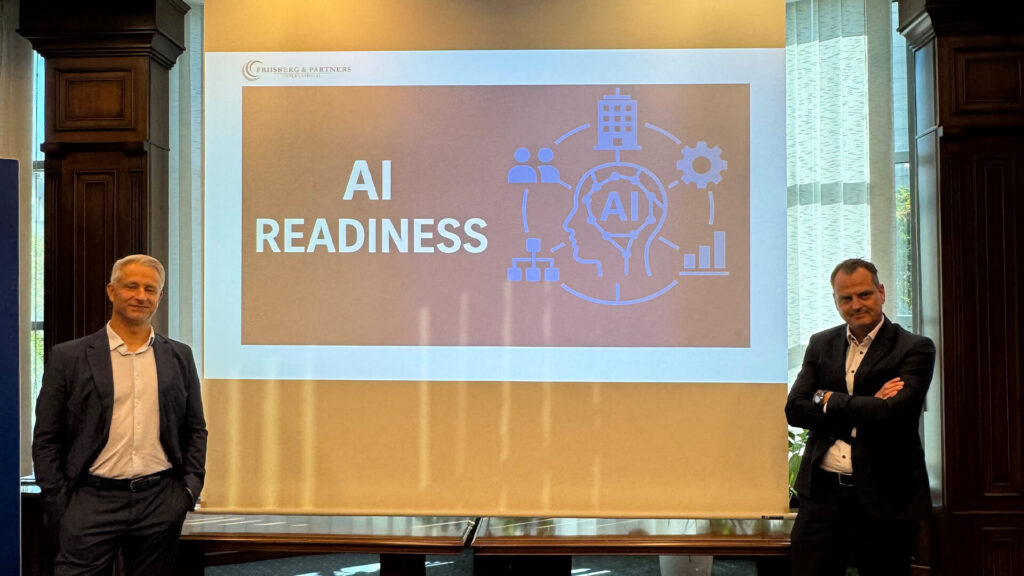
Following recent talks by Zoltán Pethõ and Zoltan Kadar from Friisberg Hungary at the MVÜK Zrt. and Nitro Digital Solutions Ltd. conferences, we ran a poll to understand how organisations viewed their AI readiness.
These insights confirm what we see in our consulting work. Most organisations recognise AI’s potential but need structured guidance to turn ambition into action.
At Friisberg, AI Readiness has become one of our key service areas. We help clients navigate the entire AI journey - from exploration to execution. Together with our expert consultants and strategic partners, we assess where you stand today, define a clear roadmap, and support the implementation of tailored, value-driven solutions. If your organisation is looking to move from curiosity to capability with AI, we’d love to help you get there.
When Friisberg partners with international clients investing in or acquiring companies in Hungary, we often hear reflections on how different the local business culture feels compared to Western Europe. While Hungary is firmly integrated into the EU and global markets, its business practices remain shaped by a unique history, strong national identity, and Central European pragmatism.
Friisberg has a long-established presence in Hungary and across Central Europe. Our consultants understand the nuances of local culture while operating as One Firm, globally connected. We support clients not only in executive search but also in management audits, integration, and leadership development ensuring that international businesses entering Hungary can adapt effectively while building trust and credibility.
For companies seeking to navigate Hungarian business culture, the key is not just compliance with local law, but respect for authority, patience in negotiation, and a readiness to build strong personal relationships.

As global tensions rise, Sweden’s defence strategy is undergoing significant changes, influencing both business practices and executive leadership. At Friisberg & Partners International, we’re observing how these shifts are reshaping executive search and corporate resilience in Sweden.
Since reinstating conscription in 2017, Sweden has a selective service system where only a small percentage of 18-year-olds are called up, though this may increase due to the Ukraine crisis. Under Sweden’s Totalförsvarsplikt (Total Defence Obligation), businesses, especially those providing critical infrastructure, are required to maintain contingency plans and may need to release staff for military or civil defence duties during crises.
The Russian invasion of Ukraine has intensified the demand for executives with military and strategic experience. Organizations are increasingly seeking leaders with crisis management expertise to navigate geopolitical risks and enhance resilience.
Diversity in leadership - across gender, culture, and professional experience boosts Sweden’s defence strategy by fostering innovation and adaptability. A broad range of perspectives is key to building resilience in the face of future threats.
CEOs must now integrate security and continuity into their business strategies, especially regarding supply chain and cyber risks. Discussions about offering lower taxes in exchange for employees participating in military training reflect Sweden's readiness to adapt to changing defence priorities.
At Friisberg, we’re committed to promoting co-opetition within Sweden’s defence sector, encouraging collaboration among stakeholders to drive innovation and strengthen the country’s defence capabilities.
Sweden’s NATO membership has reshaped defence priorities and increased the focus on leadership in defence tech and the public sector. The country’s defence strategy now emphasizes preparedness and resilience, marking a new chapter in Sweden’s security landscape.
Nevena recently joined thought leaders, innovators, and HR professionals at the Future of Work Summit hosted by K Events at the Grand Hotel Millennium Sofia. The event was a dynamic platform for discussing how organizations can prepare for a future shaped by technology and AI. Key topics included rethinking workforce capabilities, harnessing people analytics, and cultivating cultures of adaptability and well-being.
“I’m taking away a renewed sense of purpose around helping teams stay agile, continuously learn, and thrive in a world where change is the only constant”.
A big thank you to the organizers and speakers for their insightful presentations and for fostering meaningful connections.

Earlier this month our partners gathered in Helsinki, 'The land of a thousand lakes' for our 123rd conference - a powerful opportunity to explore the leadership challenges and opportunities emerging across defence, cybersecurity, sustainability, and the future of work. Thank you to our fantastic Finnish team for kindly hosting us!
We heard from Olli Koski, Director of Nordic Public Policy at Wolt, who shared insights into scaling one of Finland’s most successful tech companies. Janne Peljo, Chief Policy Adviser at EK, explored Finland’s energy strategy and climate goals. Juho Nojonen, EVP at Barona, offered a practical view into current workforce trends in industry and construction.
We had the honour of welcoming Antti Vasara, Special Envoy for Technology at the Ministry for Foreign Affairs of Finland. His session on European technology leadership left a lasting impression - especially his timely reminder: “It’s not the AI agent that will take your job - it’s the person who knows how to use it better than you.”
Coinciding with our event was the UK-Finland Defence Industry Day at the British Embassy Helsinki - a clear signal of the innovation and cooperation happening across Europe, and a timely backdrop for many of our conversations.
We return home energised by the ideas exchanged, the relationships strengthened, and our shared commitment to helping clients lead through change.

Over the years, I have worked with many boards and have seen first-hand the difference that strong Non-Executive Directors can make. The best ones share certain qualities that go far beyond technical expertise or impressive CVs - they bring balance, perspective and courage to the boardroom.
For me, these qualities can be summed up in what I call ‘The Seven Cs of a Good NED’.
A capable NED combines sound judgement with practical wisdom. They know their craft and understand how organisations really work. It is not about knowing everything, but about knowing what matters most, and when to step in.
Curiosity keeps a board alive. The best NEDs never stop asking questions, not to trip people up, but to see things from every angle. They read beyond the board pack, stay connected to the business and are genuinely interested in the people who make it run.
Boards work best when there is mutual respect and trust. A collaborative NED listens carefully, values differing opinions and builds bridges between executives and non-executives; they understand that the board’s strength lies in collective wisdom, not individual authority.
Good challenge is at the heart of governance. It means testing ideas without undermining confidence and the best NEDs know how to ask hard questions in a constructive way, keeping discussions focused and purposeful.
Confidence allows a NED to hold their own when opinions diverge, but it also means having the humility to admit when they do not know something. The right balance of confidence and modesty brings credibility and respect around the board table.
Being a NED is not an honorary title, it requires time, preparation and genuine involvement. The most effective NEDs are those who show up fully, engage deeply and stay informed between meetings.
Courage is what separates a good NED from a great one. It is the willingness to speak up, even when it is uncomfortable and courage means standing firm on matters of ethics, accountability and fairness. It is about doing what is right, not what is easy.
In every strong board I have seen, these seven qualities appear in some form. They are not static attributes, but habits that grow through experience, reflection and self-awareness.
As governance expectations continue to rise, the best boards are those that recognise the human side of leadership. The Seven Cs provide a simple framework, but living them takes discipline, empathy and resolve.
At Friisberg UK, we focus on finding people who genuinely embody these seven traits. True board calibre is not measured by titles or tenure, but by attitude, integrity and the ability to influence wisely. Our work lies in recognising these qualities early, even when they are not obvious on paper, and bringing together boards that are both capable and courageous in equal measure.
You need to load content from hCaptcha to submit the form. Please note that doing so will share data with third-party providers.
More InformationYou need to load content from reCAPTCHA to submit the form. Please note that doing so will share data with third-party providers.
More InformationYou need to load content from reCAPTCHA to submit the form. Please note that doing so will share data with third-party providers.
More InformationYou need to load content from reCAPTCHA to submit the form. Please note that doing so will share data with third-party providers.
More InformationYou need to load content from Turnstile to submit the form. Please note that doing so will share data with third-party providers.
More Information