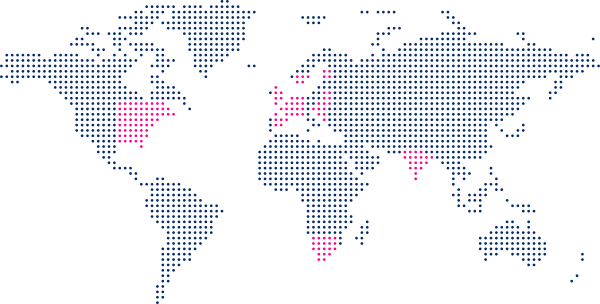
As of September 1, 2023, Friisberg & Partners International is also present in the Netherlands. With the opening of an office in Amsterdam, we are taking the next step in our international expansion.
Maarten van de Sande will lead our Dutch office. With almost 20 years of experience in recruitment, headhunting and executive search for both multinationals and local companies, his style of working is characterized by a high degree of involvement with both clients and candidates and an in-depth knowledge of the markets in which he operates. Maarten studied Finance & Business Administration at Nyenrode University, and followed several Master courses on HR and Strategy; he speaks four languages including Danish and German.
Maarten is trained as an accountant and started his career at KPMG in the general audit practice. Afterwards he had a number of management roles, including at the German Heidelberger Druckmaschinen, where he was Managing Director for two small Dutch entities for seven years. At that time he started his own recruitment agency, which he and a partner developed into a medium-sized player on the Dutch market.
After the sale of this agency at the end of 2019, Maarten shifted his focus towards specialist Headhunting and Executive Search assignments, mainly for medium-sized companies, often international and many of them family-owned. Together with his team of experienced researchers, Maarten guaranteed high quality service and the best solution. Joining Friisberg & Partners was therefore a logical step for Maarten to serve both his existing and new clients even better in their ambitions to attract the best local and international candidates.
Zoltan Petho, Chair of Friisberg & Partners International, gave a warm welcome to Maarten:
“It has been never easy to expand and find a new Partner in a new geographical location. Especially when it is a mature market, like The Netherlands. Friisberg is not only looking for a professional with proven track record in Executive Search or Management Consulting but also someone who is a great fit for the Friisberg family and shares our values from the very beginning. Maarten is very honest when describing his experience and ambition, and understands the business, which was clear after the very first talk we had - he never hesitates to ask questions showing his ability to be open and learn new things. Maarten has also a sparkling personality and a great sense of humour….and our common Danish background was just the icing on the cake! Welcome to Friisberg, dear Maarten!”
Maarten added:
“When I first met my new colleagues, during the conference in Budapest earlier this year, I became acquainted with the characteristic Friisberg culture: friendly, collaborative, entrepreneurial and ambitious. It fits like a glove!”
In today's fast-paced and competitive world, the significance of mental health in the workplace cannot be overstated. We all know that the well-being of employees not only affects their individual lives but also has a profound impact on organizational success. Addressing mental health concerns within the workplace is not just a moral imperative but also a strategic necessity. Based on my talks with various firms, let me explore the challenges associated with mental health in the workplace and discuss effective strategies for promoting a mentally healthy work environment.
As I see, one of the major challenges concerning mental health in the workplace is the stigma that still surrounds mental health issues. This stigma often prevents individuals from seeking help, as they fear negative repercussions on their careers or reputations. Consequently, mental health problems might go unnoticed and untreated, leading to more severe issues down the line.
Moreover, the nature of modern work, characterized by high demands, tight deadlines, home office environment and long working hours, can contribute to stress and burnout. These conditions, if left unaddressed, can lead to decreased job satisfaction, increased absenteeism, and reduced overall productivity. Additionally, the blurring of boundaries between work and personal life due to technological advancements can make it challenging for employees to disconnect, exacerbating stress levels.
Managing and improving mental health in the workplace requires a comprehensive and honest approach that involves both employers and employees. Obviously there are many effective strategies to consider, including:
Employers can take the lead in creating a culture of open conversation around mental health. This involves destigmatizing mental health issues by providing information, resources, and training to employees and managers. Encouraging honest discussions about mental health can help create an atmosphere where seeking help is seen as a sign of strength rather than weakness.
Employers should strive to design jobs that consider the mental well-being of employees. This includes manageable workloads, reasonable deadlines, control of work and the autonomy to make decisions. Furthermore, offering flexible work arrangements, such as remote work or flexible hours, can help employees manage their work-life balance more effectively.
Many organisations established already Employee Assistance Programs (EAPs) or provided access to mental health professionals can offer employees a confidential outlet for discussing their concerns and receiving guidance. These programs can play a crucial role in early intervention and prevention.
We must encourage employees to take breaks, use vacation time, and disconnect from work outside of working hours to help prevent burnout. This can be reinforced through company policies that prioritize employee well-being.
Providing training to managers and employees on recognizing the signs of mental health issues and how to provide appropriate support can contribute to a more compassionate and understanding work environment.
Managers can conduct regular one-on-one check-ins with their team members to discuss their workload, challenges, and well-being. This not only helps address potential issues but also shows that the organization values its employees' mental health.
If you are not confident dealing with this topic as a business leader, CXO or a senior HR person, you may ask for help or advise from a professional. The gains are incredible. This can make your company a healthier, happier, and more productive firm.
We caught up with Nevena Nikolova, from our office in Sofia, who is a prize-winning film maker and a hugely successful head-hunter. Clearly there are parallels between casting the lead and supporting roles for a film and identifying the best possible hires for a corporate client.
Both professions are all about recognizing talent and making the best use of it, making the talent really shine to its fullest potential. The job of a Head-hunter and Management Consultant helps develop transferable skills like influential communication (capacity to convince and inspire) as well project management capability that are very useful for me as a filmmaker.
On the other hand the Directing boosts my creativity, helps me build out-of-the box solutions and support clients and candidates in finding new perspectives and changing their way of thinking or acting. What I experience is a kind of a cross-pollination between the two professions and I find it very enriching. I discover a certain Work-Art balance as the one activity is helping me recover from the other and vice-versa.
My artistic journey started as an actress with stage performances of various fringe shows, but I felt I needed more so the second step was a smooth transition to stage directing and afterwards I jumped into film directing.
My mind naturally produces multiple ideas, images, stories, small pieces of the universe, so writing and directing a movie is a way to share my internal world with thousands of people all over the globe. To feel 'seen' from inside, to experience other people`s reactions, to be able to touch so many souls and minds - this is really powerful and exciting; it makes me feel complete and fulfilled.
Movie Directing is great for upgrading my own leadership skills and style. It requires vision, determination and capacity to balance, align and synchronize the ideas and the input of very diverse professionals, who are often quite opinionated, very emotional and expressive - sometimes ego-driven. When you are an aspiring director, you are full of doubts and it is a huge challenge to keep your authenticity and allow yourself to show vulnerability while nurturing the faith in the project among the crew members. What I discovered while film-making is that it is not necessary to have all the answers and the full picture in order to lead the team, it is enough to be just a couple of steps in front of them.
My first movie MORNING won multiple awards for Best Debut, Best Student Short, Best Silent Film, Best Dance (dedicated to Dance) Film, Best choreography in a Short film, Best actor, Best aspiring filmmaker etc. from international festivals in Cannes, Italy, UK, Mexico, Israel, Chile among others.
The second movie ROOFTOP was recognized for Best Dark comedy, Best lead actor, Best young actress, Best female director ect. Couple of months ago the movie won the Best Independent Short Film award in Silk Road Film Festival Cannes.
Some of my favourite directors are Yorgos Lanthimos, Christopher Nolan, Lars von Trier, Quentin Tarantino, Pedro Almodovar, Daren Aronofsky, Krzusztof Kieslowski, Jane Campion, Wong Kar-Wai and many others. All of them have inspired my love of cinema but I`m still searching for my very own style as a director.
My business understanding and thinking was influenced by David Ogilvy, Richard Branson, Steve Jobs, Ray Dalio, Patric Lencioni, and Simon Sinek.
Lovely question! For the younger me I would cast Anna Tayor Joy and Juliette Binoche would be my first choice for the middle aged me.
The Top HR Business Executives in Hungary magazine is a special annual publication of the Budapest Business Journal. It focuses on outstanding achievements and how the Hungarian HR market is developing. It looks at leading HR organizations, the challenges of a tight labour market and the trends shaping the market in Hungary today. The selection is unashamedly subjective, having been made by the editorial team of the Book of Lists and the BBJ, and draws on a 30-year-history of providing unparalleled business news and analysis. The readership of Top HR Business Executives mirrors much of that of the BBJ, including many of the country’s leading business executives, diplomats, and decision-makers.
Last week Friisberg & Partners International was privileged to be invited to participate in the Ukraine Recovery Conference 2023 (URC23) in London from 21st – 23rd June. It is an annual global conference and was this year organized and hosted by the governments of the United Kingdom and, of course, Ukraine. URC23 brought together a coalition of thousands of representatives from civil society, businesses and governments from 59 countries to discuss and commit to support for Ukraine’s recovery and reconstruction.
Elena Maysyura, who leads our office in Kyiv, was joined by Lorri Lowe and Andrew Guy from our office in London. Speakers at the conference included Ukrainian President Volodymyr Zelensky, UK Prime Minister Rishi Sunak, his Ukrainian counterpart, Denys Shmyhal, as well as President of the European Commission Ursula von der Leyen (who confirmed that Ukraine’s accession to the EU is imminent), US Secretary of State Antony J. Blinken, foreign ministers of EU countries, and others.
We know that Ukraine has significant economic potential. The international community came together at the conference to unlock the potential of the private sector to help Ukraine’s economic recovery. This, in turn, will support the country to come back stronger, as a modern, stable and resilient democracy.
"By building Ukraine, we are building much more than one country, we are building the world.
"Will it be peaceful? Will it be stable? Will it be democratic? It depends on each and every one of us."
President Zelenskyy (video remarks)
The focus of day three of this year’s conference was to advance private sector participation in the Ukrainian recovery and for this URC23 was hailed a great success, with one of the largest international financial commitments for reconstruction since the Second World War. By the end of the event, a total of some US$60 billion in international commitments had been made.
It was noteworthy that a recurring theme at URC2023 was the strength of human capital already in Ukraine and the willingness of the Ukrainian diaspora to rebuild the economy back home - not just after the war, but now.
With our office in Kyiv and many more in other cities in Europe and around the world, Friisberg & Partners International is ideally placed to identify and secure the right leadership for Ukraine's revived businesses and FDI projects.
Friisberg stands with Elena, her team in Kyiv, and her country - we remain united in our support for Ukraine.
Due to remote working, many organisations have hired employees who are only tied to their working community by virtual means. This makes it easier for employees to leave their working community behind.
No one can yet say for certain how society will open up during the coming months or whether there will be new setbacks. There is an ongoing discussion at workplaces and especially in expert organisations on how to proceed as the remote work recommendation is removed after the long period of uncertainty we have all faced.
There are certainly more choices available: the employee is allowed to come to the workplace and there are different quotas as well as other models based on alternation, individual preference and common expectations. The need for automation in one’s own work may well have been increased and organisational hierarchies reduced. Everything will slowly fall into place, which may take months, maybe even years.
There is one thing of note that has seen very little discussion:
Organisational culture plays a key role in an employee’s commitment to their organisation, especially as things stand currently. It lays the foundation for the operations of the entire organisation and constitutes a part of the employee’s work performance - even when working alone.
Organisations have not stopped hiring new employees during this exceptional period. Many newly employed people have been a part of their new working community only by virtual means. Many companies have invested an enormous amount of time and resources in personnel well-being and commitment during the pandemic.
We have also discussed these issues extensively in our own company, pondering whether we have made the right decisions. It is hard for me to say, but I naturally hope that we have.
I like to believe that an ideal working community provides its members with opportunities to work flexibly, respecting different approaches. Workplaces are now trying to find the balance between freedom and, on the other hand, approaches that relate to the needs of the clients. If a client wishes to meet the team in person instead of through virtual means, this should be weighed against one’s own individual wishes.
If the employee does not have real workplace relationships, physical and intimate working community and thereby the experience that humans need as social beings, they are unlikely to be as committed to their current position as before the start of the pandemic. In this case, they will have an easier time leaving their employer and working community behind and simply working remotely.
Of course, there will be exceptions. In such a case, something has been done differently – perhaps intuitively, or maybe the interaction between the employees and management has been very successful. I believe that the new guidelines for organisational culture during the pandemic are not enough for management to keep its organisation functional. Simply giving orders from above will not do either, as there is likely to be a backlash.
The appreciation of the employee experience is growing. A strong feeling of commitment to the work and organisation can better motivate people to stay than salary or other financial benefits. A high degree of commitment to one’s work not only maintains continuity, but also decreases sick leave rates and improves performance and efficiency at work.
Now is the time to invest in listening to the teams and allowing them to participate. We need to take measures through which our personnel can be brought together at the workplace in a safe manner as soon as possible, and give everyone the chance to become part of the working community instead of just working remotely. There is value in being present at the workplace at least from time to time.
Mika Rossi
Managing Partner, Helsinki
Top management positions, mainly in multinational companies, represent a goal for 83% of the employees within the age group of 23 – 40, according to a study made by Friisberg & Partners Romania, of 150 Bucharest-based subjects.
The career path towards a top management position invariably goes through middle management ones, yet the abilities and knowledge necessary for a top management role can be different.
Which are the differences between a middle management position and a top management one?
Following a study on a focus group of 52 middle and top managers, as well as from our own experience in the market, we came to the following conclusions:
In the end it is a personal decision, one makes in his/her career path.
Aiming to become a top manager means more than education, experience and data accumulation. It means even more than long work hours and sacrifices made. Becoming a top manager also means a higher degree of decision making in regards to putting to work one’s business vision.
Our study reveals not only the aspirations and goals of professionals in the market, but also a deeper understanding of what it takes to be a top manager.
Although native abilities are important, in order to successfully walk in the shoes of a top manager, one needs years of experience, a profound market understanding and, most of all, a business vision.
Floriana Enescu
Partner, Romania
Talks with: Lorri Lowe, Partner, Friisberg & Partners UK
The change to remote working has for many companies meant a dynamic acceleration and a rapid embedding of digital ways of working. Without physical interaction and positive reinforcement of an office culture, it is too easy for people to feel isolated and undervalued – this is the challenge for many employers. There is a tendency for some people to work too hard, to burn out - perhaps to over compensate for not being visible on a daily basis and maybe some, who have been hiding behind others, are suddenly exposed.
Employers want different and instant ways of connecting with and rewarding their remote teams to keep productivity and engagement high and not lose the value of a shared work ethic. Increasingly digitised ways of working are undoubtedly the future and similarly access to ways of incentivising teams will be through readily accessible and easily usable digital platforms.
I believe leaders need to find ways to show they care in order to maintain productivity, focus and engagement of their team. Digital Benefit platforms are increasingly important and we have seen more employers turn to these to better take care of employees to ensure their wellbeing.
Leadership teams are focusing less on the long-term strategy of the company, perhaps less overtly on the financials, instead spending more time connecting with their people to ensure they know and understand what is expected of them. If someone feels isolated, knowing what steps can quickly be taken to re-focus them is vital.
This is undoubtedly the biggest challenge - not just in terms of maintaining employee engagement, but also their overall efficiency. I believe that at this time the leadership team must be more visible and accessible than ever.
It is important to celebrate and encourage a better work/life balance. In the past leaders were understandably focused on the best ways of transacting the company strategy, but now it is more about having the right mindset and the right tools to effectively manage their teams remotely. Being mindful of your people’s needs, not expecting everyone to always be available 24/7, ensuring the team has regular breaks, communicating a shared understanding of the KPIs and ensuring everyone feels supported – in summary, looking after your employees’ wellbeing has never been so important.
As leaders we must take care of ourselves too. It is all too easy to be so concerned about the team that it is easy to forget about yourself. Being a role model to promote wellbeing for the Board and leadership team is essential.
Transparency of feelings and open communication are also vital. At Sodexo, we meet formally and informally, virtually of course, to check in and discuss where we are, how we are feeling about home, about the office, and what might we need. This means any action can be taken promptly and everyone feels they have a voice and are heard. Informal communication is very important – e.g. quizzes, late afternoon drinks in smaller teams promote easier conversations, so if there is a problem we can immediately help.
Socially and economically the world has changed. Previously we worked collaboratively in our office and I knew working remotely would not replace the daily physical interactions. Of course, the general principles stay the same in terms of how employees bring potential to the business, how they can best contribute and how we can all engender trust. But I took the time to do lots of research on remote working and I reviewed our communication strategy straight away adjusting my daily focus from addressing the long term goals to being more agile and nimble – we had to evolve and quickly. We introduced a temporary program , we identified targets over 6 months rather than a year, and with shorter term objectives we can be more agile, reactive and proactive in response to change from the impacts of COVID19.
One million business consumers interact and use our products daily, so we genuinely understand consumer behaviours. It was vital that our platform was totally digital and incredibly user friendly. Consumers now demand short lead times – not 3 days anymore, but immediate. They also want more for their money and want to shop with trusted brands. Demands for our discount platform (engagement of consumers is positive where there are good discounts) is high – people are more focused on their earnings and household budgets.
Never underestimate what you and your team can achieve. In 120 hours we moved from being office based to 100% remote working. We embraced the technical, adjusted the infrastructure, aligned our collective mindset, and ensured all our processes were in line. I might never have thought that possible - after years of discussions, in just two months we were 100% digital – this as a result of external pressures to adapt to unforeseen change. We achieved this together and now we know we can achieve anything. It is important to share ambition and to look for the potential in people - the real potential. Taking the time to reflect on what you have achieved is paramount and, of course, never underestimating anyone.
Being a positive leader means caring for your team, engaging with them openly, finding different ways of communicating and listening to what they need. This can mean you have to stretch yourself to demonstrate effective leadership skills - and that isn’t always easy. It is vital that those on the leadership team adapt quickly to new technologies and lead on this efficiently to best communicate with teams in the right way. Building and maintaining trust is essential. Finally, never underestimate the importance of a ‘thank you’ - and meaning it. Many people are understandably concerned about their observable performance; they are worried about their perceived contribution to the success of the business. Employee recognition has never been so vital and recognition platforms drive positive culture and best practice.
Friisberg & Partners International is proud to be a preferred supplier of executive search to Sodexo in the UK.
You need to load content from hCaptcha to submit the form. Please note that doing so will share data with third-party providers.
More InformationYou need to load content from reCAPTCHA to submit the form. Please note that doing so will share data with third-party providers.
More InformationYou need to load content from reCAPTCHA to submit the form. Please note that doing so will share data with third-party providers.
More InformationYou need to load content from reCAPTCHA to submit the form. Please note that doing so will share data with third-party providers.
More InformationYou need to load content from Turnstile to submit the form. Please note that doing so will share data with third-party providers.
More Information