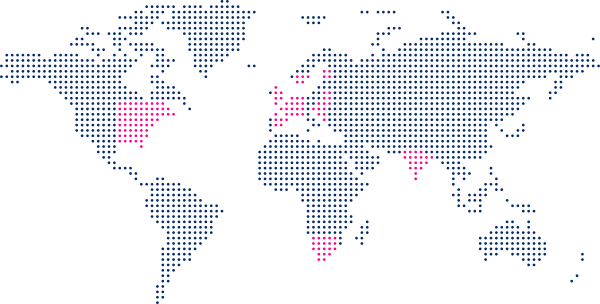
Friisberg, as a firm and a multinational family, stands shoulder to shoulder with Elena, our Partner and her team in the Kyiv office.
She has bravely withstood all that Russia can throw at her, and her family.
These are Elena's thoughts, on this day, after 12 months at war:
A year has passed since that terrible moment when I woke up to the sounds of explosions. But the most difficult task, as it turned out, was to wake up my relatives and say the word, 'War'.
Parts of Kyiv look normal on the surface, but daily we hear air raid sirens. There are now few children in the city because so many have been displaced with their mothers or grandparents living elsewhere in Ukraine, or outside the country. The toll of the human suffering has been staggering – thousands have been killed and more than 8 million Ukrainians have left.
People in Ukraine say that your life is divided into 'before' and 'after’ - and it is true.
We have all changed during this year, but we are not broken and we believe in Victory. It keeps us going.
Ukraine will continue to defend the unarguable fact that it belongs within Europe. We uphold the values, rights and freedoms that underpin Western civilization.
The Friisberg family looks forward to holding a Partner Conference in what will again be a free Kyiv, as capital of a sovereign Ukraine.
Our own Diversity & Inclusion gives us a huge and sustainable advantage over our competitors. Gender parity is vital to any workplace. Not just because it's a laudable goal; it simply makes bottom-line business sense.
It is also the backbone of our innovation. We know that our multiplicity of perspectives sparks creativity, and helps us to spot and seize new opportunities. It also encourages us to always challenge stereotypes.
We understand that our diversity is integral to our success. It enables us to understand the unique needs of our clients and find innovative ways of addressing those needs.
Gender diversity helps us to attract and retain talented women. No company can afford to ignore 50% of the potential workforce and expect to be competitive in the global economy.
We know that only the highest-performing teams, those with different opinions, perspectives, and cultural backgrounds will ultimately succeed in the global marketplace. We encourage different viewpoints, ideas, and market insights, which enables better problem solving, leading to superior performance.
We make sure our teams have a diversity of genders, as well as backgrounds and ethnicities. But we know that hiring women, transgender, or nonbinary people into our workplace isn’t enough. - we empower our teams to not only reach but exceed their full potential.
And are female managers committed supporters of women?
In my conversations with female managers, I like to ask the women whether they have actually received support over the course of their careers. Many confirm this by saying that it couldn't be any other way: you need a manager who recognises your potential and pushes you forward, or delegates new tasks and ultimately promotes. And in every new team and / or department it is important to make contacts again and ideally find sponsors. In the best case, it is possible to establish a good relationship with board members and managing directors, who are also successfully following their path and promoting and developing potential. Leadership programs for young talents also help to gain visibility, but such programs are not available everywhere.
Very few women say they made it without a sponsor. They also recognise that further development, with support, would have meant fewer detours and would have been faster. In most cases the sponsors are male. This may be due to the fact that there are fewer women than men in management.
But the question also arises, to what extent do women actually support other women?
In the interviews I have experienced two “extremes”:
On the one hand, there are women for whom, the quota is (unfortunately) a necessary intervention by the legislature in order to correct past mistakes. It is very important to them to support other talented women and to be available to them as mentors - even keeping lists of potential female executives to promote.
Then there are women who do not even want to be associated with the “gender issue”. They neither want to be a quota woman, nor do they want to attract attention through the special promotion of female executives. They are of the opinion that only experience and knowledge should be deciding factors regarding promotion.
Does that coincide with your observations?
How do “quota women” feel in companies? Do we see legislative intervention as an opportunity for all women to bring change in the male-dominated boardrooms?
Meltem Ay, Principal
Frankfurt
The future is anything but predictable and having a strong finance leader is crucial for any organisation as the CFO most directly contributes to a company’s financial health and resilience.
In the times of the current pandemic, CFOs are assuming a greater role and are likely to hold onto those greater responsibilities in the future.
What are the key competencies and skills required from future CFOs?
While every search is unique and there is no universal advice to finding the right CFO, these are the most sought-after attributes:
Strategic mindset
To serve as a right-hand of the CEO, CFOs need to be able to focus on shaping strategy, transformation and scenario planning. Today’s CFOs are responsible for much more than finance, they often oversee multiple functions from IT, Legal, Real Estate to Supply Chain. Control and compliance is not enough, companies need a strategic CFO who can look at the business through the windshield, rather than the rearview mirror.
Ownership mindset
CFOs must focus on protecting the bottom line but also are expected to view the financial performance through an ethical lens to ensure sustainability and value creation.
Adaptivity and openness to innovation
Digital skills and adopting new technologies has become priority, not just “nice to have”. CFOs need to have solid knowledge of technology and how to use it to both advance the business and protect it against cybersecurity and data privacy risks. Coping with rapid changes and decision making despite uncertainties are must haves.
Communication skills and leading with empathy
Though some CFOs have impressive technical backgrounds, that is not a key to success. In the past, CFOs might have been focused on communicating with investors and shareholders. Today, they have to manage remote teams, they deliver messages of company situation and prospects to all employees, customers, suppliers and the community. The pandemic is proving that ‘softer’ leadership qualities such as empathy, compassion and reflexion are more effective than dominance and directive style. We are finding that this is helping to expand the diversity of CFO candidates.
Conclusion
Resilience and adaptability became more important and will remain crucial for the uncertain times ahead. Technical skills and sector-specific experience remain important but past achievements do not guarantee future success and despite the clear benefits of hiring from within the industry, our experience has shown that companies are open to look beyond their own industry to find top talent.
Mary Keane
Andrea Chládková
Partners, Czech Republic
Ich glaube, das hat auch viel mit unserer Sozialisierung zu tun. In den 70iger Jahren brauchten Frauen noch die Genehmigung ihrer Männer, um arbeiten gehen zu dürfen. Das ist nicht einmal 50 Jahre her! Es ist bei uns immer noch weit verbreiteter Konsens, dass sich vor allem die Frauen um die Kinder zu kümmern haben. Rabenmutter ist ein urdeutsches Wort und Symbol dieses Gedankenguts. Hier findet inzwischen ein Umdenken statt. Inzwischen sind ja z. B. ein signifikanter Prozentsatz der Kolleg*innen, die in Elternzeit sind, Männer. Aber es muss konsequent fortgeführt werden; die Infrastruktur muss angepasst werden. Wir brauchen bezahlbare Krippenplätze und ein gutes Ganztagesschulangebot. Frauen müssen die Chance haben, sich nicht nur für Kinder, sondern auch für eine Karriere entscheiden zu können.
Natürlich muss auch bei den Männern ein Umdenken stattfinden, aber auch sie brauchen Unterstützung. Es muss in Ordnung sein, dass sie ihre Kinder um 17 Uhr irgendwo abholen, ohne schief angesehen zu werden. Das machen beispielsweise die Niederländer so viel besser. Dort werden keine Meetings vor 9 oder nach 17 Uhr angesetzt. Das ist viel familienorientierter!
Gerade in Führungsetagen sind wir in Deutschland sehr rückständig, was die Akzeptanz dafür betrifft, dass Familie versorgt werden muss – ob von Mann oder Frau.
Wie bewerten Sie die aktuelle Entwicklung beim Thema Geschlechtervielfalt in Führungsgremien mit Blick auf Deutschland?
Da gibt es noch viel zu tun! Es muss ‚from the top down‘ gelebt werden, in die Zielvereinbarungen der Führungskräfte einfließen und in den Köpfen der CEOs verankert sein. Das Verständnis muss sein, dass Vielfalt einen Mehrwert bringt und Andersartigkeit förderlich für Teams ist. Das geht weit über die Frage des Geschlechtes hinaus.
Worauf sollten Frauen in ihrer Karriereplanung achten, um sich auf eine Spitzenposition vorzubereiten?
Ganz wichtig ist es, sich über sein Leben klar zu werden und ein Ziel zu setzen. Was will ich? Karriere machen ja, aber zu welchen Opfern bin ich bereit? Was ist mit Auslandsaufenthalten? Die Partnerwahl ist ebenfalls relevant. Unterstützt mich mein Partner in meinen Bestrebungen?
Im Übrigen gibt es nichts, was man nicht machen kann. Ich kann auch mit Familie ins Ausland gehen! Aber ich muss meine Ansprüche anmelden, klar formulieren und sagen, ich will das. Offen sein und keine Angst haben vor Herausforderungen.
Und wo sehen Sie die größten Hindernisse?
In den Köpfen! Wir Frauen neigen dazu, einen Job oder eine neue Aufgabe nur dann anzunehmen, wenn wir über 100 % der Skills verfügen. Da sind Männer ganz anders.
Wenn ich merke, dass es in einem Unternehmen für mich nicht weitergeht, ich so nicht ans Ziel komme, muss ich neue Chancen suchen. Dazu muss ich bereit sein, meine Komfortzone zu verlassen, Gespräche mit anderen führen und vielleicht auch mal privat einen Coach buchen. Sich selbst als Priorität sehen. Vielleicht muss man mehr delegieren – beruflich wie privat. Das kann so aussehen, dass man die Kinder mal zu den Großeltern schickt, um etwas Kraft zu tanken. Sich selbst Auszeiten zu gönnen und auf den eigenen Energiehaushalt zu achten – ohne ein schlechtes Gewissen zu haben – ist wichtig.
Denken Sie, dass der Gesetzgeber weitere Schritte unternehmen muss?
Ich beobachte die Entwicklung nun seit 30 Jahren und für mich geht es immer noch zu langsam. Wichtiger als eine Quote ist aus meiner Sicht, dass die entsprechende Infrastruktur bereitgestellt werden muss. Steuerliche Anreize schaffen, wie z. B. Kindergartenunterbringung oder Ganztageseinrichtungen und volle steuerliche Absetzbarkeit von Tagesmüttern etc.
Welche Frau bewundern Sie und warum?
Nicht eine, ich habe viele Vorbilder. Amelia Earhart als die erste Frau, die geflogen ist. Aber auch andere, wie die erste Frau, die eine Hose getragen oder einen Uniabschluss gemacht hat. Frauen, die sich also in ihrer Zeit haben extrem durchsetzen müssen. Es braucht diese Vorbilder. Ich bewundere aber vor allem auch Frauen in unserer Zeit, die es aus schwierigen Verhältnissen geschafft haben, die am Ball geblieben sind, oder auch alleinerziehende Frauen, die den Alltag trotz aller Widrigkeiten stemmen und meist mit wenig Geld auskommen müssen.
Brauchen wir einen International Women‘s Day heutzutage überhaupt noch?
Ja, brauchen wir! Noch ist er nötig, aber es bleibt die Hoffnung, dass wir ihn irgendwann abschaffen können.
Wer hat Sie inspiriert?
Meine Mutter. Sie ging vor dem Mauerbau mit einem Einkaufskorb von Ostberlin nach Westberlin und hat ihre Familie zurückgelassen. Ihren Mut habe ich sehr bewundert. Sie wusste ja nicht, ob und wann sie ihre Eltern und Geschwister wiedersehen würde. Sie wurde 1931 geboren, ging 7 Jahre zur Schule. Immer hat sie mir signalisiert, du kannst alles erreichen. Mach dich nicht abhängig.
Ich hatte auch eine Grundschullehrerin, die mir geraten hat, mich nie abhängig zu machen und auf eigenen Beinen zu stehen. Mit einer guten Ausbildung können wir alles im Leben erreichen.
Hatten Sie einen Mentor*in?
Ja. Ich war im Mentorenprogramm der Deutschen Börse. Mein direkter Chef hat mich sehr unterstützt. Später hatte ich das Glück Reto Francioni als Mentor zu haben. Von beiden konnte ich viel lernen. Mir wurde viel zugetraut, sodass ich immer in die nächste Rolle kam.
Aber auch mein Mann war mein Mentor. Er hat einen ähnlichen Background, war mir beruflich aufgrund seines Alters etwas voraus und hatte viele Situationen bereits durchlebt. Mit ihm konnte ich alles besprechen. Er hat mir mit Rat und Tat zur Seite gestanden.
Und heute stehe ich selbst gerne vielen jungen Frauen als Mentorin zur Verfügung. Das ist mir sehr wichtig! Und wer keinen Mentor*in hat, sollte sich einen suchen. Eine Person ansprechen, die man bewundert, und fragen, ob sie diese Rolle übernimmt.
Was glauben Sie, welche Fähigkeiten sind notwendig gewesen, um Sie dahin zu bringen, wo Sie heute sind?
Dass ich an mich selbst geglaubt habe! Vertrauen in sich selbst zu haben, dass man das schaffen kann, ist ganz wichtig. Aber auch Mut, Beharrlichkeit und Authentizität.
Vielen Dank für das Gespräch, Frau Gruber!
Meltem Ay
Senior Consultant, Germany
We asked two of our female Partners, both very successful management consultants...
Susanne’s answer
I have two pieces of advice for the young women starting their careers.
Firstly, make a career plan. Having been a headhunter and mentor for over 20 years, my experience has showed that having written down your expectations and dreams for your work life is of great benefit. A study from Harvard University also confirms this observation. The study was conducted in their MBA class where 3% had a written career plan, 13% had a mental career plan and 84% had no career plan. 10 years after finishing their MBA the 13% had performed twice as well as the 84% and the 3% were making 10 times as much the remaining 97% annually.
Secondly, ensure that you have a good balance between work, studies and your private life. I see many young women who have focused solely on their studies for many years, and then find it very hard to find a job afterwards. Having solely focused on their studies and good grades for so long has unfortunately made them narrowminded, and workplaces today are looking more and more for educated and interesting people with a certain degree of charisma. If you have spent all your time behind your desk, it does not give you that charisma. Prioritizing your hobbies, drinking wine with your friends and travelling, while also studying, makes you a more interesting person for your future workplace – and it also gives you a great start to creating your own network.
Lorri’s answer
Being a woman today means there is a much wider range of career options. We have young women fighting in our army, in construction - we are politicians and CEOs of global companies – there is no limit. Yet many women are still reluctant to use their voice. Remember: you are hired for a job because of your skills and talents so don’t let these get minimized by not speaking up. Your ideas, contributions and achievements are yours to realize AND to highlight, no matter how uncomfortable it may be. Don’t force conversations or to become arrogant, but take those natural opportunities to talk about the work you’re doing and what you’ve achieved.
I think one of the best pieces of career advice for women is to develop a strong personal brand which together with a strong reputation can put you on the radar for exciting career opportunities.
Finally, if you're asked to do something that excites you, but that you aren't sure you're completely ready for, always say yes – you'll figure out the "how" later. The more confident and competent you appear, the more you'll be able to build confidence in your abilities in others.
Always have the confidence to try new things, or even take a lateral move to get a new perspective. Believe in yourself.
Norway currently tops the European statistics for gender-balanced corporate governance, with France and the UK in second and third places. (Source: Gender Diversity Index, europeanwomenonboards.eu).
Many factors explain why Norway has made great strides with equal opportunities, and gender quotas for company boards is one. Despite the progress, however, the Norwegian labour market remains very divided along gender lines. Four out of every five CEOs is a man – and nine out of 10 nurses are women.
Gender quotas on public-sector boards were introduced to Norway in 2004, and extended to private companies planning for a stock market listing (public limited companies) two years later. The requirement was that women should hold a minimum of 40 per cent of board seats, with companies which failed to meet this proportion threatened with being wound up.
Owner perspective
Norway has many small family-owned businesses. A majority of these belong to men. As a major owner, the Norwegian state also makes a clear mark on the domestic scene. Directors are almost always non-executive and largely independent of the company’s management.
Trust between owners and directors is important. Historically, owners have chosen directors from within their own network, since it is easier to trust people you already know. These networks are homogenous. Boards drawn from them generally work effectively, but risk missing out on important perspectives.
The 40% women requirement has increased the awareness of the expertise desired and the contributions directors make. This is considered a very positive consequence of the quota regulations.
Megatrends
The need for renewable energy, for example, has shifted huge investments from coal and oil to solar and wind power. Digitalisation has created radical changes in companies' development and the competitive position and will continue to affect all sectors.
Major changes call for non-traditional thinking, and curiosity about how other sectors overcome their challenges is particularly important along with a sense of urgency and solid understanding of financial risk. Having directors of both genders as well as different ages and backgrounds – nationally and internationally and from various sectors – will be necessary in order to widen perspectives and make the right strategic choices.
Female boardroom candidates
Holding a directorship is not a right, but an opportunity to contribute required expertise. During the first few years with gender quotas, we saw some poor solutions – female directors with a combination of high self-confidence and low relevant expertise, and enterprises which invited women on in order to fill their “quota” without wanting them to make an active contribution. Such things are rarely seen today.
Generally speaking, bottom-line responsibility and thereby executive experience are necessary to contribute effectively on a board. Norway has far more men than women in leadership roles, which means that the pool of female candidates with relevant experience remains smaller than for men.
But big variations exist between sectors. So, when putting together capable boards which also meet the need for gender balance, an overall view must be taken of expertise and efforts are needed to identify where scope exists for a good selection base.
“Younger” sectors, such as technology, media and telecom, have a more balanced gender distribution and thereby more women with solid management experience who amply provide the expertise required of a director. This contrasts with traditional industry, for example, where the pool of women with similar management expertise remains smaller.
Win-Win
Good boardroom contributions emerge from relevant expertise, strategic insight, understanding of roles, commitment and a personality able to exert influence and collaborate.
Some people argue that being “quota'd in” is unequivocally negative, and that quotas weaken the authority of women on the boards. We believe gender quotas ensure that highly competent women are invited to serve and give able females opportunities to contribute. If the starting point has been that male owners chose directors from networks of friends and acquaintances, the quota system has been both a necessary and an effective tool for ensuring diversity. We argue that it also ensures the best possible value creation.
In our experience, the quota rules have contributed to owners adopting a more analytic approach in assessing the board’s overall expertise and contribution. The requirement for 40 per cent women has thereby definitively made owners aware of able female directors. Our hypothesis is that the boards also end up with more capable male members.
Hild Kinder
Benedikte Stiff
Partners, Norway
Today, the fifth and final report from the Hampton-Alexander Review was published.
The Hampton-Alexander Review was an independent, voluntary and business-led initiative supported by UK Government to increase the representation of women in senior leadership positions and on boards of FTSE 350 Companies, from 2016-2020.
The scope of the Review covered over 23,000 leadership roles in Britain’s largest listed companies, covering the board and two leadership layers below the board, making the UK’s voluntary approach to improving women’s representation at the top table, arguably the biggest and most ambitious of any country.
FTSE 100, 250 and 350 all reached target of women making up 33% of boards by the end of 2020. Culture change at the top is paving the way for greater gender parity across business with women’s representation in wider senior leadership also rising. Hampton-Alexander Review CEO, Denise Wilson said:
“The lack of women in the boardroom is where it all started a decade ago, and it’s the area where we have seen the greatest progress. But now, we need to achieve the same - if not more - gains for women in leadership.”
The final report states that there is no doubt that the executive search community has a critical part to play in the selection process and working together with clients, has been a major driver of progress.
Friisberg has a long established success in helping appoint women candidates to a wide range of business and public boards. This is important given the significant reach of many of these boards generates a critical ripple effect across boards in a wide range of sectors and positions of influence.
We work with our clients to ensure talent is evaluated on a level playing field.
We ensure that briefs are drawn as widely as possible, which prevents candidates with the appropriate skills and attributes being unintentionally ‘written out’ at an early stage.
We offer support and guidance to staff, and clients alike, on how to evaluate different work and life experiences with the more traditional career paths, and on the power of bias in the process, and final appointment stage.
As we look to build back better from the pandemic, it’s important businesses keep challenging themselves to use all the talents of our workforce and open up the top ranks for more, highly-accomplished women.
As diversity gradually increases in many boardrooms (still too slowly, in my opinion) we are seeing more women take on the role of:
Now, I know some would argue that Chairman is not necessarily a masculine term in much the same way as we use hu(man), wo(man) or fe(male).
I disagree.
If it doesn’t matter, then why don’t more men call themselves Chairwoman?
Well, I asked a couple of Chairmen and they felt to call themselves a Chairwoman would just be daft. Yes, perhaps, but no more daft than the other way around – surely?
We still live and work in what is irrefutably a man’s world, and historical semantics dictates Chairman literally means a Chair who is also a MAN.
However, I know plenty of women who refer to themselves as Chairman.
Why?
In the UK, the Companies Act 2006 actually specifies the term 'Chairman' - which is as astonishing as it is unnecessary - and may be the reason.
But, do women really aspire to holding a masculine title? Are they content that it’s the way it has to be? Do they care nothing for its sexist overtones? Perhaps they are actually afraid to rock the boat in what might be a predominantly male boardroom?
But argue I must and argue I will.
I care deeply about the message it sends. If men want to call themselves Chairman, fine. It’s accurate. If women want to call themselves Chairwoman, well, that’s fine too. However, if women use Chairman, aren’t they saying, “I identify as a woman, but this is a man’s world, and I need to conform to get on."?
It sends the wrong message to women, and it also sends the wrong message to men too, especially younger men who shouldn’t be growing up with the potential for a sense of entitlement - that the seat at the head of the table is reserved for ‘men’ only.
Why not use the simple, non-gender specific term Chair?
It’s short, to the point, offends no one, creates no sense of entitlement, and does not attribute gender to something that is absolutely nothing to do with gender…
If you are reading this article and huffing and puffing or muttering about ‘political correctness gone mad’ – there is no need to ask ‘What’s the problem?’...
Lorri Lowe
Partner, UK
Many résumés for women in top positions read like a handbook to business success. They didn't need a quota, the career steps followed one another seemingly logically, opportunities always presented themselves and women took advantage of them. But there are few - at least in Germany.
The legislature now wants to change that.
The plans for a binding quota of women on executive boards affect almost a third of the 100 largest listed companies in Germany because 29 of them have more than three board members, but no position for a woman, according to an analysis by the Boston Consulting Group.
As a diversity officer, I speak to highly qualified women in management positions every week. Many of them have come along a rocky road, yet not all are in favour of a quota; and have differing opinions on the advancement of women.
But when it comes to the question of what women need above all to make it to the top, they all agree:
Courage to seize opportunities and also to fill uncomfortable roles - even if you do not yet have all the skills.
What do you think?
Do women lack courage?
I look forward to a lively exchange with you!
Meltem Ay
Principal, Germany
You need to load content from hCaptcha to submit the form. Please note that doing so will share data with third-party providers.
More InformationYou need to load content from reCAPTCHA to submit the form. Please note that doing so will share data with third-party providers.
More InformationYou need to load content from reCAPTCHA to submit the form. Please note that doing so will share data with third-party providers.
More InformationYou need to load content from reCAPTCHA to submit the form. Please note that doing so will share data with third-party providers.
More InformationYou need to load content from Turnstile to submit the form. Please note that doing so will share data with third-party providers.
More Information