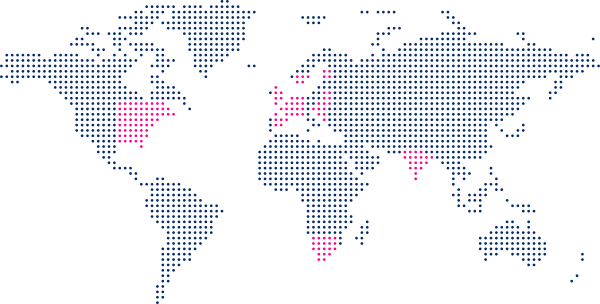
The UK government recently updated the UK Department for International Trade Support Directory.
Friisberg has been recognised as a company that has the skills and experience to help overseas businesses establish themselves, or expand, in the UK.
At a time of both political and economic uncertainty, companies need trusted, professional advice on how to promote and grow their businesses. We already work with investors across the globe and the DIT has now made it even easier to access our multi-sector expertise.
We are delighted to have been included and recognised as a specialist Management Consultancy firm for FDI. This demonstrates that Friisberg enjoys a reputation as a game changing and an authoritative firm providing leadership and recruitment advice to UK and international companies, ranging from start-ups to global corporates.
We always work closely with our clients, offering bespoke recruitment strategies, training insights and estimated salary projections that could be essential to the success of your business.
Sooner or later most of us face a resignation.
Resigning is never easy, especially when you’ve worked at a company and become a part of a team, but I always recommend that you leave your employer on a positive note. If you have given your best to the job, you will be missed, especially by those most inconvenienced by your leaving.
Go straight to your boss. Your immediate supervisor should be the first person you tell about your decision to leave the company.
Give the news in person. Tell your boss that you have accepted a new position and let them know your effective last day at work.
Try to give as much notice as possible
Put your resignation in a hard copy letter that includes your last day and any transitional agreement. Keep a copy.
You also need to be prepared to leave right away- some companies require it, so if you have any personal information on your work devices, be sure to clear it off before you give notice.
Resist accepting a counteroffer. The factors that caused you to seek an opportunity outside your current employer are likely to remain in force. Aside from that, your current employer will probably lose trust in your loyalty.
Karen DelPrete
Partner, New York
Every four years, our senior partners elect one of their peers to serve as our global Chair. The role plays an important part in shaping the strategic direction of Friisberg & Partners International. Zoltan Petho has been elected as our next Chair from July 1 2021. He will follow in some impressive footsteps since our 1977 foundation. In his previous role as Friisberg’s Chief International Business Development and Quality Officer he has worked closely with colleagues in all of our 40+ offices around the world, focusing on expanding our capabilities while ensuring we continued to answer our clients’ most urgent needs amid times of rapid upheaval.
People describe you as outgoing, proactive, and a genuine people-person. Is that how you would describe yourself?
Well, I think it is better that I leave it for others to describe me as they see me! One of our biggest assets is most definitely our people and I like communicating with people. It is essential that our ideas and strategy are not just words, but brought to life and evidential in our daily work. Here I feel my personality means I make sure things happen.
You’re about to step into a hugely demanding role. What three things are you looking forward to the most?
There is no doubt that expectations are high following our former Chair, Peter Strandberg who led our firm for 8 years. The support I have received from Partners has been outstanding and the opportunity to help direct Friisberg’s future, energizes me very much.
You have mentioned that you are supported by an elected board of directors, known as the Executive, consisting of four senior partners. How do you feel you will work together to set the strategic direction and policies of the firm?
Yes, it is great to have the support of our senior Partners in the Executive Committee. I have known them for a long a time and have worked with them quite often over a number of years. I really count on them for their input, and their opinions – and more importantly I really enjoy working with them. It is worth noting that the elected Board are all women and we pride ourselves on our gender parity throughout Friisberg.
Diversity within Friisberg is part of our daily life. More than 50% of our Partners are women and in the Executive Committee I am the only male. So, when we talk about diversity with our Clients, it is something we can show we understand. Diversity is always a top propriety for our clients - especially in those countries, Germany or in Scandinavia, where there is legislation in place to ensure Boards must operate in terms of diversity.
How do you think our profession needs to evolve?
Well, although we have found ourselves in a challenging situation during the pandemic. I am proud that four of our offices have experienced significant growth during 2020. This highlights the strength of our Partners and how we support our clients, not only as a search firm, but as trusted advisors.
I am very positive about our future as we are an agile firm and are able to adapt to a changing environment and new requirements from our Clients. This approach enables us to quickly implement new technologies, to achieve success in newly born sectors (greenergy, e-mobility, etc) and on the other side also support our traditional family-owned businesses.
What do you enjoy doing outside of work?
Being a Partner and Chair of Friisberg requires lots of energy, enthusiasm and passion as well as my times. I try to spend as much time as possible with my family, I like gardening, sport and I am also an enthusiastic Formula 1 fan.
Schneider Electric is leading the Digital Transformation of Energy Management and Automation in Homes, Buildings, Data Centres, Infrastructure, and Industries. With global presence in over 100 countries, Schneider is the undisputable leader in Power Management – Medium Voltage, Low Voltage and Secure Power, and in Automation Systems.
How did you adapt to Covid pandemic and what challenges did you face during this year?
A year ago, when the pandemic started, we were lucky that we needed only one meeting to decide that we would work from home. However, over the past 12 months, we faced challenges we never thought we would. By far the strangest feeling for an HR professional is being away from colleagues at work, but since we all agreed that the work from home solution was the best, we all started to get used to seeing each other via our online meeting platforms.
The toughest challenges we have had to face so far are probably recruiting and onboarding due to the limitations we now have in demonstrating the Schneider Electric Romania organizational culture to the new recruits. We have a vibrant organization of dedicated professionals, and meeting with them and understanding the feeling of camaraderie we all share is especially important for any new employee. Of course we tried to replicate most of that online and we made sure new employees have access to as many relevant colleagues as possible.
We are now allowing some of the people to return to the office under strict conditions, and we can see they missed each other. On a positive note, online communication has been more intense than ever. Many managers now have a chance to reach out to their entire teams even more frequently than in the past. It is easy to set up a quick online meeting, involving many employees - and this is much easier than in real life! So managers have taken the opportunity to talk to their people directly about how the pandemic has affected both their professional and private life.
What are the projects you implemented during this time?
Schneider launched a big global project last year in April, 'Open Talent Market'. There were many discussions at HR level at the time about whether we should launch it, being in the middle of a pandemic and worrying people would not have time necessary to dedicate to this type of program. However, there were many employees who said they wanted to join the platform as soon as it was launched.
Open Talent Market is a platform that allows all employees to enter and connect with mentors from across the Schneider world, if they want to develop their skills. They can connect or apply to local or global projects, but also apply for full-time roles. At South East Europe level, the area for which I am responsible, Romania is leading with an adoption of 78% in less than a year, according to last reports.
'Career Week' is another project that was recently launched in June. In this learning week we offered content, both locally and globally, on five main directions: technical career, functional career, cross-country career, a career that involves interaction with clients and a career in
At the moment it certainly seems to be!
In 25 years our UK Partners have not seen it like this at senior levels.
After a year of ‘hanging on in there’ in roles they didn’t like, or in industries that have suffered a hit, many executives are more than ready to move.
With remote work as a viable option, employers are now casting a global net for remote workers, and clearly this has expanded the catchment area for companies looking to tempt in the best talent. And we are noticing that candidates are accepting offers promptly – especially where location is not an issue. Today alone, several candidates have accepted offers without hesitation.
Maybe this has always been the norm for junior or mid-level positions, but for executives the fence is lower and the grass greener than they have seen for a generation.
Candidates for senior roles are:
I’ve noticed many of my clients having to substantially quicken their process to secure their chosen candidate before they get snapped up elsewhere.
The biggest problem is that CEOs and HRDs have many competing priorities right now and many don’t have the bandwidth to decide and then act at the speed the market demands.
Executive Search has never been so necessary. Assignments must be expedited to minimise candidates lost to other roles, yet still conducted thoroughly and professionally.
Not only is the grass greener, but the fences between sectors are falling.
Talent is on the move, at pace.
Lorri Lowe
Partner UK
We aim to get to know you by understanding your leadership style together the philosophy and culture of your business. This is an integral part of attracting, developing and retaining great talent for your organisation.
The pandemic has encouraged a new set of leadership behaviours and empathy has emerged as a critical skill.
Whether it has been to manage a remote team during the pandemic, or ensuring employees are safe when going onto a site, business leaders have had to focus on their team’s health and well-being while sustaining a culture that brings out the best in them.
A recent global study by HBR (Harvard Business Review) highlighted that 89% of professionals felt their work-life balance was getting worse. It is therefore essential to listen to the individuals in your team and imagine what it would be like to be in their shoes. As Executive Search and Management Consultants we appreciate the importance of this, every day, from both a candidate and client perspective.
Clearly the economic impact of Covid-19 differs from a larger, established business compared with a SME or a start-up. We have also noted industry specific trends and those less impacted have continued to hire at pace. Conversely, other businesses have had to instigate cost-saving programs, resulting in resizing or restructuring of teams.
In either of the above situations, we have consistently remained the first point of contact, whether for someone who recently been made redundant and is looking for a new opportunity, or helping an organisation grow at pace with the right talent. Leaders have found themselves in situations where they must let go of their people, but some have lacked the experience or skill to do it with empathy.
Being emphatic extends beyond your team, beyond your business and should include those with whom you interact daily. People buy from people and creating a win-win situation will lead to everyone benefiting.
To ensure a better outcome and improved experience for you as the hiring manager, and your candidates:
Several research papers indicate a re-emergence of a War for Talent during 2021 and there is no doubt it remains a highly competitive hiring landscape. Randstad Risesmart UK polled 85 HRDs, from organisations employing approximately 50,000 people, to establish their views on talent in the wake of Covid-19. Almost two-thirds (65%) reported that organisations will need the best people on board to help them rebuild following the pandemic.
Candidates engage with employers and brands when they are treated as individuals.
We believe that showing empathy enables you to differentiate yourself and your business in this highly competitive talent market.
Yvonne Erlandsson, Senior Consultant
Sweden
Anna Rudzińska and Dorota Serwińska, formerly of Korn/Ferry and Spencer Stuart respectively, started their firm in 2016 and this rebranding is timely both because of the rapid evolution of their firm as an increasingly respected provider of executive search in Poland, and also as the successful Warsaw office of an international firm working on cross-border assignments for global clients.
Whilst RSC was well-known in Poland, Anna and Dorota believe the time is now perfect to adopt a trading name which is recognised everywhere. Having been Partners of Friisberg for 5 years now, they were already entirely comfortable that Friisberg accurately reflects their own values, offers a range of premium client services and has real stature in the professional services and consulting sector. RSC and Friisberg are two strong brands synonymous with providing consulting-led executive search that their clients really value. Anna and Dorota have seen the success of Partners in other countries following a transition to the Friisberg name and the warm welcome that receives in those markets, so are they are keen to build on that yet further.
“Initially, Friisberg’s polycentric model allowed us to retain our defining characteristics as a partner-led search firm and all that meant to us, and our clients” explained Dorota, “while at the same time offering access to a broad range of national and now international expertise. However, we face a time of accelerated change and, more than ever before, we must be able to help our clients transform to meet and exceed the dynamic needs of the new normal. We are changing our name because the world around us is changing and it embodies our deep dedication to client success and relationships, wherever our clients do business. Friisberg has a determination to never stop leading the way in innovation and thought leadership, so recognising that we were already so well aligned philosophically with Friisberg, we are genuinely delighted to now be Friisberg Poland. There is a real sense of kinship throughout the Friisberg partnership, and we know that our like-minded, determined and professional partners can collectively enable the success of our clients.”
Anna continued, “This is a major milestone for us. As the Polish market accelerates this is a unique opportunity for us to better serve Polish clients as they expand elsewhere in the world, and equally for Friisberg to support international companies investing in Poland. In Poland we have noticed a significant and growing amount of cross-border work and positioning ourselves as the Warsaw office of a 40 year established firm with 40 offices around the world aligns perfectly with our abilities and ambitions. We are no less committed to our Polish clients, and they too will see that our reach, networks and expertise are enhanced on their searches.”
Zoltan Petho, Chair of Friisberg & Partners International, welcomed this rebrand, “Despite a global pandemic and economic crisis, Friisberg remains focused on its strategy to expand and innovate to connect clients to talent, internationally. We have made it our purpose to grow with our clients, as individuals and as a team, and Poland further strengthens our already significant presence in Central & Eastern Europe.”
Friisberg is embarking on a renewed expansion plan and hope to see the success of our firm in Poland replicated around the world at a time when other management consultancy firms are standing still, or even withdrawing from key markets. There is no doubt that Friisberg is becoming increasingly attractive to executive search professionals who want to become Partners in a firm that is succeeding for its clients.
In the future, board members with four or more members will have to have at least one woman.
In addition, in certain life situations, such as maternity leave, parental leave, caring for family members, etc., members of the Board of Management can take liability-free time off.
In order for this strong signal for more equality and for a cultural change in Germany to be implemented quickly, the law has to be passed by the Bundestag before the summer break.
I look forward to when companies discover that more diversity is not a chore, but an essential key to growth!
Meltem Ay, Principal
Frankfurt
Several of our clients have embarked on completely new managerial challenges which require them to find new and innovative ways of creating, and maintaining, a dynamic and motivating workplace.
In the world after Corona, the pressure on management is rising.
While we are slowly returning to a world that resembles what we knew before Corona, it has become clear to many that it will never be quite the same in terms of ”going to work".
Many of our clients have recognized that the virtual workplace has come to stay. Covid-19 has driven a development leading to major and radical changes in the way we will function in a workplace of the future.
It is the management that is responsible for the strategy and therefore the consequences of their decisions. Management must show the way while also acknowledging that many employees now prefer working from home and enjoy being able to plan their time independently.
It has also become harder to motivate employees to meet physically in the workplace and feel part of a physical work environment.
Some challenges our clients face:
In all the above situations, I must conclude that management has simply not been in close enough contact with the employees. At this time HR departments and management have had to be proactive to ensure that all employees are satisfied and motivated.
Three inspiring solutions where management has been creative and dared to explore new avenues:
Which management skills are in demand?
Corona has forced us to think of other and increasingly digital ways of working. Experts estimate that by 2023, 2/3 of the world's economy will be digital – this is a development that puts future leadership roles under huge pressure.
We have noticed that our clients have started to demand more of these 5 personal competencies:
These observations alone cannot answer my initial question, but maybe they will prompt you to think outside the box in managing your post-Covid business.
Susanne Becker Mikkelsen
Partner Denmark
Is it better to hire someone who’s a good match for your culture, or someone who can make it better?
Smart organizations are paying lots of attention to their culture, and for a good reason. There is a lot of evidence that organizational culture is a top driver of employee engagement. But due to human nature, hiring managers are often unintentionally biased and work with a definition culture fit - favouring candidates who would fit in well with the current team based on personal attributes. Feelings of “we can have a beer after work” may play important part in the selection process.
But as more companies strive for diversity and inclusion, the term “culture fit” is falling out of favour.
In contrast to the culture fit mindset and seeking to hire more of what is already working well, "culture add” focuses on gaining what the current culture lacks - it looks for people who value an existing culture, but also bring something different that positively contributes to the company.
Assessing for culture fit works well in small businesses but leads to homogeneous culture and at some point, the company needs people who experienced larger and more complicated systems and team members who look at the same problems in a different light - and with different ways of thinking emerge different interests and personalities.
With that of course comes more discomfort - but in the same way that exercise without discomfort does not lead to growth, a team without cognitive discomfort limits its own potential.
Diversity in viewpoints and ability to take different perspectives allows to debate different strategies and come to better outcomes. It is well documented that:
The most effective way to grow is to hire diverse executive talent.
Adding people with same ideas and approaches can create an environment where everyone thinks and acts in the same way.
Diverse teams may at first feel less comfortable, but that is why they perform better.
Andrea Chladkova, Partner
Mary Keane, Partner
Czech Republic
You need to load content from hCaptcha to submit the form. Please note that doing so will share data with third-party providers.
More InformationYou need to load content from reCAPTCHA to submit the form. Please note that doing so will share data with third-party providers.
More InformationYou need to load content from reCAPTCHA to submit the form. Please note that doing so will share data with third-party providers.
More InformationYou need to load content from reCAPTCHA to submit the form. Please note that doing so will share data with third-party providers.
More InformationYou need to load content from Turnstile to submit the form. Please note that doing so will share data with third-party providers.
More Information