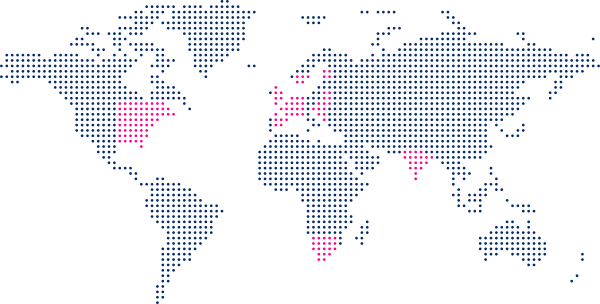
With 350 delegates from 50 countries meeting in Edinburgh, Scotland to consider and discuss developments in foreign direct investment, Friisberg was honoured to contribute.
Lorri Lowe, our UK Managing Partner, was invited to moderate the keynote panel discussion of the conference on Workforce Development & Global Competition for Talent. Her panel comprised experts from Lockheed Martin, IBM, Silicon Valley and and Auticon, a neurodiversity international social enterprise.
Andrew Guy, another UK Partner, was a panellist on the subject of Healthcare Infrastructure and Health Tech.
It was evident that the overriding consideration for investment promotion agencies throughout the world is the location availability and access to talent. Friisberg's representatives fielded numerous questions from the forum which was a cross section of the FDI community responsible for over $1.56trillion of cross border investment worldwide every year.
With over 45 years of as one of the preeminent international search firms, Friisberg is ideally placed to inform and support major investment with clients ranging from Fortune 500s to innovative tech start ups and scale ups.
In addition to mapping the personal, managerial and professional characteristics of candidates throughout the Search process, we can often be asked:
Recent scientific studies suggest that leadership is 30% genetic and 70% learned. These findings propose that leaders are made, not born. The conclusion of such studies is that both hold true: a person can be born with natural leadership abilities, and someone can learn how to be a good leader at work.
Are theory and practice the same? In reality, they are not. So why is it important, how does it work, which roles require which type of leadership and what is the added value in assessing an existing management team?
Driving a RV bus on a F1 circuit is as inefficient as going on a 3 week-long camping road trip with your family in a v16 GT Roadster. Choosing the right vehicle is essential and can determine your result in the race. The analogy applies when choosing between natural or learned leadership.
As I discussed the replacement of the CEO with one of my clients, the owner stated, “You know us, our values, our business. We simply want the best from the market. We want a Natural Born Leader.”.
I know my client well enough to have a clear picture of his autocratic view of leadership and weariness of critical questions about the role.
I’ve seen so many owners and C level managers make disastrous decisions - and all of them because there was not a single person on their team that dared question their strategy.
In my view, we must build the kind of relationship with our clients where we can have the courage to oppugn and articulate our opinion.
We must never be afraid to challenge our clients honestly and openly.
Bence Berkó
Senior Consultant, Budapest
On April 28-30th in Madrid, Partners convened for Friisberg's 116th Global Conference.
This conference had a particular focus on "Energy and Infrastructure" which involved dynamic presentations and discussions that addressed the future of the sector.
Our guest speakers, Rosa Mª Sanz García, Andreas Nauen, Florian Klein and Alberto Martín Rivals led a discussion on how the world of Energy has changed significantly during the last one to two decades including the “5-D” set of trends:
These already appear as the new normal in the objectives of the Executive levels in regional as well as global energy organizations.
It was especially useful to hear from a client in renewables, with operations in dozens of countries around the world, and discuss strategies for securing the specialist leadership talent they need.
We understand that today's shifting business climate commands constant growth and innovation. To face all the challenges, we must encourage our clients to INNOVATE and for this, the most important ingredient is PEOPLE.
Whilst the conference itself gave us the opportunity to extend our knowledge, it is always a great pleasure to meet with colleagues and friends from different countries.
When Jorgen Friisberg established our firm in 1977, he set the standard for a profession that always seeks to discover that rare talent - talent capable of launching businesses to new heights; talent that conditions future leaders for high endurance decision making, and talent to activate organizations to accelerate ahead of the competition.
We would like to thank everyone who attended our conference, and for our Spanish office who organised such a great event.
If you decide to recruit Board members on your own instead of turning to a professional executive firm, it will result in lost opportunities and lower turnover.
Furthermore, it is not enough simply to elect Board members and a Chair, based solely on their professional competences. It is often overlooked, but far more important, can be the personal competencies that the headhunter puts into sharp focus.
An analysis from the Centre for Corporate Governance at Copenhagen Business School indicates that companies can increase revenue by between 25-40% by having a diverse and professional Board. However, about half of the Boards in Denmark are occupied by family members - and that is an issue. The human nature of the owners is governed by the power of habit and the aspect that it is difficult to replace oneself or a family member. That is why we see Boards that are characterized by:
In recent years, we, Friisberg & Partners International Denmark, have experienced a greater interest from companies, who acknowledged that a professional Board can be a competent and strategic tool to increase the growth and development of a firm. The increased interest is supported, among others, by external advisors such as EY, who through their workshops and dialogues assure the owners about the advantages of having non-familial members on the Board.
When an owner has decided to strengthen the Board or when a current Board member quits, we are contacted to ensure the circle of potential candidates becomes wider and more diverse. The owner has often given some consideration to which professional competencies the company should have replaced in the Board of Directors. Typically, these competencies reflect the stand of the current situation of the company and partly the qualities and competencies the outgoing Board member possessed, and which are now to be replaced.
Having the Board’s professional competencies described is one of the prerequisites for any successful Board recruitment. The Board’s competence descriptions contribute positively to an overview of which competencies the Board possesses and which are desired in the future. However, this alone is not enough to achieve the successful recruitment of a new Chair or a new Board member. There are many different perceptions of what it takes for a Board to create value and therefore it is important to clarify what kind of value creation is needed – and in addition to this, to understand the human side of Board work.
We are of the opinion that effective Board work takes place in the interaction between different people. It is simply not just the interaction in the Boardroom that is significant. The dialogue with management, employees, local business partners, authorities, costumers, and suppliers etc. further contributes to the positive dialogue and the value creation. So, one is the professional skills such as financial literacy – another is the personal competencies which are most often overruled in the recruitment for a new Board member.
We work with six key competencies that the Board Chair or member must have to create value. Often, a Chair of the Board is elected from the existing Board, therefore the Chair's competencies are advantageous for all members of the Board.
The prerequisite for a good working relationship requires that one can speak the language and appreciate the concerns of management that every CEO faces. Moreover, having a sharp business judgement, deep understanding of the company’s strategy, how it operates and the human issues.
Many members are very adamant in their opinions, and it requires a special competence to be able to listen, understand and read between the lines when other members argue their positions. In addition, to be able to listen to, understand and support a CEO when the person expresses a reservation towards the Board’s decisions.
We have seen Boards where there are many strong personalities = alpha males/females (it can be both men and women), who are used to being top manager and thereby take their “director” behaviour into the boardroom. It inhibits the good, constructive, and idea-generating dialogue. Therefore, it is an important competence to hold back and to support that everyone around the table has their say.
It is incredibly important to have the ability to establish relationships and to be able to work with the DNA that the specific Board and management have. It should be easy and safe for the CEO to approach the Chair of the Board and have a confidential conversation.
The candidates of the Board of Directors must be in a place in life where they are in balance. That is where they have or have been successful in their careers and where they have no need to become No.1 or feel that they have yet to achieve a top position - that is, not dreaming of taking over the CEO’s office or longing for operational control. It is a high sense of self-worth, a “commitment” for the good of the company, without a trace of a personal agenda, which is something we especially ask about during the recruitment.
It is necessary to uncover how much time the Board member is ready to spend on Board work. It is far from certain that it is “merely” four meetings a year. There can easily be situations where the meeting frequency will be much greater, and you must be ready to spend the necessary time between meetings. Emergency situations can always arise where a Chair of the Board or the entire Board of Directors must step in at short notice. It can be crisis situations, and in such times, it is the personal perseverance and drive to overcome a crisis that is essential. All things considered, it is especially the ability to confront these stressful situations and to avoid the organization becoming paralyzed, if they occur, that is central.
Susanne Becker Mikkelsen,
Partner Denmark
The talent pool in some markets is highly competitive, with candidates receiving multiple offers simultaneously. This is, in part, related to the “Great Resignation”, where approximately 4 million Americans quit their jobs in July 2021 while there were still more than 10 million job openings.
A survey run from Linkedin in 2021 on more than 2,000 adults in the U.S. found that 47% said the coronavirus pandemic changed how they feel about their careers.
While the Great Resignation was mostly driven by mid-career employees, Executives have also been seeking new opportunities at faster than usual rates.
Europe appears to be experiencing a different type of crunch, driven by long-term demographic trends. Each year, the number of executives in the Baby Boomer generation are retiring at greater rates, while the next generation is considerably smaller. In fact, the pandemic has likely sped up this trend, with many Baby Boomers either being forced out of the workforce or leaving voluntarily in order to maximize their quality of life.
There is a shift in generations in the labour force, including the leadership roles.

Voluntary resignation trend in Italy 2017-2021 (Labour Statistics Office)
With new challenges and rapidly changing market conditions, organizations need to redefine leadership roles in their organization. That can range from areas of responsibilities and structure, but it is as much about the soft skills a leader brings to the table as it is about their industry knowledge and expertise.
Former Best Buy CEO, Hubert Joly , interviewed by an MIT Research in January 2021, observes, “All of us have to rewire ourselves for a new way of leading. What’s the purpose of work? I’ve been CEO for 15 years, and the initial part of my time as CEO was much easier because it was purely about the business. But now it’s broader”
The same research reports that the 72% of respondents of more than 4,000 managers and executives interviewed , strongly agreed that it is very important to them to work for an organization with a purpose they believe in, but only 49% strongly agreed that they believed in their organization’s purpose.
They require a new executive’s mind set and leadership style:
| Profit | Purpose & Values |
| Hierarchical Pyramids | Network of Teams |
| Business knowledge | Digital & Business Disruption |
| Directive Leadership | Supportive Leadership |
| Rules & Control | Trust and Self Control |
| Business Hours at office | No boundaries home/work |
Donatella Paschina
Associate Partner, Milan
Once upon a time there was great pride in telling the truth, but a reality of our current political climate is the prevalence of lies and misleading statements from some of our world leaders. We have descended in many of our communications to a level where the truth might, or might not, be included in what is being said about any given topic.
When Sun Tzu wrote The Art of War two thousand years ago, he was overtly opposed to telling the truth. He basically said telling the truth was a bad and dangerous thing to do relative to your enemies. He advocated deceit and skilful deception, and his strategies very intentionally used multiple layers of misinformation with the goal of defeating the enemy.
Creating a culture of deception can be extremely dangerous. I guess some leaders might think that they have the right (even a duty?) to distort the truth if it benefits the organisation because experience teaches us that the truth brings risks, but leaders who habitually lie run the risk of normalizing that behaviour and creating a toxic culture. Credibility is all and lying destroys a team’s trust for their leader - people simply don’t like being lied to.
Lies can be innocuous or they can be critically important. It can be difficult to get a straight answer to the most basic questions - for example, ‘How are you?’ Virtually no one expects to hear anything but, ‘Fine, thanks. And you?’ Withholding information has become normal. As children we are told many tales about the merits of telling the truth, but science says we learn to deceive as toddlers. Adages such as ‘Honesty is the best policy’ continue to influence our adult lives, but we often tell little white lies to make others feel better.
If you lie about the small things, people distrust you with the big things. Even worse, if you lie consistently, people may begin to instinctively distrust everything you say, just as the boy who cried wolf.
Communication, and with it the threads that connect us to each other, simply breaks down.
I maintain that truth is the most powerful trait shared by great leaders.
A leader’s words carry great power. Words can determine whether a business thrives or fails. Truthful words, a close grasp on reality and the willingness to follow through on actions are necessary tools for running and leading a business. All leaders should work towards developing a culture that supports truth-telling.
Great leaders build strong relationships founded on honesty, which in turn builds inspiring organisations.
We may never be perfect, but some of us can be a lot better than we are now.
Thank you very much. Of course, it was a big change both for me and for our two companies in Poland at this time.
I am afraid, I won’t say anything revolutionary: always in such a situation, the first task is to build a team. Experience, knowledge and belief tell me that if you have a good team, you can achieve any goal. The beginning was not easy. Relatively quickly I found people with great potential and knowledge, but also with an appropriate value system. The challenges were in all possible areas, from relations with business partners, through improperly selected products, lack of communication with consumers, to the profitability of both companies.
Together, we defined who we want to be and what we want to achieve. We developed a new business model and then the perfect execution of the plan became the key to success.
Simultaneously, we were working on the changes in the structure and merger of the companies, developing new methods of operation on the consumer and client side. Today, we know a lot about our consumers, that enables us to communicate effectively with them. I gives me great satisfaction and joy that as a team we have created a friendly and stimulating workplace. We have a unique culture which translates into commitment, constant development and searching for new ideas how to develop a business.
In the current situation our action plan is twofold. First, Ukraine - our main task there is to evacuate our employees and ensure their safety. We are also in constant contact with our clients. Some of them are active and we help them whenever possible.
The Baltic countries, on the other hand, have some similarities and differences compared to the Polish market. Modern retail chains operate similarly to the best players in Poland. The preferences and expectations of consumers when it comes to household appliances are slightly different. At this stage, I cannot reveal too much, but we have an idea and we see great opportunities to develop our business in all three countries. We certainly have a lot to offer consumers as well as distributors.
I think that today nobody has any doubts that the future belongs to modern digital solutions, thanks to which we simply live more comfortably. All our new devices can be connected to the hOn app and use functions that make our daily activities easier. Artificial intelligence makes our equipment quickly adapt to the consumer's lifestyle, making it easier to wash, cook and store food. At the same time, we put great emphasis on pro-ecological solutions. For instance, our washing machines are certified with the highest energy class at affordable prices. Candy RapidO offers comfortable and quick washing with very low energy consumption. Exactly what consumers expect today. To this you need to add aesthetics and design as household appliances have become an element of interior design today.
Our goal is to improve the quality of life of consumers. To make daily activities easier or even take them off customers’ hands. That is why we focus not only on modern solutions based on artificial intelligence, but also create an ecosystem together with various partners. As a result, we will provide consumers with a comprehensive solution in a modern way that makes life easier. Even today, using our wine cooler, you can easily check what we have in stock and order your favourite wine through the aforementioned hOn application.
This is a very good question, especially in the context of Haier's values. Since the day the company was established, its culture has been built on three pillars: entrepreneurship, close communication and cooperation with consumers, referred to in our company as Zero-Distance-To-Consumer, and the construction of the aforementioned ecosystem.
At Haier, we act as company owners. This is also the most sought-after feature in potential candidates for our team. I used to work in a company with a "highly corporate culture”, focused on internal goals. We always look at the reality around us through the eyes of the consumer. Therefore, when creating the ecosystem, we do it based on local partners. Thanks to this, we support the local community but also better respond to the needs of consumers.
This is a kind of logic puzzle. People are the most important. A properly built team with a wide range of experiences and skills is able to create and implement ambitious plans. Naturally, under the right conditions. My role is to build this team and create the right conditions. We promised each other two years ago that we would create together a workplace where we will be able to pursue not only corporate goals but also our own goals, especially those related to development. In order for the team to function efficiently, it must have the right conditions. The combination of these two elements gives you a chance for success.
She lists three key insights every business owner should remember when starting a Search:
As the business grows, owners of family businesses face a challenge to transition towards more structured management, rigorous strategic planning and the need to bring in new skills to improve efficiency and profitability.
Oftentimes it means a search for new CEO with strong track record of leading growing enterprises and success in international expansion.
In the majority of cases, recruiters have to consider more factors than usual, including a company history, family dynamics and core values, traditions and expectations of the workforce.
Furthermore, it is critically important to ensure that the owner and candidate share a joint vision regarding the owner's involvement into decision making once the new CEO is in place.
For an external CEO to be successful in a family businesses he/she needs to build strong relationship with the owners. It is impossible without shared values and beliefs- these are as important as professional skills and competencies.
In fact cultural fit is a critical element that makes or breaks long term future collaboration. Therefore the sourcing of candidates should include a particular emphasis on the candidate‘s ability to connect with the company’s values and mission.
How fast does the the owner want to reach the targets? How is the timeline viewed by the new CEO? How long and what errors will be tolerable? When and how will both the owner and CEO know their relationship works? Both sides tend to rush and to forget that expectations should be specified in great detail and efforts should be made to establish a realistic rather than an optimistic timeline. A time buffer should be in place bearing in mind that the owner knows what they want, but knowledge transfer does not happen in a couple of weeks.
To understand the candidates' market is not an easy task for those who never dealt with it. Hiring for family owned business requires deep expertise and abilities to facilitate the dialogue between the owner and potential hire to ensure the match. Furthermore, it requires a well detailed on-boarding process which often gets forgotten. Experienced consultants should be the advisor to both parties in order to ensure an optimal outcome.
As ever, our conference will feature a rich programme of keynotes, presentations, workshops and panel discussions which will provide critical content to help our consultants, and the clients they serve, thrive.
Our Spring conference is being held in Madrid and our Spanish colleagues are looking forward to welcoming us, once again, to their vibrant city.
There will also be time for great networking opportunities as well as the chance to share knowledge and best practice. We all continue our relentless pursuit of constant improvement and advancement through learning from each other and growing together. We know that culture change and purpose are gaining more attention than ever as leaders seek to define their organisations as attractive and meaningful places to work.
Organisations must be prepared to adapt and evolve as the world around us changes. We must learn how the disruptions of the recent past can be reframed for a thriving future for Friisberg and its clients.
However, the impact of social crisis, economic dislocation, and global pandemic also calls on us to reflect on how we work, what we believe, and what matters most. We are a supportive organisation and recognise that many of our colleagues, especially those whose neighbours may now be at war, are facing unknowable challenges.
We all genuinely enjoy spending time with each other and look forward to visiting our beautiful offices in Madrid.
In times of change much is on the shoulders of leaders. They have to decide with speed and accuracy, adapt boldly, deliver reliably and commit to impact while retaining their energy and health.
Rapid external change should be followed by wise and rapid changes inside the corporation.
Leaders are usually fast in processing available information, determining what is necessary and making decisions thereafter. It is easier if 3-5 priorities are defined which become the basis for decisions, be they financial liquidity, customer care, or keeping all engineers on payroll. Smart compromises are also easier to make if priorities are set.
Sometimes it is smart to ask for expertise and seek new inputs. It is also good to decide what not to do and share it with team. New rules of the game should include new modes of action as the old ways sometimes halt progress. Times of big change usually mean stopping and overlooking the big financially bonding plans.
Leaders also tend to keep an eye on all the important functions that may change in quickly- supply chain, transportation and others that may need backup in the near future.
Effective leaders are acutely aware of their team's distractions and their collective and individual frames of mind so they seek ways of engaging and motivating them when communicating new information and goals.
While many factors may not be under their control, they seek to align the team's objectives, develop new performance monitoring indicators and create a culture of accountability.
During a crisis, people will be be overloaded with emotions, and incomplete information will distract resulting in paralysis. It might be good to focus on a few things that matter most and make an scalable framework for quick decision-making.
It is necessary for an effective leader to keep themselves fit both physically and emotionally. Establishing a healthy routine such as mindfulness exercises, short gym sessions, plenty of time outdoors and time with family in the evening are all essential.
Pille Päss
Partner, Estonia
You need to load content from hCaptcha to submit the form. Please note that doing so will share data with third-party providers.
More InformationYou need to load content from reCAPTCHA to submit the form. Please note that doing so will share data with third-party providers.
More InformationYou need to load content from reCAPTCHA to submit the form. Please note that doing so will share data with third-party providers.
More InformationYou need to load content from reCAPTCHA to submit the form. Please note that doing so will share data with third-party providers.
More InformationYou need to load content from Turnstile to submit the form. Please note that doing so will share data with third-party providers.
More Information