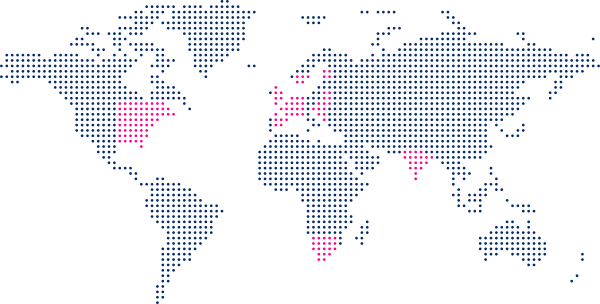
With so many diversity and inclusion activities underway it is easy to assume that progress is being made. Then why are there so few women in executive positions?
The new McKinsey report “Win-win: How empowering women can benefit Central and Eastern Europe” examines the potential benefits of greater gender equality for businesses and society, identifies barriers to progress, and suggests actions that could unlock as much as €146 billion in annual GDP by 2030—an 8 % increase over a business-as-usual scenario.
In the seven CEE countries analysed (Croatia, Czechia, Hungary, Poland, Romania, Slovakia, Ukraine):
To find out why there are so few women in executive positions in CEE, the survey of approximately 3,000 employees in the region uncovered the following insights:
Ambition is not a challenge: Women are as ambitious as men, but they perceive more barriers to promotion. Men and women showed almost the same level of interest in getting promoted (57 % of women versus 56 % of men). However, 28 % of women said that their gender made it harder for them to secure a raise or a promotion.
Women blame themselves; men blame others: Women who thought they were unlikely to make it to the top said that it was because they lacked the necessary skills (43 %) or the right leadership style (38 %), or that promotions to top executive positions were not based on merit (33 %). A far smaller proportion of men said that they lacked the necessary skills for the job (8 % less than for women), and a much larger share said that it was because promotions were not based on merit (10 % more than for women). In other words, women are more likely to blame their own shortcomings for their failure to become executives, while men are more likely to blame the shortcomings of their company.
Unpaid work is a major barrier: Nearly 40% women provide daily unpaid care work (looking after children, the elderly, or people with disabilities). This is twice as many as men. Essentially, female employees are still working a “double shift”.
The COVID-19 crisis has created additional burdens on women: The increased burden has fallen disproportionately on women. 54% of women with children under the age of ten said the pandemic has made them more likely to consider scaling back on their paid work, compared to only 25 % of men.
Correcting this imbalance would tremendously benefit not only women in their careers and personal lives, it could have a potentially transformative effect on the economies of CEE.
Despite abundant evidence that gender equality in leadership is good for business, for an overwhelming majority of organizations advancing women into leadership roles is not a formal business priority.
One of the major and most complex challenges is to shift the underlying cultural factors. The McKinsey research highlights the need of the leaders of companies and public institutions to be visibly engaged in efforts to reduce the gender imbalance, rather than delegating this work to Diversity Officers.
But including men (holding 98% of CEO positions in CEE) in diversity efforts is not as simple as inviting them to a gender-equity event. Worldwide data from BCG shows that 96 % of companies with men actively involved in gender diversity initiatives report progress at all levels, compared to only 30 % of companies without men engaged. It seems intuitive that involving men would lead to greater results. Yet part of the challenge of getting men to join the efforts, according to BCG data, is that they tend to overestimate how well their company is doing in terms of gender issues.
To remove the barriers that hold women back at work, we have to acknowledge that the barriers exist. We need to realise that gender equality is not a “women issue”, it is a “leadership issue”.
The last thing that women need is men “rescuing” them or assuming the role of the workplace knight in shining armor.
Because men are in so many leadership roles, they have an enormous opportunity to accelerate progress. Men's voices are critical because of, not in spite of, their gender. When men speak up against gender disparities, they not only become visible as allies, they also raise awareness and acceptance about gender inequity as a shared problem, not a special interest.
Sources:
Before writing this article, I had one of those “Blah” days when I felt low and could not put my finger on why. For those who do not know what this is, there is another word for it - languishing. Languishing is a sense of stagnation and emptiness, and if you would like to learn more, I can highly recommend you read Adam Gratton’s article, as posted in the New York Times.
My “Blah” day however, was lifted by a quote that I found by Sonya Renee Taylor:
"We will not go back to normal. Normal never was. Our pre-corona existence was not normal other than we normalized greed inequity, exhaustion, depletion, extraction, disconnection, confusion, rage, hoarding hate and lack. We should not long to return, my friend. We are being given the opportunity to stitch a new garment. One that fits all humanity and nature "
I am far from an expert in diversity, equality, and inclusion. Still, I have researched the topic during my years working within the talent and leadership profession. As a result, I am passionate about how we harness differences in our workplaces and create a fair playing field for everyone.
I live in Sweden, ranked 1st in the EU on the Gender Equality Index, yet we are still lagging in gender balance regarding our leadership positions. Research from SCB (2020) shows that 41% of Sweden’s total leaders’ population are women and 59% are men - however, only 17% of Sweden’s CEOs are women.
A recent Di Digital survey reveals the investment distribution to privately-owned technology companies in Sweden. 1% of investments was granted to companies founded by women in 2020. In addition, the share of investment value given to mixed founding teams increased to 11%.
The relationship between diversity and business performance persists and continues to grow, so progress is being made.
Fredrik Hånell, an entrepreneur and investor who currently works as a “business creation director” at EIT Urban Mobility, stated in the Di article, “If entrepreneurs cannot build a gender-equal team, they lack one the most important components for building a successful company. Soon I hope that all start-ups we work with have a female co-founder.”
Gender is only one aspect of equality. As Pride month has come to its end, I reflected on how we, as executive talent consultants and business advisors, can actively support our clients with their diversity, equality, and inclusion agendas.
As a business, you must have an inclusive culture. Research shows that diversity is not just a metric for which to to strive, it is an integral part of a successful revenue-generating business. This does not mean simply having colourful posters throughout your offices stating your values, instead, it is a business strategy and mindset, a commitment and responsibility of all leaders and embraced across the whole organization.
At Friisberg, we:
DE&I matters, and we bring the thought of diversity into our board services assignment or when conducting management audits.
"We are committed to serving our clients by finding diverse leaders and providing an unbiased thought process throughout our consulting process. We have improved our knowledge, by running internal programs such as Reverse Mentoring and Unconscious Bias training." Michael Rooslien, Partner, Sweden.
Social and technological changes will continue to transform the landscape in every industry.
Organizations who don’t embrace DE&I will potentially risk earning potentials and falling behind their competitors.
I believe, the companies who create a workplace for everyone will cultivate tremendous value from their people’s differences and thrive.
Yvonne Erlandsson
Snr Talent Consultant, Sweden
Progressive organisations and their leaders are now realizing that the hackneyed excuse of “there just is no qualified diverse talent” is an outdated phrase from before the pandemic.
The question of who will be returning to the physical office and who will remain virtual is a burning issue. In 2020/2021 many organizations operated in a virtual, or hybrid, workplace and there is no doubt that this has influenced how they view their current talent, how they deploy that talent and from where they now look to acquire talent.
We recognise that leaders are becoming more open to looking at how the work gets done irrespective of a specific physical location.
Women and people of colour who might have felt like outsiders in a white male-dominated in-person workforce might find working in a hybrid or purely virtual workplace an attractive way to gain career experience. Talented people who are differently-abled can now become entrants into a job market that was once physically closed to them when all work was done in-person. These are exciting options for everyone.
Long commutes to an office may have dissuaded people from working for a particular company. By casting a wider net for talent to fit new hybrid workplaces means roles can be much more attractive if newly hired talent only had to go into the office two days a week — or even one week a month.
The world has changed.
The workplace has changed.
We have all changed.
Friisberg works with organisations all over the world to help them keep pace with rapid progress and ensure they secure the very best talent.
Lorri Lowe,
Partner UK
Here’s a few insights from Delyan Grozdev, Veronika Mohacsi, Raik-Eric Theil and Sina Nowack about the invaluable role they and all our researchers play.
What does a day in the life of a Researcher look like?
It is varied! Being a researcher is undoubtedly a wide-ranging role involving lots of communication (with the team and our candidates), timely emails, telephone interviews and compilation of project briefs leading to systematic search, collection of business news and knowledge sharing (in person and with web platforms), thorough industry research and of course database maintenance.
What is your typical approach to finding candidates for a specific role?
At the outset we discuss with the consultant the best approach in terms of any possible sources or candidates on which to focus. If the role is one we do regularly in a given industry, then we get rolling pretty fast. In other cases though, the first thing to do may be to talk to a source well-positioned in the given field to get a better understanding. Vera says, “Naturally, we examine our earlier projects for similar roles, draw on our database and do Boolean search. I am old school in that I strongly believe in great candidates recommending great candidates.”
Raik-Eric agrees, “I work with Boolean strings in Linkedin and Xing and systematic cover letters. I talk to key people from the sector and ask them and contacts for recommendations.”
With an ever-increasing online presence, Executive Search is changing. How do you see your role developing in the future?
Delyan believes that the future is already here with automated tools like LinkedIn and Google Alerts being a good way to stay up to date with people and companies. “Technical skills for working with CRM/database tools and web search tricks are essential, but it is still a knowledge-based job so it remains crucial that we are deeply interested in how businesses and people work, to be able to target our searches well, using all the technology at hand. Data management is an increasingly time consuming issue both in terms of volume and knowing what’s what - don't talk to me about GDPR!”
The modern researcher, agrees Raik-Eric, must understand how to collect the right data, process it and translate it into appropriate action in order to continuously improve. “In the digital world, work is becoming more data-driven and scalable. We must therefore be able to move confidently in the relevant systems and on the relevant platforms.”
Sina reiterates however that is vital researchers do not lose professionalism in the way candidates are contacted, “It is becoming more and more important to address candidates in the right way and to network in a discreet way.”
What do you enjoy most about your role?
All agree that it is a privilege to interact with many differing personalities from a range of industries on a variety of issues. Acquiring knowledge is a vital part of the role – from business through to science - as well as understanding how businesses work and how the economy evolves.
In terms of international collaboration, Sina added, “Networking across national borders is very important for our clients and thus for me as a Researcher.”
How has the changes and new demands on industry affected the search process?
With so much information readily available and the pace of change in the world today, clients expect results faster. To stay competitive we need to balance speed with quality search methodology. In general, the demands on services are constantly increasing. In the course of customer centricity, our clients and candidates also expect our process to be targeted, transparent and fast.
Whenever the new normal arrives, and it will come in 2021, there will be a rush for talent. What action are you seeing companies taking at the moment?
Vera sums it up, “ In my experience, companies have recruitment needs now same as ever, I don’t see them holding back on a rush for talent later. Most of our clients are simply rethinking the way they work in the new normal.” Reflecting on the anomalous 2020, she added, “We’ve been conducting projects with virtual interviews and while it doesn’t offer the same experience as live interviews, it seems to be working pretty well. Considering how much time and energy can be saved (both from our side and candidates’ as well), virtual interviews may be with us for good. Our roles could involve zero face to face interaction with candidates - but I hope not!”
Veronika Mohacsi, Hungary
Raik-Eric Theil, Germany
Delyan Grozdev, Bulgaria
Sina Nowack, Germany
You have been responsible for international business development for years. What do you enjoy most about this role?
Diversity. Diversity, in terms of colleagues, cultures, projects and the international scene where we service our Clients. It delivers new challenges on a daily basis that I need to solve rather fast. Besides my work as a consultant on the Hungarian market, my international business development role makes it more complex providing me with a lot of new information, insights of international trends and involvement with how our Partners handle projects in various countries. It is just fun!
The concept of thinking globally is now more widespread. Why do you think Friisberg is so successful working globally and on cross border assignments?
Quite simply, Friisberg can be very responsive to the markets. Our flexible methodologies mean some of our offices actually exhibited massive growth during 2020, which is simply admirable. Even before the pandemic we positioned Friisberg not only as a trusted search firm, but also a management consultancy firm, delivering solutions for business leaders in management audit, board services, network science-based organisational development and business partner search.
What qualities do you think are required to facilitate effective international business development?
You must love it and you must be dedicated to it. Having inspiring people around you whether that is your colleagues, clients or candidates, helps and we must all listen to each other carefully. Openness is very important in such a role.
How do you use technology? Do you use business intelligence tools or systems and what steps you do take to analyse trends and identify new opportunities?
Throughout Friisberg we use various cloud based platforms for our business administration, but most importantly our Friisberg Network Advisory (FNA), which is a network science-based organisational development tool supported by AI, reveals the social network of the company and provides the opportunity to visualize and thus analyse and manage the relationship of business units and individuals. This is much loved by our clients too!
Where do you see Friisberg in 5 years’ time?
Friisberg is a growing organisation so my role is increasingly interesting. We are opening new offices in new cities and new countries and we plan to expand even more in the coming years. The future is very bright for Friisberg!
Zoltan Petho
Partner, Hungary
With such economic volatility and uncertainty currently, oversight by boards is more important now than ever.
A balanced view is critical to the success of a company, and maybe even its survival. However, boards may whether wilfully or unwittingly converge on collegial consensus and by doing so fail to address crucial issues. Independence from each other and thereby better collective decision-making are interconnected prizes that are hard fought but well worth winning.
In 2015, Siobhan Sweeney’s “The creation of the Contrarian Director and their role in achieving workable board independence and better risk oversight” caused something of a stir. The premise of that paper is as pertinent now as it was then, and in the aftermath of Coivd-19 perhaps even more so. Having a ‘Contrarian Director’ - a devil’s advocate - on a board to question the herd instinct, to investigate alternatives and recommend innovative approaches whilst acting independently and impartially will deliver more robust examinations of facts, options and proposals.
The longstanding and arguably inevitable consequence of capitalism is that the untried, untested, unknowns are avoided in favour of their more familiar counterparts. The composition of a board of directors will often follow the same trajectory, with reinforcement of success in the form of making another appointment not too dissimilar to the last. The case for independent thinking, and diversity of background (gender, ethnicity, education, experience) has not been made in sufficient boardrooms - all too many boards continue to miss opportunities in the appointment process leading to a reinforcement of an established culture.
Groupthink and confirmation bias in a board room are dangerous and difficult to root out. They can easily override the most rigorous of decision-making processes and detract from even the most respected expert opinion. Self-awareness is the key to reversing such a slide.
Chairs, and other NEDs should recognise when:
Consciously or subconsciously Chairs may prefer directors who will help them build a consensus. The concept of the contrarian runs counter to that – and deliberately so – so it will take a strong Chair (and CEO too) to actively seek out and secure someone to the board who can and will challenge them, routinely, but professionally of course.
Once the benefits of more varied thinking in the boardroom become apparent, then the same principles extended to senior management and throughout a company might yield yet more advantages for that company.
But… do please feel free to disagree with me!
Andrew Guy
Partner, UK
We asked two of our female Partners, both very successful management consultants...
Susanne’s answer
I have two pieces of advice for the young women starting their careers.
Firstly, make a career plan. Having been a headhunter and mentor for over 20 years, my experience has showed that having written down your expectations and dreams for your work life is of great benefit. A study from Harvard University also confirms this observation. The study was conducted in their MBA class where 3% had a written career plan, 13% had a mental career plan and 84% had no career plan. 10 years after finishing their MBA the 13% had performed twice as well as the 84% and the 3% were making 10 times as much the remaining 97% annually.
Secondly, ensure that you have a good balance between work, studies and your private life. I see many young women who have focused solely on their studies for many years, and then find it very hard to find a job afterwards. Having solely focused on their studies and good grades for so long has unfortunately made them narrowminded, and workplaces today are looking more and more for educated and interesting people with a certain degree of charisma. If you have spent all your time behind your desk, it does not give you that charisma. Prioritizing your hobbies, drinking wine with your friends and travelling, while also studying, makes you a more interesting person for your future workplace – and it also gives you a great start to creating your own network.
Lorri’s answer
Being a woman today means there is a much wider range of career options. We have young women fighting in our army, in construction - we are politicians and CEOs of global companies – there is no limit. Yet many women are still reluctant to use their voice. Remember: you are hired for a job because of your skills and talents so don’t let these get minimized by not speaking up. Your ideas, contributions and achievements are yours to realize AND to highlight, no matter how uncomfortable it may be. Don’t force conversations or to become arrogant, but take those natural opportunities to talk about the work you’re doing and what you’ve achieved.
I think one of the best pieces of career advice for women is to develop a strong personal brand which together with a strong reputation can put you on the radar for exciting career opportunities.
Finally, if you're asked to do something that excites you, but that you aren't sure you're completely ready for, always say yes – you'll figure out the "how" later. The more confident and competent you appear, the more you'll be able to build confidence in your abilities in others.
Always have the confidence to try new things, or even take a lateral move to get a new perspective. Believe in yourself.
Norway currently tops the European statistics for gender-balanced corporate governance, with France and the UK in second and third places. (Source: Gender Diversity Index, europeanwomenonboards.eu).
Many factors explain why Norway has made great strides with equal opportunities, and gender quotas for company boards is one. Despite the progress, however, the Norwegian labour market remains very divided along gender lines. Four out of every five CEOs is a man – and nine out of 10 nurses are women.
Gender quotas on public-sector boards were introduced to Norway in 2004, and extended to private companies planning for a stock market listing (public limited companies) two years later. The requirement was that women should hold a minimum of 40 per cent of board seats, with companies which failed to meet this proportion threatened with being wound up.
Owner perspective
Norway has many small family-owned businesses. A majority of these belong to men. As a major owner, the Norwegian state also makes a clear mark on the domestic scene. Directors are almost always non-executive and largely independent of the company’s management.
Trust between owners and directors is important. Historically, owners have chosen directors from within their own network, since it is easier to trust people you already know. These networks are homogenous. Boards drawn from them generally work effectively, but risk missing out on important perspectives.
The 40% women requirement has increased the awareness of the expertise desired and the contributions directors make. This is considered a very positive consequence of the quota regulations.
Megatrends
The need for renewable energy, for example, has shifted huge investments from coal and oil to solar and wind power. Digitalisation has created radical changes in companies' development and the competitive position and will continue to affect all sectors.
Major changes call for non-traditional thinking, and curiosity about how other sectors overcome their challenges is particularly important along with a sense of urgency and solid understanding of financial risk. Having directors of both genders as well as different ages and backgrounds – nationally and internationally and from various sectors – will be necessary in order to widen perspectives and make the right strategic choices.
Female boardroom candidates
Holding a directorship is not a right, but an opportunity to contribute required expertise. During the first few years with gender quotas, we saw some poor solutions – female directors with a combination of high self-confidence and low relevant expertise, and enterprises which invited women on in order to fill their “quota” without wanting them to make an active contribution. Such things are rarely seen today.
Generally speaking, bottom-line responsibility and thereby executive experience are necessary to contribute effectively on a board. Norway has far more men than women in leadership roles, which means that the pool of female candidates with relevant experience remains smaller than for men.
But big variations exist between sectors. So, when putting together capable boards which also meet the need for gender balance, an overall view must be taken of expertise and efforts are needed to identify where scope exists for a good selection base.
“Younger” sectors, such as technology, media and telecom, have a more balanced gender distribution and thereby more women with solid management experience who amply provide the expertise required of a director. This contrasts with traditional industry, for example, where the pool of women with similar management expertise remains smaller.
Win-Win
Good boardroom contributions emerge from relevant expertise, strategic insight, understanding of roles, commitment and a personality able to exert influence and collaborate.
Some people argue that being “quota'd in” is unequivocally negative, and that quotas weaken the authority of women on the boards. We believe gender quotas ensure that highly competent women are invited to serve and give able females opportunities to contribute. If the starting point has been that male owners chose directors from networks of friends and acquaintances, the quota system has been both a necessary and an effective tool for ensuring diversity. We argue that it also ensures the best possible value creation.
In our experience, the quota rules have contributed to owners adopting a more analytic approach in assessing the board’s overall expertise and contribution. The requirement for 40 per cent women has thereby definitively made owners aware of able female directors. Our hypothesis is that the boards also end up with more capable male members.
Hild Kinder
Benedikte Stiff
Partners, Norway
Today, the fifth and final report from the Hampton-Alexander Review was published.
The Hampton-Alexander Review was an independent, voluntary and business-led initiative supported by UK Government to increase the representation of women in senior leadership positions and on boards of FTSE 350 Companies, from 2016-2020.
The scope of the Review covered over 23,000 leadership roles in Britain’s largest listed companies, covering the board and two leadership layers below the board, making the UK’s voluntary approach to improving women’s representation at the top table, arguably the biggest and most ambitious of any country.
FTSE 100, 250 and 350 all reached target of women making up 33% of boards by the end of 2020. Culture change at the top is paving the way for greater gender parity across business with women’s representation in wider senior leadership also rising. Hampton-Alexander Review CEO, Denise Wilson said:
“The lack of women in the boardroom is where it all started a decade ago, and it’s the area where we have seen the greatest progress. But now, we need to achieve the same - if not more - gains for women in leadership.”
The final report states that there is no doubt that the executive search community has a critical part to play in the selection process and working together with clients, has been a major driver of progress.
Friisberg has a long established success in helping appoint women candidates to a wide range of business and public boards. This is important given the significant reach of many of these boards generates a critical ripple effect across boards in a wide range of sectors and positions of influence.
We work with our clients to ensure talent is evaluated on a level playing field.
We ensure that briefs are drawn as widely as possible, which prevents candidates with the appropriate skills and attributes being unintentionally ‘written out’ at an early stage.
We offer support and guidance to staff, and clients alike, on how to evaluate different work and life experiences with the more traditional career paths, and on the power of bias in the process, and final appointment stage.
As we look to build back better from the pandemic, it’s important businesses keep challenging themselves to use all the talents of our workforce and open up the top ranks for more, highly-accomplished women.
Many résumés for women in top positions read like a handbook to business success. They didn't need a quota, the career steps followed one another seemingly logically, opportunities always presented themselves and women took advantage of them. But there are few - at least in Germany.
The legislature now wants to change that.
The plans for a binding quota of women on executive boards affect almost a third of the 100 largest listed companies in Germany because 29 of them have more than three board members, but no position for a woman, according to an analysis by the Boston Consulting Group.
As a diversity officer, I speak to highly qualified women in management positions every week. Many of them have come along a rocky road, yet not all are in favour of a quota; and have differing opinions on the advancement of women.
But when it comes to the question of what women need above all to make it to the top, they all agree:
Courage to seize opportunities and also to fill uncomfortable roles - even if you do not yet have all the skills.
What do you think?
Do women lack courage?
I look forward to a lively exchange with you!
Meltem Ay
Principal, Germany
You need to load content from hCaptcha to submit the form. Please note that doing so will share data with third-party providers.
More InformationYou need to load content from reCAPTCHA to submit the form. Please note that doing so will share data with third-party providers.
More InformationYou need to load content from reCAPTCHA to submit the form. Please note that doing so will share data with third-party providers.
More InformationYou need to load content from reCAPTCHA to submit the form. Please note that doing so will share data with third-party providers.
More InformationYou need to load content from Turnstile to submit the form. Please note that doing so will share data with third-party providers.
More Information