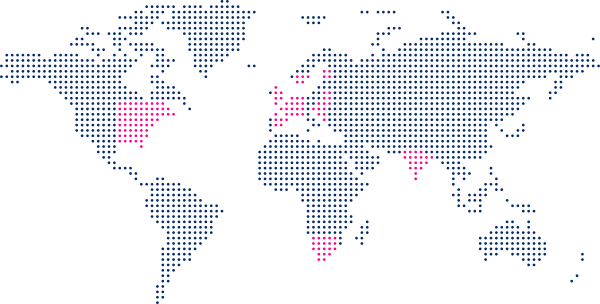
The holiday season is a time when cultures shine brightest, revealing the rituals, flavours, and customs that bring people together. At Friisberg, we are proud to have 32 offices across 22 countries. Each deeply rooted in local traditions and rich cultural heritage. This global presence gives us more than just geographic reach; it gives us local insight that brings meaningful value to our clients.
This year, we’re excited to launch the Friisberg Holiday Series, where we ask our colleagues around the world to share the traditions that make the season special in their countries. From festive foods and family rituals to symbols of hope, generosity, and togetherness, these stories offer a window into the diverse ways people celebrate this magical time of year. Hanna Kuntsi from our Finnish team even describes Santa as "The CEO of all our dreams!".
Just as Poland’s Christmas Eve traditions highlight hospitality, unity, and inclusion - setting an extra place for a stranger, sharing the opłatek wafer, and gathering around a table prepared with care - each of our offices brings unique customs that reflect the values at the heart of Friisberg: connection, empathy, and community.
Join us as we travel from country to country, discovering how our global teams celebrate the season and how these traditions inspire the way we work, lead, and collaborate.
We are starting the series with Nevena Nikolova Friisberg Partner and Group CFO who is based in Sofia, Bulgaria.
Across Bulgaria, winter has long been a season shaped not only by cold and darkness but also by traditions that bring warmth, protection and connection. Some of these customs remain central to holiday celebrations, while others are kept alive mainly in smaller communities or remembered fondly as part of Bulgaria’s cultural heritage. Together, they reveal a deep understanding of how people stay energised during the darkest months: through meaning, togetherness and shared light.
Budni Vecher, the Christmas Eve ritual supper, is one of the season’s most symbolic gatherings. Families prepare a vegetarian meal with an odd number of dishes, each carrying its own meaning. Walnuts are placed on the table for fortune-telling, incense is burned to cleanse the home and the ceremonial badnik log is kept alight through the night to bring warmth and blessings. It is a quiet, reflective moment rooted in hope.
The Koledari, Bulgaria’s Christmas carollers, once travelled from house to house before sunrise on Christmas Day. Groups of young men sang ritual songs that promised health, prosperity and protection from misfortune. Although less common today, the tradition remains one of Bulgaria’s most powerful winter customs and symbolises the triumph of light and community over darkness.
Survakane, the joyful New Year’s blessing, remains widely practised. On New Year’s morning, children gently tap adults on the back with decorated cornel-branch sticks, called survachki, while reciting blessings for abundance and good health. Homes are filled with laughter and optimism, and the exchange becomes a cheerful transfer of positive energy from one generation to the next.
Baba Marta, the celebration of 1 March, marks the symbolic end of winter’s heavy months. Although not a mid-winter tradition, the giving of red-and-white martenitsi (small piece of adornment made of red and white yarn) is closely tied to the psychological shift out of darkness. These simple threads carry enormous emotional significance, acting as wearable reminders that brighter days are returning.
Kukeri rituals, elaborately costumed Bulgarian men, who perform traditional rituals intended to scare away evil spirits., held from mid-winter into early spring, bring colour, movement and noise to villages across the country. Elaborate masks, heavy bells and energetic dancing are used to scare away evil spirits and awaken new life. While often celebrated in festival form in cities, the villages that preserve the tradition experience it as an intense, communal release of energy.

Light and fire play a central role in restoring hope during the darkest weeks of the year. Whether from the burning badnik log or the flaming torches of the Kukeri dancers, fire symbolises purification, safety and the shared ability of a community to “bring back the light”.
Communal movement and visiting also reinforce the feeling of belonging. The songs of the Koledari and the lively steps of Kukeri dancers rely on participation and presence. These customs spread positive energy through physical closeness and collective action.
Food plays an important symbolic role too. The dishes prepared for Christmas Eve, such as grains, beans, nuts, honey and the traditional pita with a hidden coin, represent nourishment, continuity, health and luck. These foods offer reassurance at a time of year traditionally marked by scarcity.
The dramatic masks, loud bells and vigorous movements of the Kukeri are designed to drive away negativity and awaken life forces. The result is a powerful emotional release that lifts communities during the heaviest part of winter.
Finally, martenitsi provide a simple but powerful reminder of resilience and renewal. The red-and-white threads symbolise the return of warmth and the gradual reawakening of nature, offering hope even before spring fully arrives.
Bulgarian winter customs show that resilience grows through meaning rather than endurance alone. Leaders can draw on this insight by creating shared rituals, such as regular reflections or symbolic moments of recognition, to support their teams through demanding periods.
Community is another essential source of strength. Just as the Koledari and Kukeri thrive through participation, teams flourish when there is a sense of belonging. Encouraging shared experiences helps people feel supported and energised.
Small symbolic gestures can also have significant emotional impact. The hidden coin in the Christmas bread or the exchange of martenitsi demonstrates how simple actions can create moments of joy. Leaders can provide similar experiences by celebrating small milestones, offering personal encouragement or establishing weekly team rituals.
Finally, these traditions show the importance of leadership that brings light to challenging circumstances. People need clear markers of hope, progress and possibility. Leaders who highlight the positives and illuminate the path ahead help their teams remain motivated even when the environment feels difficult.
Find out more about our Bulgarian team here: Sofia Office - Friisberg & Partners International
When Friisberg supports clients in acquiring Turkish businesses, or when we audit management teams as part of integration or executive search processes, one question arises repeatedly, “What defines Turkish business culture?”
Externally, Turkey is often viewed as a uniform system. Its business environment includes both locally owned, often founder- or family-led organisations and multinational corporations that operate according to their own global cultures.
This mix is shaped by historical traditions, European economic integration, and one of the youngest workforces in Europe. These elements create a commercial landscape that is relationship-driven, fast-moving, entrepreneurial, and highly adaptive. The experience varies depending on the type of company involved.
Below, Kıvanç Ersöz, from our office in Istanbul, shares the cultural insights international leaders most often encounter.
Many Turkish companies, especially local ones, maintain clear hierarchies. Seniority and titles are respected, and leaders are expected to be visible, decisive, and protective of their teams. Leadership is also personal - managers are expected to show genuine interest in employees' wellbeing, and a distant or overly formal manager is usually seen as disconnected.
Important distinction:
Local companies often revolve around a central "boss" figure whereas multinational companies follow global processes, policies, and leadership structures which usually override local habits.
In Turkey, trust comes before business. Meetings often begin with personal conversation about family, background, or mutual contacts, so what may seem unrelated to foreign visitors is often an essential step in building rapport. Once trust is established, cooperation tends to move quickly and with strong commitment.
In multinational firms, global procedures and governance frameworks reduce, though do not remove, the emphasis on personal rapport.
Communication is often indirect. Instead of saying “no” directly, people may say “Let’s think about it,” or “It might be difficult,” which typically signals disagreement or the need for alignment. Emotions are expressed openly, but usually in a way that preserves group harmony.
Flexibility is also a distinctive strength. Economic shifts and an entrepreneurial environment have made Turkish professionals highly adaptable and quick in their responses.
Local companies often rely on strong, centralised leadership. Decisions can be very quick, and priorities may change rapidly. In multinational organisations, global structures and governance rules lead to a more systematic approach, and while this can feel slower, it provides consistency and alignment across regions.
Because of these differences, leaders entering the Turkish market should understand the type of organisation they are joining. Moving from a multinational culture to a local, boss-driven environment can be challenging, particularly for executives used to structured processes. Expats working inside multinationals typically adjust more easily since they remain in a familiar corporate culture.
Extended availability is common in many local firms, and responsiveness outside standard working hours is often seen as a sign of commitment. Younger professionals, especially in multinationals and the technology sector, increasingly push for more balance and flexible working models.
Team cohesion is valued. Colleagues often socialise together, and personal and professional relationships overlap, so once trust forms, loyalty to leaders and organisations can be very strong.
Foreign investors and integration teams often find indirect communication, the emphasis on personal relationships, and rapid changes in priorities challenging. Centralised decision-making and expressive discussions can also feel unfamiliar.
At the same time, many of these characteristics turn out to be advantages. Turkish organisations often excel in adaptability, entrepreneurial thinking, commitment once trust is established, and speed of execution. The country also benefits from a young, educated, and ambitious workforce, with more than half the population under 45.
At Friisberg, we support leaders navigating cross-border complexity through management audits, executive search, integration projects, and cultural alignment work. We help foreign investors understand both local and multinational norms, support Turkish leaders entering global corporate environments, and guide executives as they move between these very different systems.
In a market where trust, agility, and relationships strongly influence performance, cultural intelligence is a strategic advantage.
These insights reflect common patterns observed in professional settings. Every individual and organisation is unique, and no culture can be defined in absolute terms. Our aim is to highlight trends that international leaders may encounter when working across borders, and to share how Friisberg helps clients navigate these differences with respect and effectiveness.
ithuania’s business culture continues to evolve at high speed, shaped by three decades of transformation, global integration, and the rise of new growth sectors. Through our work across Friisberg’s Lithuanian office, and in comparison, with other markets, we observe a culture that blends ambition, adaptability, and a growing international mindset.
While generational differences remain visible, the overall direction is clear: Lithuania is moving from hierarchical to collaborative, from cautious to opportunity driven, and from local to global in both expectations and capability.
Leaders in Lithuania share a strong sense of responsibility, discipline, and performance orientation. Younger leaders, many educated or trained internationally, tend to favour agile, participative, and innovation-driven approaches. In contrast, older or more traditional sectors retain elements of hierarchy, predictability, and controlled risk-taking.
The startup ecosystem, now complemented by thriving sectors beyond fintech and shared services (including deep tech, cybersecurity, manufacturing modernisation, and life sciences), is accelerating a widespread shift towards speed, experimentation, and global ambition. Today’s emerging leaders are fast, motivated, highly educated, and ready to take bold steps to scale businesses internationally.
Communication in Lithuania is typically direct, efficient, and task-focused. Small talk plays a role but remains secondary to purpose and written communication is valued for clarity and accountability.
Silence appears in interactions, reflecting a slightly Northern reserve and comfort with pauses, but it is not strong enough to be regarded as a defining cultural trait. Increasingly, we observe more open dialogue, constructive challenge, and cross-functional collaboration, especially in modern or internationally oriented environments.
Despite this openness, the results orientation remains pronounced: many professionals hold themselves and others to high standards, sometimes leaning more towards challenge than support.
In Lithuanian companies, decision-making is pragmatic, analytical, and notably fast. Teams prepare responsibly, gathering data and assessing feasibility, but it is the speed and decisiveness after alignment that truly stand out. Once direction is clear, execution moves quickly and iteratively.
This combination of responsible preparation followed by rapid action creates a strong 'doer' culture. People take initiative, focus on outcomes, and push for high-quality delivery.
Generational contrasts persist, with traditional environments valuing predictability and formality, but across sectors we observe a consistent ambition and readiness to take on greater responsibility.
Ambition in Lithuania is confident and outward looking. The talent pool is digitally fluent, internationally exposed, and eager to outperform expectations. A growing number of businesses, from tech scale-ups to modernised industrial companies, are targeting global markets and competing successfully.
Lithuanians usually separate professional and personal spheres more clearly than many Southern or Eastern European cultures. Professional relationships start formally and remain task-oriented and once trust develops, relationships become warm, loyal, and long term.
From Friisberg’s vantage point, Lithuania exemplifies a culture in transition:
This blend of cultural layers can create friction, but it also fosters resilience, flexibility, and sustained growth. In a small and highly adaptable country, businesses and leaders evolve quickly.
These insights reflect common patterns observed in professional settings. Every individual and organisation is unique, and no culture can be defined in absolute terms. Our aim is to highlight trends that international leaders may encounter when working across borders, and to share how Friisberg helps clients navigate these differences with respect and effectiveness.
I often reflect on how much the world has changed since I started working as a head-hunter more than 25 years ago. One thing, however, has never changed: when someone is looking for a new role, it is not just a process it is a very personal, emotionally charged period. I meet candidates who are excited, others who are tired, disappointed, or even rethinking their entire career, and they all ask the same question: What should I do now, in this new world shaped by AI?
I penned some thoughts below for those who are seeking direction amid this uncertainty and who want to position themselves consciously and intelligently in the future labour market.
For job-seekers, one of the most important realisations may be that industry boundaries are blurring much faster than role categories are crystallising. In my view, instead of focusing solely on traditional career paths, it is worth seeking roles that connect different domains & positions that combine human judgement with AI capabilities, or that serve as a bridge between technical systems and business needs.
If you are looking for a new role, considering a career change, or want to grow in your current or a new workplace, I suggest:
Don’t simply list what you have done so far; emphasise how you learn, how you solve problems, and how you work with new systems. Employers increasingly value people who can navigate uncertainty and integrate new tools into existing workflows. In fact, how you handled the last major change at your workplace may matter far more than your proficiency with any one piece of software.
Every organisation introducing AI faces the same challenge: how to make sophisticated technology work within a messy, human system. Look for positions and responsibilities related to management, training, or process optimisation within AI-adopting companies, and even in those where AI is not yet an integral part of operations. These roles often do not require deep technical knowledge, but they do require people who understand how organisations function when theory meets practice.
While tech hubs get most of the spotlight, every sector needs people who can bridge the gap between AI capabilities and local implementation. For example, healthcare needs professionals who understand both patient care and data analytics, and manufacturing plants need operators who can work alongside automated systems. Often, the combination of your existing industry knowledge and basic AI literacy creates far more opportunities than starting from scratch in an entirely new field.
At Friisberg, beyond ensuring client satisfaction, we place huge importance on the candidate experience throughout the search process. Every one of our consultants pays close attention to the Candidate Journey.
One aspect that has always mattered deeply to me at Friisberg is the experience we create for candidates. Behind every search is a person making an important life decision, and our team never loses sight of that. I’m grateful for consultants who treat every Candidate Journey with thoughtfulness and care.
Poland has become one of Europe’s most dynamic business environments, attracting international leaders with its skilled workforce, strategic location, and competitive market. Yet achieving success in Poland requires more than strong operations or a solid entry strategy. It also depends on understanding the cultural factors that influence how people lead, communicate, and work.
Polish business culture blends structure with adaptability, clear communication with diplomacy, and traditional hierarchy with a growing focus on collaboration. These nuances can surprise foreign executives. Direct feedback may be misread as criticism, early formality may be mistaken for reluctance, and credibility must be earned through both expertise and consistency.
This article highlights the cultural dynamics that matter most for leaders operating in Poland. It explores expectations around leadership, communication, trust, work values, and market behaviour. Drawing on insights from Friisberg’s Warsaw office, it offers practical guidance to help international executives navigate the Polish workplace with confidence and cultural intelligence.
Polish organisations generally value structured leadership, where managers provide clarity, direction, and measurable goals. Ambiguity is discouraged, precision and preparedness signal competence.
However, leadership in Poland is not strictly top-down. While hierarchy is recognised, effective leaders are expected to be approachable and people focused. The strongest foreign leaders balance authority with empathy, combining confident decision-making with genuine engagement.
Polish professionals tend to communicate clearly and directly, particularly in business settings, but with a preference for tact and professionalism.
Overly indirect communication may be viewed as unclear, while very blunt feedback (common in some cultures) can feel unnecessarily harsh.
Polish business culture places strong value on reliability, competence, and consistency. Trust develops gradually and is reinforced through actions. Early interactions may feel formal, but warmth and openness grow as relationships deepen.
Poland’s workforce is recognised for:
Work–life balance views are evolving. While older generations may favour more traditional structures, younger employees increasingly value autonomy and wellbeing.
Poland remains a major hub for manufacturing, shared services, technology, and international investment. Through our Warsaw office, Friisberg consistently observes:
For expanding organisations, understanding these dynamics is essential for sustainable success.
Leadership styles, communication patterns, and work–life expectations vary across countries. A polite “yes” in one place may not signify commitment; direct feedback in another may be seen as impolite.
For leaders entering Poland, overlooking these differences can:
The world’s most successful international businesses understand that culture is strategic. It shapes decision-making, leadership effectiveness, and ultimately, financial results.
Our Warsaw office, working closely with our global teams, brings together deep local understanding and international experience. Whether supporting a Scandinavian acquisition, a UK expansion, or a global investor entering Poland, we help you bridge cultural differences with clarity and confidence.
We do not simply conduct executive search or management audits, we interpret cultures; our consultants equip clients to adapt, integrate, and thrive in cross-border environments.
This article forms part of our expanding Culture Factor series, exploring the business cultures that shape leadership and success across our international footprint.
More perspectives from our European colleagues will follow.
Culture is not soft-it is structural, strategic, and essential.
At Friisberg, we help organisations see culture not as an obstacle, but as an opportunity to build stronger, more resilient leadership across borders.
Read more here: The Culture Factor – Friisberg & Partners International
Note: These insights reflect common professional patterns. Every individual and organisation is unique. Our aim is to highlight trends that international leaders may encounter and to share how Friisberg supports clients in navigating them effectively and respectfully.
Last month, McKinsey released its Global Energy Perspective 2025, offering a detailed outlook on long-term energy trends, transition pathways, and the evolving economics of global systems. When combined with the International Energy Agency’s World Energy Outlook 2025, these perspectives create a clearer picture of what the coming decade will demand from leaders in the energy sector.
Drawing on these insights and supported by real-time knowledge from Friisberg Spain who specialise in placing C-suite and senior leaders across the energy industry we highlight the themes most relevant for today’s organisations.
McKinsey’s scenarios show that the transition will not unfold along a single predictable path. Spanish energy companies are experiencing rapid policy evolution, fluctuating subsidy structures, and fast-changing regulatory expectations.
This dominance of renewables means organisations increasingly need leaders with strong strategic foresight, the ability to navigate uncertainty, and the depth of regulatory understanding required to operate successfully in solar, wind, hydrogen, and grid-modernisation markets.
Despite the rapid growth of renewables, McKinsey still anticipates meaningful fossil-fuel demand well beyond 2050. Spain reflects this hybrid reality:
Friisberg Spain frequently conducts searches for executives who understand both conventional energy operations and emerging transition technologies. A combination that is becoming more valuable across the Iberian energy landscape.
McKinsey highlights that technologies such as green hydrogen will expand gradually unless supported by strong regulatory intervention. Spain, however, is an exception:
This environment requires leaders comfortable managing long-horizon projects, working with investors, and collaborating across government and industry.
Both McKinsey and the IEA emphasise that energy transitions will progress unevenly between regions. Spain is positioning itself as a European energy-export hub:
Friisberg Spain plays a central role in this network, especially as Iberia emerges as a strategic link between the EU and Latin America.
The IEA notes that the world is entering the “age of electricity.” Spain is already seeing this surge:
Friisberg Spain is increasingly supporting clients who require leaders capable of managing these diverse needs.
According to the IEA, renewables continue to grow faster than any other source of energy. Spain’s 2024 electricity mix illustrates this:
Nuclear remains a stabilising force, while solar continues rapid expansion. Leaders must balance innovation in renewables with long-term infrastructure planning.
Across Friisberg, organisations are increasingly seeking leaders who combine strategic transition capability with commercial discipline, operational excellence, and digital fluency. In Spain, this is especially pronounced as energy businesses accelerate efforts in renewables, storage, grids, hydrogen, and industrial decarbonisation.
Friisberg Spain continues to play an essential role in shaping leadership pipelines for these sectors, identifying individuals capable of driving transformational change while ensuring operational and financial performance.
Friisberg’s global reach combines deep sector understanding, partner-led search quality, local-market knowledge, and strong cross-border cooperation. Our office in Madrid has become a flagship practice in the energy sector, consistently placing C-suite executives, transformation leaders, board members, and senior P&L heads who are shaping one of Europe’s most dynamic markets.
McKinsey and the IEA both reinforce a fundamental truth: the energy transition requires leaders who can bridge legacy systems and emerging technologies, navigate uncertainty, and deliver sustainable, commercially viable growth.
Friisberg Spain is ready to support clients in meeting this defining leadership challenge.
Hosszú, 25 évnyi közös út után Németh Árpád ügyvezető partnerünk baráti és kölcsönös megegyezéssel lemond ügyvezető pozíciójáról és távozik a cégtől.
A vállalatot továbbra is Pethő Zoltán és Zalai Márton alapító partnerek viszik a megszokott lendülettel, energiákkal és stratégiai fókusszal, míg az operatív feladatokat Kádár Zoltán kollégánk veszi át.
Szívből köszönjük Árpi az elmúlt negyed évszázadnyi nagyszerű közös munkát, élményeket és sikereket.
Sok szerencsét és örömöt kívánunk neki a szakmai és személyes terveiben!
Köszönjük, hogy velünk vagytok ezen az izgalmas úton továbbra is!
We would like to share an important piece of news from the life of the Friisberg family.
After a long and successful journey of 25 years together, our Managing Partner Árpád Németh has decided to step down from his executive role and leave the firm, in a spirit of mutual respect and friendship.
The company will continue to be led with the same energy, momentum and strategic focus by our founding partners Zoltán Pethő and Márton Zalai, while Zoltán Kádár will take over the operational responsibilities.
We would like to express our heartfelt thanks to Árpi for the wonderful collaboration, shared experiences and successes over the past quarter of a century.
We wish him every success and happiness in his future professional and personal endeavours!
In recent years, technological changes have been reshaping the world of work in ways that profoundly transform employment. Artificial Intelligence (“AI”) does not “just” automate: it generates new ways of working, new professions, and new competencies. While many fear that AI will “take people’s jobs,” and we often discuss which roles are at risk, it’s equally important to examine the other side: which jobs will thrive in the future.
If we look at broader fields, the following areas may contain roles that will be the winners in the coming years:
AI excels in structured, repetitive tasks: collecting data, automating repetitive decisions, generating text or code. For example, IT development, customer service, and simple administrative work are already visibly changing.
In contrast, roles that require creativity, human intuition, emotional intelligence, or strategic thinking - such as product development, strategic consulting, creative agency work, and leadership roles - will be in a strong position in the AI era. Here AI doesn’t replace; it augments, freeing humans from routine tasks.
Introducing and operating AI requires more than end-users: it needs people who design, run, interpret, and adapt AI systems. Such professions include data and machine-learning engineers (Data Scientists, ML Engineers), AI product developers, and AI ethics and governance leaders.
Companies aiming to become “AI-mature” will compete for these specialists, meaning demand for these roles will grow.
While automating highly structured and mechanizable jobs is easy, roles requiring strong interpersonal skills, empathy, and complex human-to-human interaction remain relatively safe. Examples include healthcare assistants, mental-health professionals, counsellors, and creative employees.
AI can support efficiency here, but cannot replace the human element.
Many jobs won’t disappear but will transform. AI will take over routine, rule-based tasks, while humans take on higher-level responsibilities.
For example, the data analyst role used to focus on modelling and reporting; today, interpreting data, supporting decisions, and drawing strategic conclusions are the priority.
In other words, the professions that win are those where humans and AI work together and where humans retain final control, creativity, and value creation.
As AI technologies spread rapidly, roles with a high share of automatable tasks will become disadvantaged - typically administrative work, data collection and entry, simple customer service, invoicing, and repetitive internal activities.
But success requires more than simply “avoiding automation”: we must prepare for the AI era - learning how to collaborate with AI and create comparative advantages that AI cannot generate alone.
• Develop skills AI cannot replicate: creativity, emotional intelligence, critical thinking, complex decision-making.
• Learn to use AI tools, enabling true human–machine collaboration not merely fearing automation.
• At the organizational level: build operations where AI implementation is not just a technology initiative but a business and operating-model transformation.
• Reskilling and adaptation: those who do work today that AI may take over tomorrow should consider how to transition into higher-level roles.
AI likely won’t eliminate all jobs, but it will significantly transform many. Those roles will thrive where humans perform deeply human tasks: creative, complex, relationship- and intuition-driven work.
The “AI-winning” professions combine human value that algorithms cannot independently generate with the technological fluency required in the future of work.
If we recognize this direction as professionals or business leaders, we can not only adapt but gain a competitive advantage.
Here is the list of 65 specific occupations with the highest expected growth that could be winners of the AI era in the next 5–10 years, according to the US Career Institute.
After reading through - especially seeing my position ranked 64th - I felt reassured that I still have a future. 😊
As someone working closely with C‑suite executives at Friisberg & Partners International I’m curious to find out what makes leaders excel. A recent statistic from EY immediately stood out:
It’s no coincidence. Sport develops resilience, teamwork, discipline, and decision-making under pressure all the qualities that make leaders thrive. As EY puts it, while we’re all competing in the war for talent, there’s another battle ongoing: the fight for gender parity. Women gain a crucial advantage when sport becomes a lever to level the playing field.
Yet, too many girls step away from sport early. By the age of 16, 64% of girls have stopped participating, often due to fear of judgment, low confidence, or academic pressures. These numbers show why it’s so important to encourage girls and women to stay active and share the lessons learned along the way.
I’ve seen the impact of this personally. I’ve been rowing since 2009 and, since 2016, have balanced a full-time career with training and competition, including years in GB high-performance programmes, at Molesey Boat Club, Oxford Brookes University, and with The Paralympic British Rowing Team. Managing work alongside rowing taught me lessons in focus, resilience, and leadership that continue to shape how I operate today.
The EY article argues that athletes often become exceptional leaders because of the unique pressures and demands of sport. As a cox, I learned to:
These are the same skills that make for an effective C‑suite executive: clear decision-making under pressure, motivating diverse teams, and adapting strategy on the fly.
While this was extremely rewarding, it included many hours a day driving to training, family sacrifices and annual leave being used up on competition. The experience taught me lessons about resilience, focus, and balance that I now bring into my work with executives:
Sport teaches you that leadership is not just about personal excellence - it’s about lifting the entire team and sustaining performance under pressure, but my main takeaway is to make sure you enjoy the journey. Otherwise, what's the point?
Whether you’re in high-performance sport, a professional environment, or both, the crossover is clear:
The EY article highlights female athletes as future leaders but the principle applies to all leaders: the lessons learned in sport create exceptional, adaptable, and resilient leaders.
I acknowledge that I sometimes didn't get the balance right along the way which left me burnt out, but the reminder of why I was doing this, always pulled me through.
So how can we close the gender gap? Keep showing up for women's sport. Simple.
Scandinavia is a region, not a country. Within it lie nations such as Sweden, Norway, and Denmark - each with subtle but consequential differences in how work is done, how leaders lead, and how people relate.
Many say ‘The Finnish design, the Swedes build, the Danes sell and the Norwegian buys’. Michael Karlsson from our Swedish office offers his take on the cultural nuances in Sweden.
Swedish organizations tend to emphasize equality. You might see senior executives grabbing lunch in the staff canteen, and open dialogue is encouraged, even when expressed views diverge from the majority.
One of the more striking, and sometimes frustrating, behaviours to outsiders is how decisions are made: only after lengthy discussion and with broad buy-in. Some see this as overly cautious or consensus-driven, and I agree it can be slow at times.
Swedish managers are typically strong on defining objectives, but less directive about execution. Topics like politics or religion are avoided. Emotions are usually kept in check, confrontation is muted, and critical feedback is often delivered indirectly.
Outside office hours, Swedes generally respect strong boundaries. Socializing outside work is limited unless it’s an organized event. At the same time, benefits such as generous parental leave, extended holidays, and solid pension contributions are highly valued and contrast favourably with many local norms elsewhere.
For many acquired firms, the Swedish way can feel frustrating and not very transparent: the deliberative decision process, indirect communication, and strict work–life boundaries represent a different rhythm than they’re used to.
And for businesses entering Sweden from abroad, a common and unexpected hurdle is the cost and legal obligations tied to Swedish employment norms - especially around parental leave, vacation entitlements, and pension contributions.
But those very attributes - equality, fairness, and balance - are also what many come to admire and adopt over time.
At Friisberg, our experience blends local insight with global reach.
We regularly support clients navigating cross-border transitions, whether via management audits, integration projects, or executive search mandates.
Our role is not just to explain culture, but to bridge it helping clients connect foreign ways of doing business with Swedish norms sustainably.
Note: These insights reflect common patterns observed in professional settings. Every individual and organisation is unique, and no culture can be defined in absolute terms. Our aim is to highlight trends that international leaders may encounter when working across borders, and to share how Friisberg helps clients navigate these differences with respect and effectiveness.
You need to load content from hCaptcha to submit the form. Please note that doing so will share data with third-party providers.
More InformationYou need to load content from reCAPTCHA to submit the form. Please note that doing so will share data with third-party providers.
More InformationYou need to load content from reCAPTCHA to submit the form. Please note that doing so will share data with third-party providers.
More InformationYou need to load content from reCAPTCHA to submit the form. Please note that doing so will share data with third-party providers.
More InformationYou need to load content from Turnstile to submit the form. Please note that doing so will share data with third-party providers.
More Information