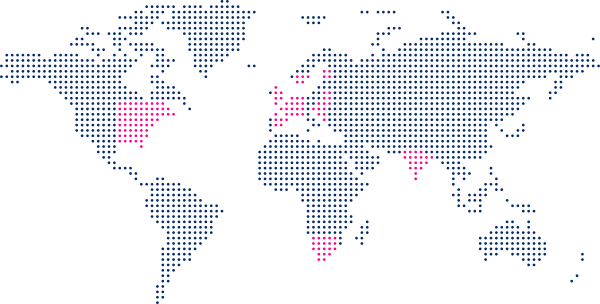
Globalization and other major world events such as the fall of the Berlin Wall (consolidation of East and West Europe), wars in countries such as Iraq, Libya, Syria and Afghanistan etc, the aging populations and low birth-rates in major economies of the world have facilitated massive movements of talent from one place to another - mainly to the West.
From a microscopic perspective, in South Africa, where I live, we have seen massive transformation of workplaces since the fall of apartheid in 1994.
This transformation is facilitated by the introduction of employment equity laws, resulting in women and people of colour slowly moving into senior positions that were previously occupied by white males.
All these megatrends point to a dire need for proactive diversity management programs to help organizations manage and leverage on these changes.
It values what every employee brings to the table as unique so that the organization can grow and succeed accordingly. The overarching theory is that when employees come together from different backgrounds, creative problem-solving processes grow in turn. This is thanks in part to an increased number of varying perspectives.
Mainly, it can serve as a reflection of a diversifying world - thanks to demographic changes, globalization and a digitalizing workplace, diversity can help teams to be better attuned to the many needs of their customers.
A study by Glassdoor shows the following advantages of a diversified workforce:
Originally diversity management was primarily about discrimination in recruitment and promoting tolerance within the company. But over time, things have evolved to where companies recognise the importance of diversity in the workplace as a key competitive advantage.
Here are some tips on how companies can craft their diversity programmes:
Themba Mthombeni
Partner, South Africa
Top management positions, mainly in multinational companies, represent a goal for 83% of the employees within the age group of 23 – 40, according to a study made by Friisberg & Partners Romania, of 150 Bucharest-based subjects.
The career path towards a top management position invariably goes through middle management ones, yet the abilities and knowledge necessary for a top management role can be different.
Which are the differences between a middle management position and a top management one?
Following a study on a focus group of 52 middle and top managers, as well as from our own experience in the market, we came to the following conclusions:
In the end it is a personal decision, one makes in his/her career path.
Aiming to become a top manager means more than education, experience and data accumulation. It means even more than long work hours and sacrifices made. Becoming a top manager also means a higher degree of decision making in regards to putting to work one’s business vision.
Our study reveals not only the aspirations and goals of professionals in the market, but also a deeper understanding of what it takes to be a top manager.
Although native abilities are important, in order to successfully walk in the shoes of a top manager, one needs years of experience, a profound market understanding and, most of all, a business vision.
Floriana Enescu
Partner, Romania
Guglielmo Sallustio, from our office in Milan, is hosting our 115th Partner Conference this week. Accepting that for many travel is still not entirely safe, nor easy, we are running a Hybrid Conference with in-person and virtual delegates taking part.
We are all genuinely looking forward to seeing each other once again, to welcoming our new Partners and Consultants – we have had numerous arrivals to Friisberg in the recent months - and to discussing our 2025 growth strategy.
Ours is a Management Consulting firm that specialises in Executive Search, particularly for businesses operating in multinational markets.
Our six-monthly Conferences ensure that our Partners are always learning from each other to constantly improve the service, and the results, we deliver to our clients.
As Search consultants, we know all too well the frustration and disappointment that comes in the form a great candidate, with whom our Client has fallen in love, accepting a counter-offer...
In recent months we’ve seen several instances of counter-offers influencing the outcome of a recruitment process.
How best to handle a counteroffer?
Well, from a Headhunter’s perspective, our aim is to prevent the serious consideration of a counter-offer - and the answer may lie in a very thorough interview process.
We strive to make sure that candidates we’ve approached, and who are interested in a career move, have given it some thought, have weighed the pros and cons and have come to a decision based on their consideration, not a spur-of-the-moment impulse.
But with all the preparation and thoroughness, we can still never rule out the possibility of a candidate getting and accepting a counter-offer. It is human nature and we are in the business of humans!
And from a candidate viewpoint:
If you are unhappy with your current position/employer for whatever reason and are exploring your options, you should be prepared for the possibility of getting a counter-offer at the end of the process (although some employers do have a policy of making no counter-offers at all!).
Most typical reasons for a company to make a counter-offer is to retain valuable knowledge and to avoid the cost and efforts of replacing you. So let that sink in. Yes, there are some cases when accepting your employer’s counter-offer is the right move, but generally speaking, an increase in salary isn’t a magic wand - in fact with such an offer should come the realization that your employer has all but admitted that you are worth more to them than they have been paying you.
Interestingly, research published in Harvard Business Review suggests 50% of people who take a counter-offer end up leaving the firm within the next year anyway.
And what about Clients?
Having an ideal candidate reject your offer only to accept a counter-offer with their existing employer can be a bitter pill to swallow. After all, you put in the effort, met with the candidate, answered their questions, etc. but apparently, it was not to be.
Well, that may be the best outcome, given that the candidate was not motivated enough to join your company. It’s possible that a pay increase was the objective all along for the candidate, or when the candidate hands in her notice, she is genuinely surprised at the steps current employer is willing to take to keep her on board.
Sit down with your Search Consultants to examine the outcome, make adjustments if necessary (is it this one candidate? Have we been turned down before due to a counter-offer? Is our salary competitive? Should we avoid the competitor where we are targeting? And move on.
Veronika Mohasci
Senior Consultant, Budapest
Gerd Gigerenzer
First of all, we should identify what kind of environment we are in. If we know all the possible alternatives, their probabilities and possible consequences, we are in the world of risk and can determine the optimal strategy.
If individual components are unknown, we are in the world of uncertainty (i.e., 90% of the time). Calculating the best strategy is impossible. We must find individual solutions to the problem.
In doing so, let us be guided by this trinity of steps to take in uncertain situations:
Marvin Siebert
Partner, Germany
With so many diversity and inclusion activities underway it is easy to assume that progress is being made. Then why are there so few women in executive positions?
The new McKinsey report “Win-win: How empowering women can benefit Central and Eastern Europe” examines the potential benefits of greater gender equality for businesses and society, identifies barriers to progress, and suggests actions that could unlock as much as €146 billion in annual GDP by 2030—an 8 % increase over a business-as-usual scenario.
In the seven CEE countries analysed (Croatia, Czechia, Hungary, Poland, Romania, Slovakia, Ukraine):
To find out why there are so few women in executive positions in CEE, the survey of approximately 3,000 employees in the region uncovered the following insights:
Ambition is not a challenge: Women are as ambitious as men, but they perceive more barriers to promotion. Men and women showed almost the same level of interest in getting promoted (57 % of women versus 56 % of men). However, 28 % of women said that their gender made it harder for them to secure a raise or a promotion.
Women blame themselves; men blame others: Women who thought they were unlikely to make it to the top said that it was because they lacked the necessary skills (43 %) or the right leadership style (38 %), or that promotions to top executive positions were not based on merit (33 %). A far smaller proportion of men said that they lacked the necessary skills for the job (8 % less than for women), and a much larger share said that it was because promotions were not based on merit (10 % more than for women). In other words, women are more likely to blame their own shortcomings for their failure to become executives, while men are more likely to blame the shortcomings of their company.
Unpaid work is a major barrier: Nearly 40% women provide daily unpaid care work (looking after children, the elderly, or people with disabilities). This is twice as many as men. Essentially, female employees are still working a “double shift”.
The COVID-19 crisis has created additional burdens on women: The increased burden has fallen disproportionately on women. 54% of women with children under the age of ten said the pandemic has made them more likely to consider scaling back on their paid work, compared to only 25 % of men.
Correcting this imbalance would tremendously benefit not only women in their careers and personal lives, it could have a potentially transformative effect on the economies of CEE.
Despite abundant evidence that gender equality in leadership is good for business, for an overwhelming majority of organizations advancing women into leadership roles is not a formal business priority.
One of the major and most complex challenges is to shift the underlying cultural factors. The McKinsey research highlights the need of the leaders of companies and public institutions to be visibly engaged in efforts to reduce the gender imbalance, rather than delegating this work to Diversity Officers.
But including men (holding 98% of CEO positions in CEE) in diversity efforts is not as simple as inviting them to a gender-equity event. Worldwide data from BCG shows that 96 % of companies with men actively involved in gender diversity initiatives report progress at all levels, compared to only 30 % of companies without men engaged. It seems intuitive that involving men would lead to greater results. Yet part of the challenge of getting men to join the efforts, according to BCG data, is that they tend to overestimate how well their company is doing in terms of gender issues.
To remove the barriers that hold women back at work, we have to acknowledge that the barriers exist. We need to realise that gender equality is not a “women issue”, it is a “leadership issue”.
The last thing that women need is men “rescuing” them or assuming the role of the workplace knight in shining armor.
Because men are in so many leadership roles, they have an enormous opportunity to accelerate progress. Men's voices are critical because of, not in spite of, their gender. When men speak up against gender disparities, they not only become visible as allies, they also raise awareness and acceptance about gender inequity as a shared problem, not a special interest.
Sources:
After two years of absence in light of the pandemic, September 2021 represents a new beginning for the city:
Milan is going through a slow and gradual reopening - it is seeking a new way of restarting.
Milan Design Week was one of the most anticipated design events to take place in Italy, and it has finally opened its doors to visitors. From the 5th- 10th of September, more than 350,000 architects, designers, artists, and craftspeople from all around the world had the chance to explore new design innovations and exchange ideas about interior design, furniture, and lighting. During the week-long event, Salone del Mobile, the renowned furniture and interior design event of the year, hosted local and international exhibitors at the Fiera Milano, Rho, along with interventions by world-renowned architects across the city.
New this year was the Supersalone, the special event of the Salone del Mobile, curated by the architect Stefano Boeri, that marks the restart in our
post-pandemic city. There were 425 brands in the four pavilions and 1,900 projects on display with spaces dedicated to companies and small consumers. The emphasis was on the smart component and the rediscovery of the home as an environment in which to live. There were 30,000 tickets only on the first day (the expectations were 50,000 for all six days), of which half were foreign visitors. And as we walk through the pavilions, the amount of visitors is undeniable.
"Milan is moving and, with Milan, Italy is moving again," said the Mayor of Milan, Giuseppe Sala. "It is an event that brings to the world the positive image of our city and the country. I welcome and endorse the invitation of President Mattarela, who I thank for his presence, to assume our responsibilities. Milan takes responsibility and wants to lead the restart.".
Guglielmo Sallustio
Partner, Milan
Many companies are poorly served by their current hiring practices – especially when competition for top talent remains so keen.
A recent study from research and advisory firm Gartner surveyed 3,500 managers and found that only 29% of new hires have all the skills required for their current roles, let alone for future ones. The shelf life of skills is becoming shorter and shorter. The research found that in key functions such as finance, IT, and sales, positions filled today will require up to 10 new skills within 18 months.
Globally, we are seeing some very specific themes emerge in 2021:
The pandemic created all sorts of disruption, from technology to corporate culture and a greater focus on diversity.
Many boards are focusing on the need to accelerate their digital transformation. and there is an increasing demand for business transformation specialists.
Virtual interviews have certainly cut the time it takes to interview and hire, but the hybrid scenario is here to stay where the first-round interviews can be done online, but further stages require in-person interviewing. However, virtual interviews can mean far less investment is required on the part of candidates, so it is vital to explore their true motivations for wanting a new position.
Companies also are giving priority to different values in their leaders, such as communication skills.
Sometimes it is good to hire for potential and transferrable skills not just specific industry experience. All too often firms simply put together a profile mirroring that of the person who has left, perhaps tacking on a few new requirements. At best, this highlights candidates who are prepared for yesterday’s challenges, but probably not ready for tomorrow’s.
Candidates are being increasingly selective about who they work for and companies are having to sell themselves to the candidates as much as the other way around.
There is an increased demand for leaders who can bring an organisation together with shared values and a mission worth pursuing, with transparency and responsibility, to present the organisation in the right way.
The freedom (or the imperative) to work remotely and to manage one’s own time has increased the effect that an individual can exert over the design of their jobs. WFH also has broadened the applicant pool - many employers are no longer limited by borders and geographies.
Executives who can motivate and lead their teams from afar will therefore bring a huge benefit to the stakeholders.
Finally, CEOs and Boards are very conscious of the need for contingency planning and lessons learned in anticipation of future events. Succession planning has become even more vital and so retaining key people is essential.
We are all living in a different world, and that world demands a new approach to hiring that can't be ignored.
Lorri Lowe
Partner, UK
For most employees, home office means having flexibility and freedom and many are reluctant to give these up. However, if studies by the Leibniz Centre for European Economic Research in Mannheim (ZEW)* are to be believed, they don't have to. Many companies plan to stick with the home office arrangements beyond Corona. In 2020, 64% of companies in the information economy wanted to continue to allow working from home at least one day per week. In 2021, it was already 74 %.
Leadership is becoming much more demanding
The fact is that in the last couple of years, many employees were allowed to work from home for the first time - and it was also a new experience for many supervisors. If it now becomes the rule that employees are predominantly at home, this also requires a rethink in terms of leadership. Leadership, already an often underestimated management discipline, becomes even more demanding. Without the chance encounters in the corridor and the short chat at the coffee machine, supervisors will have to invest more time in the future to stay in touch with their employees. Keeping this connection, even over distance, continuing to provide guidance and coaching requires a high degree of empathy. This is a quality that is much more in demand in Executive Search today than it was before the pandemic.
'New Work' means rethinking work
The much-used buzzword "New Work" tries to give a home to the megatrends in the world of work such as digitalisation, work-life balance, globalisation, etc. It is also a way of thinking about work in a new way. Those who understand how complex the topic is are rethinking work: starting with recruiting and training new employees, to leadership and employee retention. Employer benefits related to the office are losing importance - and also attraction.
What connects employees of a company, how do they become a team?
A practised corporate and leadership culture, shared values and work that is defined by the value delivered are becoming more important than ever. At the same time, the boundaries between work and private life are becoming increasingly indistinct. The risk of being overwhelmed, of restlessness is increasing, because work is omnipresent with the increase in home offices. This is yet another argument for the importance of empathic leadership.
Motivation and willingness to perform - the inseparable partners
Then as now, motivation and willingness to perform are closely linked. Employees want recognition for their performance. Company leaders have to ask themselves: How is it currently working in my organisation? How much room is there for new ideas? What about the culture of error? How regularly does exchange take place between managers and employees? Companies that see the current situation as an opportunity to take a fundamentally new look at the topic of leadership and to set fresh impulses in the design of their working and organisational world will benefit from this in the long term.
A plea for personal contact
Despite all the possibilities offered by new digital media today, I am convinced that inspiring leadership distinguished by empathy cannot do entirely without personal contact. For me, this is not a question of an old or new economy, or of trust and mistrust. It is therefore understandable that many companies specify at least one or two days of presence in the office.
Decisions in favour of a higher proportion of home office are mostly CFO-driven. Some companies have used the absence of employees due to the pandemic to sell office space. Such cost-driven decisions may be good for companies in the short term, but not in the medium to long term.
Motivation boost Corona pandemic?
In May 2020, the Fraunhofer Institute for Industrial Engineering (IAO) surveyed 500 companies from various sectors on the topic of working in the corona pandemic**. Around 70 % of the participants stated that they had largely switched to home office. Half assessed the performance of their employees to have remained the same during this time - 30% even recorded an increase in productivity. Decreased productivity mostly resulted from the reduction of working time accounts, short-time work, etc.
The study results also show what a strong impulse the Corona crisis gave to develop innovative solutions together - to overcome an existentially threatening situation together.
How long will this last?
When will motivation also decline at the home workplace and with it productivity and efficiency? To prevent this, leaders must now build up and expand their virtual leadership skills and find the right mix in delegation, team organisation, personal responsibility and duty of care. The experiences of the last few months are too important not to be used systematically.
*Source: "Home office in times of Corona", Leibniz Centre for European Economic Research in Mannheim (ZEW).
**Source: "Working in the Corona Pandemic - Towards the New Normal", Fraunhofer IAO in cooperation with the German Society for Human Resource Management DGFP e.V.
Matthias Zühlke, Partner
Hamburg, Germany
Laurence has joined Friisberg from Transearch International as a Senior Consultant and will be based in both Paris and Strasbourg where she will focus on Executive Search and Talent Management. With an extensive experience of Executive Search and Management Consultancy, with a range of clients, industries and geographies, she considers each project to be an exciting and complex challenge, combining active listening with a thorough understanding of the company culture.
She has in depth knowledge of the French economy as well as many international firms including those in Consumer/Retail, IT/Digital, Life Sciences and has worked with private clients, private equity firms and family offices for over 15 years.
A graduate of the Strasbourg School of Management, she has a specialisation in industrial project management, and has developed an interest in international culture and languages speaking French, English, German and Spanish.
Her career began as a Business Manager in an IT and engineering services company in Paris and then in Strasbourg, where her main activities were business development, recruitment and management of engineers, focusing on the success of clients' projects. She then moved into Talent Acquisition, developing a new subsidiary of an engineering group.
Laurence lives in Strasbourg with her family and is passionate about sport including figure skating, running, skiing, biking and travelling.
You need to load content from hCaptcha to submit the form. Please note that doing so will share data with third-party providers.
More InformationYou need to load content from reCAPTCHA to submit the form. Please note that doing so will share data with third-party providers.
More InformationYou need to load content from reCAPTCHA to submit the form. Please note that doing so will share data with third-party providers.
More InformationYou need to load content from reCAPTCHA to submit the form. Please note that doing so will share data with third-party providers.
More InformationYou need to load content from Turnstile to submit the form. Please note that doing so will share data with third-party providers.
More Information