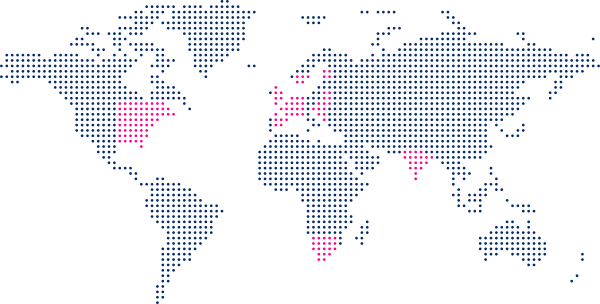
The talent pool in some markets is highly competitive, with candidates receiving multiple offers simultaneously. This is, in part, related to the “Great Resignation”, where approximately 4 million Americans quit their jobs in July 2021 while there were still more than 10 million job openings.
A survey run from Linkedin in 2021 on more than 2,000 adults in the U.S. found that 47% said the coronavirus pandemic changed how they feel about their careers.
While the Great Resignation was mostly driven by mid-career employees, Executives have also been seeking new opportunities at faster than usual rates.
Europe appears to be experiencing a different type of crunch, driven by long-term demographic trends. Each year, the number of executives in the Baby Boomer generation are retiring at greater rates, while the next generation is considerably smaller. In fact, the pandemic has likely sped up this trend, with many Baby Boomers either being forced out of the workforce or leaving voluntarily in order to maximize their quality of life.
There is a shift in generations in the labour force, including the leadership roles.

Voluntary resignation trend in Italy 2017-2021 (Labour Statistics Office)
With new challenges and rapidly changing market conditions, organizations need to redefine leadership roles in their organization. That can range from areas of responsibilities and structure, but it is as much about the soft skills a leader brings to the table as it is about their industry knowledge and expertise.
Former Best Buy CEO, Hubert Joly , interviewed by an MIT Research in January 2021, observes, “All of us have to rewire ourselves for a new way of leading. What’s the purpose of work? I’ve been CEO for 15 years, and the initial part of my time as CEO was much easier because it was purely about the business. But now it’s broader”
The same research reports that the 72% of respondents of more than 4,000 managers and executives interviewed , strongly agreed that it is very important to them to work for an organization with a purpose they believe in, but only 49% strongly agreed that they believed in their organization’s purpose.
They require a new executive’s mind set and leadership style:
| Profit | Purpose & Values |
| Hierarchical Pyramids | Network of Teams |
| Business knowledge | Digital & Business Disruption |
| Directive Leadership | Supportive Leadership |
| Rules & Control | Trust and Self Control |
| Business Hours at office | No boundaries home/work |
Donatella Paschina
Associate Partner, Milan
Once upon a time there was great pride in telling the truth, but a reality of our current political climate is the prevalence of lies and misleading statements from some of our world leaders. We have descended in many of our communications to a level where the truth might, or might not, be included in what is being said about any given topic.
When Sun Tzu wrote The Art of War two thousand years ago, he was overtly opposed to telling the truth. He basically said telling the truth was a bad and dangerous thing to do relative to your enemies. He advocated deceit and skilful deception, and his strategies very intentionally used multiple layers of misinformation with the goal of defeating the enemy.
Creating a culture of deception can be extremely dangerous. I guess some leaders might think that they have the right (even a duty?) to distort the truth if it benefits the organisation because experience teaches us that the truth brings risks, but leaders who habitually lie run the risk of normalizing that behaviour and creating a toxic culture. Credibility is all and lying destroys a team’s trust for their leader - people simply don’t like being lied to.
Lies can be innocuous or they can be critically important. It can be difficult to get a straight answer to the most basic questions - for example, ‘How are you?’ Virtually no one expects to hear anything but, ‘Fine, thanks. And you?’ Withholding information has become normal. As children we are told many tales about the merits of telling the truth, but science says we learn to deceive as toddlers. Adages such as ‘Honesty is the best policy’ continue to influence our adult lives, but we often tell little white lies to make others feel better.
If you lie about the small things, people distrust you with the big things. Even worse, if you lie consistently, people may begin to instinctively distrust everything you say, just as the boy who cried wolf.
Communication, and with it the threads that connect us to each other, simply breaks down.
I maintain that truth is the most powerful trait shared by great leaders.
A leader’s words carry great power. Words can determine whether a business thrives or fails. Truthful words, a close grasp on reality and the willingness to follow through on actions are necessary tools for running and leading a business. All leaders should work towards developing a culture that supports truth-telling.
Great leaders build strong relationships founded on honesty, which in turn builds inspiring organisations.
We may never be perfect, but some of us can be a lot better than we are now.
Thank you very much. Of course, it was a big change both for me and for our two companies in Poland at this time.
I am afraid, I won’t say anything revolutionary: always in such a situation, the first task is to build a team. Experience, knowledge and belief tell me that if you have a good team, you can achieve any goal. The beginning was not easy. Relatively quickly I found people with great potential and knowledge, but also with an appropriate value system. The challenges were in all possible areas, from relations with business partners, through improperly selected products, lack of communication with consumers, to the profitability of both companies.
Together, we defined who we want to be and what we want to achieve. We developed a new business model and then the perfect execution of the plan became the key to success.
Simultaneously, we were working on the changes in the structure and merger of the companies, developing new methods of operation on the consumer and client side. Today, we know a lot about our consumers, that enables us to communicate effectively with them. I gives me great satisfaction and joy that as a team we have created a friendly and stimulating workplace. We have a unique culture which translates into commitment, constant development and searching for new ideas how to develop a business.
In the current situation our action plan is twofold. First, Ukraine - our main task there is to evacuate our employees and ensure their safety. We are also in constant contact with our clients. Some of them are active and we help them whenever possible.
The Baltic countries, on the other hand, have some similarities and differences compared to the Polish market. Modern retail chains operate similarly to the best players in Poland. The preferences and expectations of consumers when it comes to household appliances are slightly different. At this stage, I cannot reveal too much, but we have an idea and we see great opportunities to develop our business in all three countries. We certainly have a lot to offer consumers as well as distributors.
I think that today nobody has any doubts that the future belongs to modern digital solutions, thanks to which we simply live more comfortably. All our new devices can be connected to the hOn app and use functions that make our daily activities easier. Artificial intelligence makes our equipment quickly adapt to the consumer's lifestyle, making it easier to wash, cook and store food. At the same time, we put great emphasis on pro-ecological solutions. For instance, our washing machines are certified with the highest energy class at affordable prices. Candy RapidO offers comfortable and quick washing with very low energy consumption. Exactly what consumers expect today. To this you need to add aesthetics and design as household appliances have become an element of interior design today.
Our goal is to improve the quality of life of consumers. To make daily activities easier or even take them off customers’ hands. That is why we focus not only on modern solutions based on artificial intelligence, but also create an ecosystem together with various partners. As a result, we will provide consumers with a comprehensive solution in a modern way that makes life easier. Even today, using our wine cooler, you can easily check what we have in stock and order your favourite wine through the aforementioned hOn application.
This is a very good question, especially in the context of Haier's values. Since the day the company was established, its culture has been built on three pillars: entrepreneurship, close communication and cooperation with consumers, referred to in our company as Zero-Distance-To-Consumer, and the construction of the aforementioned ecosystem.
At Haier, we act as company owners. This is also the most sought-after feature in potential candidates for our team. I used to work in a company with a "highly corporate culture”, focused on internal goals. We always look at the reality around us through the eyes of the consumer. Therefore, when creating the ecosystem, we do it based on local partners. Thanks to this, we support the local community but also better respond to the needs of consumers.
This is a kind of logic puzzle. People are the most important. A properly built team with a wide range of experiences and skills is able to create and implement ambitious plans. Naturally, under the right conditions. My role is to build this team and create the right conditions. We promised each other two years ago that we would create together a workplace where we will be able to pursue not only corporate goals but also our own goals, especially those related to development. In order for the team to function efficiently, it must have the right conditions. The combination of these two elements gives you a chance for success.
She lists three key insights every business owner should remember when starting a Search:
As the business grows, owners of family businesses face a challenge to transition towards more structured management, rigorous strategic planning and the need to bring in new skills to improve efficiency and profitability.
Oftentimes it means a search for new CEO with strong track record of leading growing enterprises and success in international expansion.
In the majority of cases, recruiters have to consider more factors than usual, including a company history, family dynamics and core values, traditions and expectations of the workforce.
Furthermore, it is critically important to ensure that the owner and candidate share a joint vision regarding the owner's involvement into decision making once the new CEO is in place.
For an external CEO to be successful in a family businesses he/she needs to build strong relationship with the owners. It is impossible without shared values and beliefs- these are as important as professional skills and competencies.
In fact cultural fit is a critical element that makes or breaks long term future collaboration. Therefore the sourcing of candidates should include a particular emphasis on the candidate‘s ability to connect with the company’s values and mission.
How fast does the the owner want to reach the targets? How is the timeline viewed by the new CEO? How long and what errors will be tolerable? When and how will both the owner and CEO know their relationship works? Both sides tend to rush and to forget that expectations should be specified in great detail and efforts should be made to establish a realistic rather than an optimistic timeline. A time buffer should be in place bearing in mind that the owner knows what they want, but knowledge transfer does not happen in a couple of weeks.
To understand the candidates' market is not an easy task for those who never dealt with it. Hiring for family owned business requires deep expertise and abilities to facilitate the dialogue between the owner and potential hire to ensure the match. Furthermore, it requires a well detailed on-boarding process which often gets forgotten. Experienced consultants should be the advisor to both parties in order to ensure an optimal outcome.
As ever, our conference will feature a rich programme of keynotes, presentations, workshops and panel discussions which will provide critical content to help our consultants, and the clients they serve, thrive.
Our Spring conference is being held in Madrid and our Spanish colleagues are looking forward to welcoming us, once again, to their vibrant city.
There will also be time for great networking opportunities as well as the chance to share knowledge and best practice. We all continue our relentless pursuit of constant improvement and advancement through learning from each other and growing together. We know that culture change and purpose are gaining more attention than ever as leaders seek to define their organisations as attractive and meaningful places to work.
Organisations must be prepared to adapt and evolve as the world around us changes. We must learn how the disruptions of the recent past can be reframed for a thriving future for Friisberg and its clients.
However, the impact of social crisis, economic dislocation, and global pandemic also calls on us to reflect on how we work, what we believe, and what matters most. We are a supportive organisation and recognise that many of our colleagues, especially those whose neighbours may now be at war, are facing unknowable challenges.
We all genuinely enjoy spending time with each other and look forward to visiting our beautiful offices in Madrid.
In times of change much is on the shoulders of leaders. They have to decide with speed and accuracy, adapt boldly, deliver reliably and commit to impact while retaining their energy and health.
Rapid external change should be followed by wise and rapid changes inside the corporation.
Leaders are usually fast in processing available information, determining what is necessary and making decisions thereafter. It is easier if 3-5 priorities are defined which become the basis for decisions, be they financial liquidity, customer care, or keeping all engineers on payroll. Smart compromises are also easier to make if priorities are set.
Sometimes it is smart to ask for expertise and seek new inputs. It is also good to decide what not to do and share it with team. New rules of the game should include new modes of action as the old ways sometimes halt progress. Times of big change usually mean stopping and overlooking the big financially bonding plans.
Leaders also tend to keep an eye on all the important functions that may change in quickly- supply chain, transportation and others that may need backup in the near future.
Effective leaders are acutely aware of their team's distractions and their collective and individual frames of mind so they seek ways of engaging and motivating them when communicating new information and goals.
While many factors may not be under their control, they seek to align the team's objectives, develop new performance monitoring indicators and create a culture of accountability.
During a crisis, people will be be overloaded with emotions, and incomplete information will distract resulting in paralysis. It might be good to focus on a few things that matter most and make an scalable framework for quick decision-making.
It is necessary for an effective leader to keep themselves fit both physically and emotionally. Establishing a healthy routine such as mindfulness exercises, short gym sessions, plenty of time outdoors and time with family in the evening are all essential.
Pille Päss
Partner, Estonia
Business organizations are now coming to terms on how the COVID-19 pandemic has become the greatest catalyst of workplace transformations of our lifetime.
In retrospect, what many business organizations did not envision was the extent to which employees would be working remotely from homes, and scrambling across back-to-back virtual meetings, while juggling the competing demands of home schooling. This evolution of work-life and the workforce has consequently impacted how HR professionals manage recruitment and talent acquisition. One of the more pronounced effects has been the increasing reliance on digital recruitment/search platforms (such as LinkedIn, JazzHR, Workable, Zoho Recruit, etc.) to source for viable candidates as fear of physical interactions through face-to face engagement peaks.
Is this true or just a perceived mental model in the post-COVID world? To answer this question, one needs to start with the endgame in mind. It is undeniable that the advent of technology will transform the way recruiters conduct searches on the way forward.
Artificial intelligence has been proven to be a capability multiplier in many aspects of work transformation. As a case in point, technology has made job search a little easier to publish and search for employee resumes, facilitating virtual interviews online, breaking down geographical separation, and allowing HR professionals to cast their net wider. However, before one is led to believe that technology can replace the “man-in-the-loop” in talent acquisition, it is important to appreciate the limits of the current state of technology and the nuances of executive retained search.
The search for C-suite level and senior executives is fundamentally a people-centric process; something that search platforms alone cannot adequately fill. Correct job fit is not based merely on CVs and past work experience alone. There are tacit work characteristics such as personality match, cultural fit, team dynamics and personal aspiration alignment. To find that best candidate, current technology (even with AI and data science) cannot adequately address those information gaps.
In essence, retained Executive Search services involve a meticulous process of human interaction that taps on the deep expertise of professional interviewers, whose skills and “gut-feel” have been honed over the years.
Securing candidates for top or strategic management roles (CEO, CFO, COO, CMO, GM, board member, etc.) requires the “feel” for the candidate in that specific organization, industry, and market. It is very different from conventional recruitment and requires a human mind that appreciates beyond titles and responsibilities – someone who knows the market and the context in which the respective candidates worked, who can read between the lines, who understands the challenges, opportunities, and trends in the industry.
We pride ourselves in being a market leader in the above methodology of retained search for the following reasons:
We are one of the leading global consulting practices specializing in financial services and digital-age technological hires with 30+ years of experience in solutions for Fortune 500 companies worldwide aimed at retaining, developing, and advancing next generation technological breakthroughs.
We have an impeccable and consistent track record of delivering top talents that have been a perfect fit for advanced technology firms, global IT companies and start-ups. This is possible because of our proven methodology of precise job profiling and multi-level deep investigative search.
We have breadth and depth. We have a team of experts and global networks with extensive market domain knowledge to help our clients secure top revenue generators, product developers, market leaders and investors; talents that are key to securing your next cycle of growth. With experts in every area of people and organizational development worldwide, we can help you envision, design, and build a truly inclusive organization.
Janet Tweed and Richard Khee Loon Foo
The energy transition was born in Germany in the 1980s and is now well known with the word “Energiewende”.
It has now become a global megatrend with the growing necessity to transform energy generation and reduce carbon emissions. In 2015, France implemented the "Energy Transition Law" aimed at developing a new energy model, "Green Growth", and so contributing more effectively to the fight against climate change.
The targets appear clear accelerated by the current situation in Ukraine: Reduce fossil fuels and transform the entire energy systems to a carbon neutral generation with renewable energies and hydrogen.
To achieve the European Climate Deal targets by 2050, France's objectives are to increase the use of renewable energies from 12% to 32% of final consumption, to reduce final energy consumption by 50% and to diversify electricity production, in particular by reducing the share of nuclear power (40% to date). The main efforts will have to focus on housing and transport, which together consume 80% of national energy.
As this example from France shows, this global and progressive transformation will of course affect us all, including with the emergence and development of new professions. Generally speaking, for the past 10 years, global renewable energy employment has been booming:

In the solar sector, employment in France will rise from 18.000 in 2020 to 25.000 in 2028. One reason companies are recruiting so much is because they have to cope with the exponential growth in demand for equipment.
The 250 main players have hiring plans for 2022 and this seems to be only the starting point. That is 40 to 100 jobs to be created per company. In demand are engineers, financial engineers, project managers, IT experts with relevant skills and executives, who are able to lead an energy transition on a large scale.
In France, ENEDIS, the EDF subsidiary, is seeking to recruit 2,000 people, has set up recruitment hubs in many French cities in order to attract talent directly on the ground. But also the large Oil companies such as BP, Shell, Exxon and Total, and in Germany RWE and E.ON are desperately seeking a talented executive workforce to orchestrate this energy transition.
From the point of view of the economy this is critical as there is clearly competition for the best talents and companies tend to search for employees with a ready to start skillset. As a consequence companies are trying to hunt for talent from their competitors. An increase of salary level is to be expected as companies tend to pay retention bonuses to avoid “bloodletting” of their competencies. Experience from our own international executive research shows that currently the willingness to change jobs has focused on expert levels but also executive levels have significantly decreased.
Not only from the perspective of the EU economy, but it makes sense elsewhere to attract excellent talent from other industries which are also in transformation but with less future certainty, such as automotive industry.
Bearing this in mind it makes sense for the energy, engineering and manufacturing sectors to put effort into reducing their carbon footprint and to elicit support from a trusted international Executive Search partner - one who has an in depth knowledge of the market and relevant industry networks.
.
Members are given the opportunity to share an important moment or dilemma in their professional / managerial lives.
The first such conversation was undertaken by Zoltán who discussed why he decided to put himself forward for the international position of Chair of Friisberg earlier this year.
"It took immense courage actually to decide to run. I have been a member of Friisberg's Executive Committee for a number of years in an international Business Development role and so I understood how the different global markets operated, the way the local offices were run and of course I knew my colleagues well. Even so, to take on this role was a big decision. I knew it would take time, a great deal of personal commitment and of course I am still extremely busy in my own local market of Hungary!"
The Friisberg Partners overwhelmingly voted for Zoltán in July 1, 2021,
"It was a huge honour to be elected and I am committed to growing Friisberg, to strengthening our presence across international markets and to providing all our clients with unrivalled service."
We have all encountered a similar situation that required us to step out of our normal world and to push our borders further. Zoltán's success is instructive for many of us.
The onlyCEO Club is a unique community of business leaders – a meeting place for key leaders from various industries.

This International Women's Day we would like to celebrate the talented and determined women of Friisberg.
This year’s theme is #breakthebias which encourages us all to strive for a gender equal world.
We are proud that Friisberg & Partners International has been a long term champion of equality achieving 50-50 representation and ensuring women are fairly represented at all levels of the business.
It is a business-imperative and something that is increasingly seen as a differentiator in client relationships.
To attract and retain top female talent, we need approachable role models. Current and future talent demand it and, if it’s not authentically experienced in the workplace, that talent will vote with their feet and businesses will simply fail.
International Women's Day gives us a chance to focus on gender balance - the magic ingredient to make a team great to work in, and great to work with.
You need to load content from hCaptcha to submit the form. Please note that doing so will share data with third-party providers.
More InformationYou need to load content from reCAPTCHA to submit the form. Please note that doing so will share data with third-party providers.
More InformationYou need to load content from reCAPTCHA to submit the form. Please note that doing so will share data with third-party providers.
More InformationYou need to load content from reCAPTCHA to submit the form. Please note that doing so will share data with third-party providers.
More InformationYou need to load content from Turnstile to submit the form. Please note that doing so will share data with third-party providers.
More Information