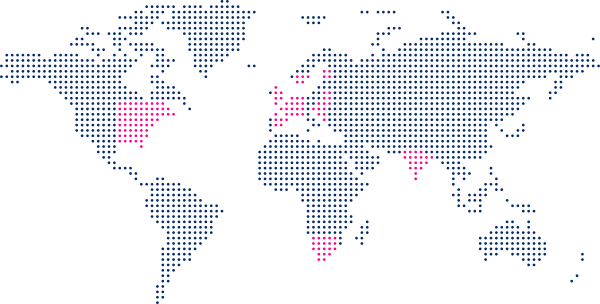
Norway currently tops the European statistics for gender-balanced corporate governance, with France and the UK in second and third places. (Source: Gender Diversity Index, europeanwomenonboards.eu).
Many factors explain why Norway has made great strides with equal opportunities, and gender quotas for company boards is one. Despite the progress, however, the Norwegian labour market remains very divided along gender lines. Four out of every five CEOs is a man – and nine out of 10 nurses are women.
Gender quotas on public-sector boards were introduced to Norway in 2004, and extended to private companies planning for a stock market listing (public limited companies) two years later. The requirement was that women should hold a minimum of 40 per cent of board seats, with companies which failed to meet this proportion threatened with being wound up.
Owner perspective
Norway has many small family-owned businesses. A majority of these belong to men. As a major owner, the Norwegian state also makes a clear mark on the domestic scene. Directors are almost always non-executive and largely independent of the company’s management.
Trust between owners and directors is important. Historically, owners have chosen directors from within their own network, since it is easier to trust people you already know. These networks are homogenous. Boards drawn from them generally work effectively, but risk missing out on important perspectives.
The 40% women requirement has increased the awareness of the expertise desired and the contributions directors make. This is considered a very positive consequence of the quota regulations.
Megatrends
The need for renewable energy, for example, has shifted huge investments from coal and oil to solar and wind power. Digitalisation has created radical changes in companies' development and the competitive position and will continue to affect all sectors.
Major changes call for non-traditional thinking, and curiosity about how other sectors overcome their challenges is particularly important along with a sense of urgency and solid understanding of financial risk. Having directors of both genders as well as different ages and backgrounds – nationally and internationally and from various sectors – will be necessary in order to widen perspectives and make the right strategic choices.
Female boardroom candidates
Holding a directorship is not a right, but an opportunity to contribute required expertise. During the first few years with gender quotas, we saw some poor solutions – female directors with a combination of high self-confidence and low relevant expertise, and enterprises which invited women on in order to fill their “quota” without wanting them to make an active contribution. Such things are rarely seen today.
Generally speaking, bottom-line responsibility and thereby executive experience are necessary to contribute effectively on a board. Norway has far more men than women in leadership roles, which means that the pool of female candidates with relevant experience remains smaller than for men.
But big variations exist between sectors. So, when putting together capable boards which also meet the need for gender balance, an overall view must be taken of expertise and efforts are needed to identify where scope exists for a good selection base.
“Younger” sectors, such as technology, media and telecom, have a more balanced gender distribution and thereby more women with solid management experience who amply provide the expertise required of a director. This contrasts with traditional industry, for example, where the pool of women with similar management expertise remains smaller.
Win-Win
Good boardroom contributions emerge from relevant expertise, strategic insight, understanding of roles, commitment and a personality able to exert influence and collaborate.
Some people argue that being “quota'd in” is unequivocally negative, and that quotas weaken the authority of women on the boards. We believe gender quotas ensure that highly competent women are invited to serve and give able females opportunities to contribute. If the starting point has been that male owners chose directors from networks of friends and acquaintances, the quota system has been both a necessary and an effective tool for ensuring diversity. We argue that it also ensures the best possible value creation.
In our experience, the quota rules have contributed to owners adopting a more analytic approach in assessing the board’s overall expertise and contribution. The requirement for 40 per cent women has thereby definitively made owners aware of able female directors. Our hypothesis is that the boards also end up with more capable male members.
Hild Kinder
Benedikte Stiff
Partners, Norway
Thorsten Marquardt has joined Friisberg & Partners International in Germany.
Thorsten has extensive knowledge of the international energy industry from more than 20 years in various management and executive functions in BP, Fortum and E.ON. Before he joined Friisberg in Germany he worked as Director of Innovation at s.Oliver and Managing Director in MediaMarktSaturn’s Retailtech Hub.
In addition to working with companies in the energy sector Thorsten also works with and across industries in digital business. He focuses on senior executive recruitment for publicly as well as privately owned customers, private equity firms and family businesses as well as start-ups. He advises the organizations and their boards along the entire value chain upstream, midstream and downstream in creating and strengthening effective top executive leadership teams who manage the sector-coupled energy transformation and digitization.
Thorsten is based in Munich. He is a passionate football fan and loves the mountains, where he hikes, bikes and skis.
Over the last five years we have further developed our Evidence-based Personnel Diagnostics (EPD) capabilities.
EPD is based on the latest and long-standing scientific findings in brain research, psychology and neuroscience. In structured interviews with narrative elements, we focus not only on personality and competencies, but above all on the predictors and potential for career success.
In the wake of the Covid-19 pandemic, it is clear that leaders with strong risk-taking skills, resilience, integrity, perseverance, passion, and empathy have been more successful in leading their companies and employees through the crisis. These competencies and potentials will also be necessary in the future to actively shape the digitalization of the economy, to question business models, and to change the management of employees working remotely, among other things.
With EPD we support owner and family managed companies, international corporations and portfolio companies of private equity firms in finding and selecting suitable and high-performing executives. Together we build on the company's success.
Our Global Financial Services Practice Group held its first - online - meeting of 2021 yesterday with our Partners from USA, UK, Spain, Lithuania, Germany, Hungary, Denmark, Norway, Ireland, Romania and Bulgaria. Our truly global structure and collaborative approach is vital because we all appreciate that the ideal candidate for a role may reside beyond national borders.
Friisberg has been at the forefront of leadership consulting since 1977. We are located in every major financial centre and have completed thousands of assignments, providing comprehensive executive search and leadership consulting to financial services clients, globally. From financial institutions and regulatory bodies, to trade associations and consultancies, we work with some of the largest and most complex financial organisations in the world, as well as with smaller, specialist boutiques and private capital in banking, insurance, investment management, venture capital, private equity and Fintech.
We discussed the pandemic with the resultant changing dynamics of global finance, increased regulatory pressure, technological advances, and how we are working with our clients to recognise emerging opportunities.
On Diversity in FS, we discussed the report published yesterday European Women on Boards (EWOB) Gender Diversity Index Full Report 2020 which revealed a gradual improvement, but still a large discrepancy between countries. The top countries being Norway, France and the UK.
EWOB Gender Diversity Index 2020:
Market analysis by the highly-respected publication Budapest Business Journal names Friisberg & Partners International as the Number One Executive Search firm in Hungary.
Árpád Németh, Friisberg's Managing Partner in Budapest said:
"We would like to say thank you to our clients for entrusting us with their valued assignments, to our consultants for their professionalism and commitment, to our Partners in Friisberg for sharing cross-border assignments with us and to the wider Friisberg community for their support. This is truly a team effort and we are delighted that our dedication to providing the very best service has been recognised. We look forward to building yet further on our successes with more hard work and great results for our clients."
This top ranking for Friisberg Hungary comes in the same year as Friisberg & Partners International was named "Top Consultant 2020" and "Headhunter of the Year 2019 (Candidate Experience)" in Germany.
Peter Strandberg, President of Friisberg & Partners International commented:
"2020 has been a very difficult year, but it is very heartening that in the last 12 months our firm has been confirmed and recognised as one of the leading Executive Search firms internationally. We look forward to continuing to succeed for our clients, success which has always been founded on our collaboration, collective spirit and our 'OneFirm' approach."

Looking back at 2020, Covid has impacted Friisberg & Partners International Denmark in ways we did not expect. First we saw several assignments being postponed, but already after a 3 month period, all assignments but 1 were up and running again. From then it was our job to ensure that we still delivered the best candidates to our clients, and this meant that we had to re-evaluate our processes. During the re-evaluation of our processes, the Friisberg network was of great help. We participated in several weekly meetings to share success stories of how Friisberg was conducting their recruitments without any physical contact at all.
We have also had great success and benefited from Friisberg group meetings regarding new articles to gain interest in the Friisberg brand among customers. At one point all Partners were asked to contact 5 customers to interview them in regards to how they were changing their organization, processes and strategies to suit the Covid-situation; the interviews I conducted ended up being a great entry angle into communicating with customers, during a time where they down prioritized communication with headhunters.
There is no doubt that Covid has taken its toll on us, but being a part of Friisberg has ensured that we have never felt alone. Through network groups we shared work experiences and through our virtual ‘Friday Bars’ we were all able to laugh and share funny anecdotes from the Covid-home-life.
Had we known in 2019 what we know now… I am not sure exactly what we could have done any differently. Maybe we would have delayed the opening of a new office from December until after the pandemic had passed, but, who really knew what was coming? The great strength of Friisberg has always been our collective spirit. I’ve been a Friisberg Partner for ten years now and in that time I have come to realise that we can always rely on one another. We can and do entrust valued client relationships to each other, and our clients clearly like that we have such mutual strong trust that we can “team up” to work more effectively on their assignments.
It’s that very same “team up” ethos that has seen Friisberg through this crisis. Thankfully the UK firm has continued to function fully, and has not had to cutback at all – and a very big thank you to our clients for keeping us so busy – but the way we work has changed so much. I was asked a few years ago to be the lead partner on our digital strategy. We selected Microsoft 365 for its collaborative sharing capability, which has made cross-border and multi-partner co-operation on international client assignments so very easy. So, when Covid-19 hit, we simply embraced the built-in "Teams" function for all our online meetings… and I’ve seen more of my Friisberg Partners online in the last six months than I have in most of the past six years.
They say adversity brings people together. It certainly has. It also reveals their “true colours”. I am proud to be in such a genuine Partnership – in every positive sense of that word. We have decided things together and supported each other and taken care to ensure none of us has been left behind… Brexit may finally happen next month, but this UK business still has the best of friends, and in all the right places!
Over the years we have experienced several crisis situations, and I have realized that it is important not to get lost, to trust yourself and make decisive decisions quickly.
Over the past months we have worked from home, met in our office when we could and sadly informed some temporary workers that we could not provide a guarantee of ongoing employment.
However, with our prudent management we have had a successful year the future looks promising.
Despite our success, we have remained ready to help our Partners who have faced more adversity than in Lithuania. We have continued to work with them to attract potential Clients and help financially if the need arose. That is how I understand the Friisberg Partnership – we work together in the good and bad times and are always there to support one another.
By April all our people in Friisberg’s Budapest office were working from home, managing ongoing assignments and searches, but acquiring few new Clients. Luckily, we were not alone we liaised closely with Friisberg globally learning how others managed this unprecedented situation. Our collective consciousness, together with the knowledge and experience of my colleagues in other countries, proved invaluable to us in Budapest.
Despite of losing 80% of our business in value during April and May, we did not even talk about making any of our consultants leave our Budapest office, but instead we tried to figure out doable actions to keep them on payroll and keep the business alive.
Friisberg Hungary is a member of one the largest business communities in Hungary. The (large) invoice came in July (when else?!) to cover the next 12 months’ membership fee.
As we had decided to optimize all possible operation costs – except labour – I told them we would suspend our membership and hopefully rejoin later in 2021. “We cannot let you go!” they replied, “We understand your situation, so your membership is for free for 3 months. You can pay later. We understand and feel your situation!” Friisberg Hungary was obviously a great Client for them and I decided to act the same way with my valued Clients.
By mid November 2020, our business, though it has not reached the level of last year’s volume, looks promising and we are about to make some new additions to our team making the Budapest office even more dynamic.
(President, Friisberg & Partners International)
There is no doubt that Covid-19 has created a massive humanitarian challenge as well as numerous challenges for all businesses, including our own. At Friisberg & Partners, we have chosen to see this moment as a unique opportunity for re-calibration, with positive implications for our organization. Over the past months I have pushed myself and our global team to think about how we use this inflection point to reimagine our potential together.
How do we learn from this and evolve better for the future?
This has been an opportunity to reset how we work together, how we can learn from each other. Our weekly calls and Teams meetings, where we discussed ways of handling the crisis, were extremely helpful. This shared experience connects us, binds us closer together and gives us all added perspectives on how we can build on our pandemic experience to refocus our interest on shared success.
I am very proud to announce that Friisberg & Partners International has upgraded its website.
We have made friisberg.com much faster, easier to navigate, more welcoming and visually vibrant. It is important that we make information easily accessible to our current and prospective clients, and candidates too, regarding market trends and to offer our insights and services in a compelling format.
Jörgen Friisberg founded Friisberg & Partners in Switzerland in 1977 and since then we have assisted, advised and supported clients all over the world – in fact we all have clients who have remained loyal to us for all that time - because we always put our clients’ interests first.
Our client-centric ethos was a founding principle of Jörgen's and this value remains core to our firm.
In 2013, I was elected Chairman & President of Friisberg & Partners International. During that time I am proud to say that I have overseen a period of considerable development and growth and realised our maxim moto of ‘Global Reach + Local Knowledge’. Our firm now has over 250 professionals in more than 40 locations across the world.
However, development never stops and this is even more true today when the world struggles with the pandemic. It is still to soon to really see what the overall outcome will be, but one clear consequence is the evolution and acceleration of different ways of working that the market has been talking about for at least a decade - which will not disappear when this is over.
Actually, perhaps it will never be over, so we all have to adapt to the new normal: working from home, not travelling so much, virtual setups and increasing digitalization. This will result in new demands on us all:
Indeed, we have discovered that looking again at the way we conduct our own business within Friisberg might just make our own impact and contributions even better.
For example, one of our services, Management Audit, has become increasingly important to our corporate clients. An audit highlights areas for improving management and provides an objective view as to the likelihood of the management team's abilities to deliver planned results.
We review and evaluate the strengths and weaknesses of directors, executives and key managers against the company strategy and business objectives. We can then make recommendations as to how to restructure the organisation and improve the performance of its key people.
Friisberg’ s Management Audit experience helps global multinationals, mid-sized businesses and owner-manged firms. Our breadth allows us to offer other follow-on services including Coaching & Mentoring and Executive Search as necessary.
Development puts new demands on organizations as well as managers. In this new reality Friisberg stands strong in our conviction that we have the experience, knowledge and methodology to assist, help and support our Clients into this new reality - not only to maintain excellent performance but, in fact, to improve it!

Peter Strandberg
President
Talks with: Peter Strandberg, Partner, Friisberg & Partners Sweden & President Friisberg & Partners International
When the Covid-19 Crisis began and ever since we have focused primarily on our employees’ health taking our cooperate responsibilities seriously.
Sandvik’s moto is always “Safety first” and we have tried now, as always, to live by that moto. We have tried to follow all restrictions and regulations as stated by the different Governments around the world to minimize the risk of viral transmission such as restrictions when traveling, quarantining people if they came from “at risk” areas, allowing people to work from home, conducting most meetings virtually and limiting the numbers of people in one place at meetings.
Business-wise we immediately recognised that this was an event that would affect us very much. With that in mind we devised various scenarios enabling us to plan accordingly and be ready for anything.
Of course everything we anticipated didn’t turn out exactly the way that we imagined, but it definitely made it easier for us to understand what we had to deal with and then make the necessary adjustments.
Irrespective of the crisis, it is good to be agile and act as soon as you possibly can - even if you do not have all facts to hand. You have to take control of the situation and even if you can’t control it, you have to try to be proactive. Try to create realistic scenarios and start to execute accordingly, but also have an open and flexible mind and be willing to change your decisions and guidelines when needed.
This is impossible to say of course, but in the short term, for our business, we must continue to de-leverage and by having effective cost control navigate through the next few months. Hopefully we have now reached the bottom, however when and how fast we will see a rise depends on many things. Perhaps if we are lucky we might see some recovery by the end of this year, but how big and how fast still remains to be seen and will rely on many unknowns such as if there might be a second wave, or if a vaccine is shown to be effective.
The things that were important before will remain just as and more important afterwards.
We have a short memory so I think a lot of things will at least, for a while, go back to more of how it was before - at least in the short term.
Taking a longer perspective, the situation has forced all organizations to rethink policies, for example travel to and from where people can effectively work. Working from different locations means of course that the logistics must be in place, but also the way organizations are structured, set up and managed might need to change.
In terms of the efficacy of the leaders and the way their performance is measured some managers will adapt, but some will not. Those aspects of business we took for granted all over the world before the pandemic, such as face to face meetings, might be replaced in the long-term with virtual tools.
Companies have amended the way they go to market using all sorts of new technology and have to be organized to facilitate that. People are now learning quickly because right now they have to - they are learning by ‘doing’ and not from ‘education’. This methodology will inevitably elicit a much better uptake and sustain these behaviours better than any training.
To our surprise we have discovered that looking again at the way we conduct our own business might just make our own impact and contributions even better. Hopefully this also means that we will have even more flexibility in our organisations, and that we will be better at measuring our performance.
Performance management will be even more important!
This new way of working and behaving will also put bigger demands on governance, and the capability of managers will be even more important. They have to be able to balance between good performance and not making people work too much. In a flexible organisation, where you can work from wherever, there is a risk that the good people never stop working and that brings its own problems such as health issues.
Yes, absolutely! I am always optimistic there will be a good future out there … I think!
It’s just a matter of getting there and as I said before, what was important before will also be important afterwards. There is no doubt that we will all be affected one way or another and might have to prioritise a little differently, both as professionals and as individuals.
Talks with: Guglielmo Sallustio, Partner, Friisberg & Partners Italy
Nobody can say today that they were ready for this pandemic. Fortunately in Minsait, an Indra Group Company, we faced this health emergency with unity, calm and commitment, trying to maintain professionalism and constant effort.
Today we can definitely say that due to our actions, the impact has been limited.
We are a global technology and consulting company and we firmly believe in flexibility at work, focusing on trust, autonomy and the responsibility of our professionals. From the very beginning, we tried to work with our colleagues demonstrating that their safety was our first priority.
We focused on:
Personally I decided to extend my relationship with my international colleagues in South America, USA and Europe, and it was great to share with them every single experience we were each facing. With my team, I changed from our traditional to “speed-date” meetings to have each team member share the good and bad moments of their week during lockdown.
This emergency can be an opportunity to accelerate the evolution towards new and more collaborative working models. I believe that we have the opportunity to build what we called in Minsait “new bridges”, a metaphor that I particularly love.
Our “Bridges to the Interior” has resulted in innovative tools and methodologies which are even more collaborative and our “Bridges to the Exterior” improves our relationship with our customers, sharing their needs and growth prospects.
Now more than ever, I feel close to my colleagues, customers, partners and providers.
Nobody can say exactly. In the meantime we have a civic and professional obligation to protect our colleagues, to never leave them alone. Change is hard and, in a crisis like Covid-19, it gets very complex. Leaders are faced with keeping their workforce engaged and productive, while keeping the business running and building for the future.
In the meantime, we have to invest in a transparent, purposeful messaging, trying to ensure communications which are clear, consistent and easily accessible to all.
We must limit the social, organizational, and economic impact of this emergency. We have amazing technological tools, and we have the opportunity to leverage them with internal and external experts who are able to support us all in this phase of rebirth, always putting people at the centre of our consideration.
For example, today more than ever, it’s necessary to focus on training as continuous improvement. It is a time for discussion and confrontation, otherwise we risk organisational chaos which could be difficult to control and could lead to a feeling of dissatisfaction - with important impacts on performance and corporate image.
Yes, absolutely! I’m always optimistic that what's to come is better.
My sector is the Industry and Consumer Goods Market, so it’s probably one of the most affected industries of this crisis. I know that each and one of us have to think about the “needs” of our people, as employees, fathers and mothers of families.
This is the time to accelerate our transformation in order to come out of the crisis even stronger, to become better people working in better companies.
Talks with: Guglielmo Sallustio, Partner, Friisberg & Partners Italy
Nobody can say today that they were ready for this pandemic. Fortunately in Minsait, an Indra Group Company, we faced this health emergency with unity, calm and commitment, trying to maintain professionalism and constant effort.
Today we can definitely say that due to our actions, the impact has been limited.
We are a global technology and consulting company and we firmly believe in flexibility at work, focusing on trust, autonomy and the responsibility of our professionals. From the very beginning, we tried to work with our colleagues demonstrating that their safety was our first priority.
We focused on:
Personally I decided to extend my relationship with my international colleagues in South America, USA and Europe, and it was great to share with them every single experience we were each facing. With my team, I changed from our traditional to “speed-date” meetings to have each team member share the good and bad moments of their week during lockdown.
This emergency can be an opportunity to accelerate the evolution towards new and more collaborative working models. I believe that we have the opportunity to build what we called in Minsait “new bridges”, a metaphor that I particularly love.
Our “Bridges to the Interior” has resulted in innovative tools and methodologies which are even more collaborative and our “Bridges to the Exterior” improves our relationship with our customers, sharing their needs and growth prospects.
Now more than ever, I feel close to my colleagues, customers, partners and providers.
Nobody can say exactly. In the meantime we have a civic and professional obligation to protect our colleagues, to never leave them alone. Change is hard and, in a crisis like Covid-19, it gets very complex. Leaders are faced with keeping their workforce engaged and productive, while keeping the business running and building for the future.
In the meantime, we have to invest in a transparent, purposeful messaging, trying to ensure communications which are clear, consistent and easily accessible to all.
We must limit the social, organizational, and economic impact of this emergency. We have amazing technological tools, and we have the opportunity to leverage them with internal and external experts who are able to support us all in this phase of rebirth, always putting people at the centre of our consideration.
For example, today more than ever, it’s necessary to focus on training as continuous improvement. It is a time for discussion and confrontation, otherwise we risk organisational chaos which could be difficult to control and could lead to a feeling of dissatisfaction - with important impacts on performance and corporate image.
Yes, absolutely! I’m always optimistic that what's to come is better.
My sector is the Industry and Consumer Goods Market, so it’s probably one of the most affected industries of this crisis. I know that each and one of us have to think about the “needs” of our people, as employees, fathers and mothers of families.
This is the time to accelerate our transformation in order to come out of the crisis even stronger, to become better people working in better companies.
You need to load content from hCaptcha to submit the form. Please note that doing so will share data with third-party providers.
More InformationYou need to load content from reCAPTCHA to submit the form. Please note that doing so will share data with third-party providers.
More InformationYou need to load content from reCAPTCHA to submit the form. Please note that doing so will share data with third-party providers.
More InformationYou need to load content from reCAPTCHA to submit the form. Please note that doing so will share data with third-party providers.
More InformationYou need to load content from Turnstile to submit the form. Please note that doing so will share data with third-party providers.
More Information