This October, European Cybersecurity Month reminded us that protecting data and digital infrastructure is now a leadership imperative. Under the NIS2 Directive, senior executives are personally accountable for cybersecurity governance – a clear signal that digital resilience must sit at the very heart of corporate strategy.
As technology evolves, another question naturally follows: are leaders truly AI-ready? As AI becomes embedded in decision-making, talent management, and operations, executives must not only understand the risks but also harness its potential responsibly. At Friisberg, we see this intersection of leadership, technology, and trust as one of the defining challenges of our time.
As we look ahead, I’m proud of how our people continue to learn, lead, and share knowledge across borders. Together, we’re helping organisations - and leaders - thrive in a rapidly changing world.
Zoltan Petho.
Did you know? Cyber-attacks cost the four largest economies in Europe €307bn between 2020 and 2025. October was European Cybersecurity Month (ECSM). Dedicated to raise awareness about online safety and empower businesses and individuals to protect themselves from cybercrime.
Under Network & Information Security Directive (NIS2), senior leadership is held personally responsible for cybersecurity governance. EU Member states set requirements for cybersecurity risk management measures at national level in critical sectors such as digital infrastructure, energy and health.
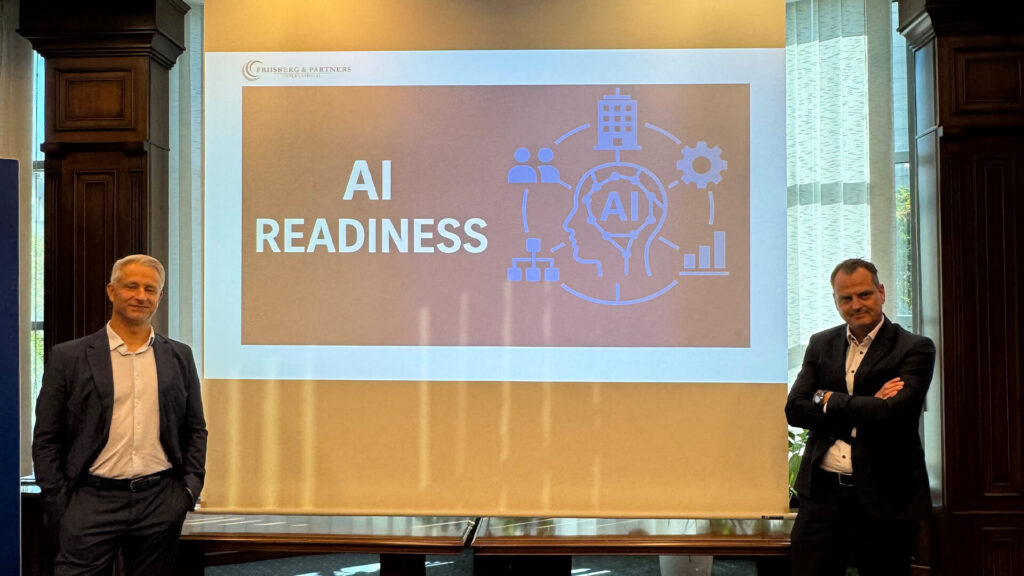
Following recent talks by Zoltán Pethõ and Zoltan Kadar from Friisberg Hungary at the MVÜK Zrt. and Nitro Digital Solutions Ltd. conferences, we ran a poll to understand how organisations viewed their AI readiness.
These insights confirm what we see in our consulting work. Most organisations recognise AI’s potential but need structured guidance to turn ambition into action.
At Friisberg, AI Readiness has become one of our key service areas. We help clients navigate the entire AI journey - from exploration to execution. Together with our expert consultants and strategic partners, we assess where you stand today, define a clear roadmap, and support the implementation of tailored, value-driven solutions. If your organisation is looking to move from curiosity to capability with AI, we’d love to help you get there.
When Friisberg partners with international clients investing in or acquiring companies in Hungary, we often hear reflections on how different the local business culture feels compared to Western Europe. While Hungary is firmly integrated into the EU and global markets, its business practices remain shaped by a unique history, strong national identity, and Central European pragmatism.
Friisberg has a long-established presence in Hungary and across Central Europe. Our consultants understand the nuances of local culture while operating as One Firm, globally connected. We support clients not only in executive search but also in management audits, integration, and leadership development ensuring that international businesses entering Hungary can adapt effectively while building trust and credibility.
For companies seeking to navigate Hungarian business culture, the key is not just compliance with local law, but respect for authority, patience in negotiation, and a readiness to build strong personal relationships.

As global tensions rise, Sweden’s defence strategy is undergoing significant changes, influencing both business practices and executive leadership. At Friisberg & Partners International, we’re observing how these shifts are reshaping executive search and corporate resilience in Sweden.
Since reinstating conscription in 2017, Sweden has a selective service system where only a small percentage of 18-year-olds are called up, though this may increase due to the Ukraine crisis. Under Sweden’s Totalförsvarsplikt (Total Defence Obligation), businesses, especially those providing critical infrastructure, are required to maintain contingency plans and may need to release staff for military or civil defence duties during crises.
The Russian invasion of Ukraine has intensified the demand for executives with military and strategic experience. Organizations are increasingly seeking leaders with crisis management expertise to navigate geopolitical risks and enhance resilience.
Diversity in leadership - across gender, culture, and professional experience boosts Sweden’s defence strategy by fostering innovation and adaptability. A broad range of perspectives is key to building resilience in the face of future threats.
CEOs must now integrate security and continuity into their business strategies, especially regarding supply chain and cyber risks. Discussions about offering lower taxes in exchange for employees participating in military training reflect Sweden's readiness to adapt to changing defence priorities.
At Friisberg, we’re committed to promoting co-opetition within Sweden’s defence sector, encouraging collaboration among stakeholders to drive innovation and strengthen the country’s defence capabilities.
Sweden’s NATO membership has reshaped defence priorities and increased the focus on leadership in defence tech and the public sector. The country’s defence strategy now emphasizes preparedness and resilience, marking a new chapter in Sweden’s security landscape.
Nevena recently joined thought leaders, innovators, and HR professionals at the Future of Work Summit hosted by K Events at the Grand Hotel Millennium Sofia. The event was a dynamic platform for discussing how organizations can prepare for a future shaped by technology and AI. Key topics included rethinking workforce capabilities, harnessing people analytics, and cultivating cultures of adaptability and well-being.
“I’m taking away a renewed sense of purpose around helping teams stay agile, continuously learn, and thrive in a world where change is the only constant”.
A big thank you to the organizers and speakers for their insightful presentations and for fostering meaningful connections.

Earlier this month our partners gathered in Helsinki, 'The land of a thousand lakes' for our 123rd conference - a powerful opportunity to explore the leadership challenges and opportunities emerging across defence, cybersecurity, sustainability, and the future of work. Thank you to our fantastic Finnish team for kindly hosting us!
We heard from Olli Koski, Director of Nordic Public Policy at Wolt, who shared insights into scaling one of Finland’s most successful tech companies. Janne Peljo, Chief Policy Adviser at EK, explored Finland’s energy strategy and climate goals. Juho Nojonen, EVP at Barona, offered a practical view into current workforce trends in industry and construction.
We had the honour of welcoming Antti Vasara, Special Envoy for Technology at the Ministry for Foreign Affairs of Finland. His session on European technology leadership left a lasting impression - especially his timely reminder: “It’s not the AI agent that will take your job - it’s the person who knows how to use it better than you.”
Coinciding with our event was the UK-Finland Defence Industry Day at the British Embassy Helsinki - a clear signal of the innovation and cooperation happening across Europe, and a timely backdrop for many of our conversations.
We return home energised by the ideas exchanged, the relationships strengthened, and our shared commitment to helping clients lead through change.